Banner photo of Larry Eugene Meredith, Ronald Tipton and Patrick Flynn, 2017.

The good times are memories
In the drinking of elder men...

-- Larry E.
Time II

Saturday, March 5, 2016

Babysitters and The Blob and Little Puppets with Big Sticks

         After we moved into 417 Washington Avenue my parents chose to hire a babysitter for me when they went out instead of sending me to my grandparents. I’m not sure why this change. My grandparents were just down the street at 424 and never seemed unwilling to have me around. As a nine and ten year old I wasn’t privy to everything going on around me, so there may have been reasons I never learned. The sitter was hired only now and again, not every time.
          The sitter was Dottie Bender. She had lived in the house up along the Lincoln Highway across from Hines Trucking during the swamp years. Her father was a mechanic there and good friend with my dad and probably had gotten my dad his job at the company. The Benders moved to Downingtown just after we moved back. They had an apartment off Lancaster Pike on the
West side, beyond Manor Avenue.  You went up a fire escape toward the back of a brick building to enter their place (apartment building is the red one pictured on right).
         The apartment looked out on the parking lot of the Downingtown Diner, known then as the Cadillac Diner. It was just a typical eatery of that type and era. Although diners per se had existed for quite awhile, there was an explosion of them after World War II. Perhaps a lot of Army cooks came home and opened a diner. Diners were usually long and rectangle like a boxcar, and prefabricated. They generally had shiny silver exteriors. The Cadillac Diner would have been just one more greasy spoon, except it was to gain long-lasting fame by the end of the decade. It was the Diner attacked by The Blob at the end of that Steve McQueen flick. (That original diner used for the film is not the diner presently on the site. You can see the diners in the photos look quite different. It was either replaced or radically changed in 1960, depending on whose story about its fate you accept.  )

       I have other connections to that film besides the diner in my old hometown. For one, I saw the film in the Colonial Theater when it had its first run. That was in 1958. In the film The Blob attacks the patrons of a movie theater, the very one I saw the film in, how cool is that? The moviegoers stream screaming into the street and several of them run to the diner. They must have been in good shape,

because the Colonial Theater was in Phoenixville and the diner was in Downingtown, about fifteen miles apart. The town of Downingtown celebrates Blogfest every August and beside showing the film they have a reenactment of those patrons fleeing the theater.
        A fire chief assists the police during The Blob’s climatic scenes. Tom Ogden played the fire chief, but I knew him as Reverend Thomas Ogden. He was my minister at the Downingtown United Methodist Episcopal Church.


       My parents didn't retain Dottie as my babysitter for long. Dottie took me to the movies at the Roosevelt. I don't remember what we saw. It wasn't anything I had much interest in. It was "mushy". She kept leaning against me and talking during the film. Then she started asking me odd questions about guys in her class. Dottie was a teenager and I was in elementary school. I didn't know any of these fellows. I can't remember much more about that night except Dottie kept trying to hold my hand on the walk to my house from the theater. I was uncomfortable and glad when my folks came home.    One evening afterward I overheard my mother and grandmother whispering about Dottie. My mother told my grandmother “there’s something not right about that girl.” I heard her say, “She’s boy crazy.” Boy crazy meant a person who flitted from boy to boy or constantly craved men. I didn't understand the term then, but I could tell by my mother and grandmother's tone and expression that it was not considered a flattering term. I believe it was right after this that I was send back to my grandparents whenever my parents went out.
        A couple decades into the future, after I married and Dottie married, my wife and I became social friends with her and her husband Jack. I can’t say if Dottie was truly boy crazy. I doubt she ever came on to me beyond what I described because she probably liked her boys a little closer to being men than in grade school. Still, something happened that turned my mother against her and maybe my mom had it half right. Several years after our friendship, Dottie was committed to Embreeville State Hospital (right), a place when I was growing up we cruelly called  the “booby hatch”


      In the fall of 1950 I entered Mrs. Sara Powell’s Fourth Grade at East Ward. I didn’t like Mrs. Powell (left). She struck me as overly strict. I thought she had a mean face, sharp like a bird of prey. Despite my young impression of her, I actually had my best report card at East Ward in her class. I didn’t really have any serious problems with her.
       I did have serious problems with my ears. I kept getting intense earaches. These had started back when we lived in the swamp, but each year they became more frequent. These caused me terrible pain; enough that I even begged my mom to take me to see the doctor, which is when my mother knew this was dire. I had always fought going to the doctors so if I asked to go I must have been in great pain
           Doctor Parke examined me and diagnosed my problem as tonsillitis. He recommended taking out the offending tissues. Chester County Hospital admitted me to the Children’s Ward once again. Dr. Parke operated. I got the stereotypical reward, a plate of ice cream. I wasn’t in the hospital near as long as when I had appendicitis. I was back to class within a week.

This was a good thing for I hated being confined to that Children’s Ward. There was a head nurse who could have been the model for Nurse Ratched. She barked orders to we children like we were Marine recruits. She showed no sympathy or mercy. I hated her.

      I still continued to suffer earaches. Whether this had anything to do with us switching to Doctor M. H. Neff, the new pill-slinger in town or not I don’t know. I do know that as common as tonsillectomy was at the time taking them out put me at risk for a greater threat, polio. By the 1950s removing tonsils had become quiet a cash cow for surgeons. They were snipping these little guys out at a rate of 2,000,000 American children a year. Was this a lot? There were only 2,200,000 babies born a year in the 1950s. The number of this operation has dropped off considerably since then. One reason may be they found a correlation between the removal of tonsils and the paralytic disease polio. Children who had their tonsils removed were 3 to 5 times more likely to contract Polio than those who kept their tonsils. It was discovered the tonsils were the primary defense against Polio. I had my tonsils removed in 1951-52; the first Polio vaccine did not appear until 1955.
         I doubt my parents would have had any of this knowledge at the time, but something caused them to switch from long-time family doctor Parke to the new guy in town, Dr. M. H. Neff.
Doctor Neff bought the building next to the Meisel's at 341 East Lancaster Avenue. Prior to his purchase it had been a restaurant called the Tea House that had served a signature dish of chicken and waffles to the town folk since 1914. He paid $38,000 for the property, a hefty sum back then.  Doctor Neff lived in the main house along the avenue. His offices were in the back in what was once the carriage house.
        Doctor Neff was childless, whether the problem lie with him or his wife was never reveled to me. Like many people unable to have children, they lavished attention on neighborhood kids. Everybody made a beeline for the Neff’s on Halloween. You were invited into their parlor. There waited a table with many treats and goodies, including apple cider. They urged you to take as much as you wished. And you could eat it there where the Charles-Bird-Way Gang couldn’t snatch it from you.

      Looking at more pleasant things, the East Ward school took us to see Santa Claus each year between Thanksgiving and Christmas break. We were marched down to the Log Cabin in lines two by two. At the time the Log Cabin was closer to the center of town than its present location in Kerr Park near the Brandywine Creek. When I was in Junior High School historians were trying to determine if it was the oldest standing home in America. (It turned out it wasn’t.) We would line up at one cabin door and exit out the other. We had a little tete a tete upon Kris Kringle’s ample lap. He gave every child a gift and not some cheap candy cane either. I received a tube of Tinker Toys one year, something I really enjoyed. I think the American Legion sponsored these visits.

       I’m sure I had a nice list for Santa, not knowing that in the very near future Iva Darlington and I would uncover the terrible secret exposing the truth and exploding the myth in a spare bedroom closet. After that year, Santa didn’t come anymore.
    This was also a year I discovered something much more exciting to me than Santa Claus. Well, more exciting now that I knew the truth. Mrs. Powell had us read a story in class that totally engrossed me. It captured my imagination completely. It was, “The Tell-Tale Heart” by Edgar Allan Poe. A couple years before I was avoiding horror; the comic books anyway and the "Tales of Tomorrow" TV shows gave me nightmares. I read this Poe story and I became enamored with the horror genre. I wanted more.
        I joined the Downingtown Library, receiving my first official Library card, an event that proved very auspicious for me eventually. It was a big disappointment at first. The Library banned Edgar Allan Poe to me. His stories were in the adult section and I was a child. It was frustrating being a kid. Everybody kept getting in my way.

       Something else occurred in Fourth Grade that greatly encouraged me. I still don’t exactly know how it came about. I’m just glad it did.
       I was interested in ventriloquisms. My grandfather had bought a television, joining his house with several others sporting antennae on the roof. One of the shows I watched with interest was the Paul Winchell Show. Here was this guy who talked to big dolls and they talked back. You seldom saw his lips move. I had seen Edgar Bergen perform on TV, too, and Bergen’s lips always moved. I was fascinated. I wanted a dummy like Jerry Mahoney, but I never got one. I did have several hand puppets. I would sit in front of a mirror and practice making a hand puppet talk without moving my lips.


       I had a dozen or more hand puppets and a marionette. It was an eclectic mix. I had little rubber headed puppets of Snap, Crackle and Pop, the breakfast cereal mascots. I sent away to the Howdy Doody show for them. I had some sock puppets my grandmother had sewn for me. They had cardboard supported mouths and buttons for eyes. I had a couple papier-mâché ones I had made with her help. I had a monkey.
       I got to put on a puppet show at school. I don’t know if it was part of a larger entertainment, like a variety show, though it doesn’t seem it was. I think I was it, a one-man assembly program.
It mystifies me why I was allowed to do this. Since I wrote the short story in Third Grade I hadn't written anything else that drew attention my way. I did get recognition for my art work, paintings I did with poster paint or watercolor or the scenes I created with charcoal. These were often put on display on the bulletin board. We did have show 'n' tell sometimes and I may have brought in some of the puppets I had made. Maybe I made a nuisance of myself with the teachers until they allowed me to do it.

      The school had a puppet stage. I made my own scenery and wrote the script. Since I had a monkey puppet and I still liked Frank Buck, I did a jungle story. I was greatly influenced by the Punch ‘n’ Judy shows one of the Philadelphia Department stores put on every Christmas season, so my play contained a lot of characters hitting each other with a stick. Stuart Meisel did one after mine was a success. Perhaps then these exhibitions were some sort of class project.
Nonetheless, I was creating things that others saw. This make-believe world was a place I could escape and for whatever reason gain some acceptance among my peers, even briefly and briefly it was.


Friday, March 4, 2016

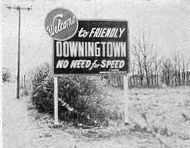
Welcome to FRIENDLY Downingtown...Now Drop Dead

There was a sign at every entry road into  Downingtown.
“Welcome to FRIENDLY DOWINGTOWN
NO NEED for SPEED.
I wasn’t feeling the love when I moved back in 1950. I certainly didn’t feel welcomed. At evening I could retreat inside or stay in the back yard where it was relatively safe. I had no choice come weekday mornings. I had to traipse over to East Ward and be either a target or a reject. None of my attempts to fit in succeeded. The way I talked was wrong, my clothes were wrong, my hair was wrong.
The Confrontation of the Baseball Caps is a typical example, but one that taught me a valuable life lesson. I often wore a Philadelphia Athletics’ Baseball Cap. It was dark blue with a large scrolled A on the crown. I don’t know where I got it. Either my dad or my grandfather gave to me I suppose. It wasn’t a statement; I hadn’t begun to follow the sport at that age. Maybe I wore the cap because it was blue or maybe I liked the Athletics big jolly elephant symbol.

One summer day Denny Myers and some of the other boys stepped in front of me and blocked my way. “Wha’d’ya wearin’ a loser hat for. Did’ja ever hear of the Phillies?”
I’m not sure I was aware of the standings that summer or that the A’s were in last place in the American League and the Phillies led the National. I may have known. I had started collecting bubblegum cards in ’48-’49. But why should it matter to anyone if I rooted for the losers? Maybe I felt more akin to them. Suddenly someone snatched the cap off my head, and I’m sure you know what followed. He held it out as if to give it back to me, but he tossed it to another boy when I reached. Soon I was spinning about in a futile effort to snag my cap as it sailed back and forth behind and over me. Everybody was laughing, except me. They dropped my hat in the dust when interest waned or somebody called them home.
I asked that night for a Phillies cap and got one. I wore it, but it made no difference. I conformed to what the clique had demanded, tried to fit their image of what I should be and it changed nothing, except they found something else to rag me about. I always wore the wrong brand of sneakers or stupid bib overalls or had a Roy Roger’s cap pistol rather than a Gene Autry, any such silly thing.
It was an epiphany. When I changed caps I realized it didn’t matter. If people choose to dislike me, they would dislike me no matter what. This was the essential kernel of prejudice, the stubborn refusal to see the content beneath the packaging. The core necessity of preserving exclusivity is some people need a scapegoat to feel superior.
It taught me to forego image and concentrate on character. The friends I began making eventually were like me in that way. They may not have been the most popular kids in school, but they were the most accepting and the most talented, although a lot of times they hadn’t realized it yet. When everybody in the farmyard calls you a duck it is hard to recognize you’re a swan.

In January 1950 I returned to East Ward Elementary. I was not exactly given a returning hero’s welcome with waving flags and thrown confetti. There were no sticks or stones thrown either -- yet. The only things thrown were insults. Everyone ignored me for the most part and didn’t allow me to join in any reindeer games. I didn’t have a big glowing red nose, but somehow I was different. Perhaps the smell of swamp clung to me.
There was a sing-song rhyme children sang when someone called them a name. “Sticks and stones may break my bones, but words will never hurt me.” Words may not break bones, but they can hurt and the wounds caused may run deep and last longer than any scars upon the flesh.
I should have been comfortable coming back to East Ward. Several of the kids had once been playmates on my block and I knew most the others from First Grade. A number of the girls still talked and invited me to play, which didn’t really help my cause with the boys. Boys and girls at that age were somewhat like cats and dogs, not expected to mix, and that I quickly became something of a “Teacher’s Pet” did me no favors either.

It may be telling that in the class picture I am standing directly in front of my third-grade teacher, Miss Ezrah. You may note as well, I am standing next to the blond girl I was moonstruck for during all of grade school, Mary Jane Chudleigh. On my left is Tim Mahan, who had been a close friend in my preschool days, but that friendship did not continue. The second boy on the left in the front row is Bobby Cuellers, the one friendship I had at West Whiteland. But it did not pick up where it left off when we reunited at East Ward. Iva Darlington is the sixth person from the left in the front row and she remained a good friend. Standing next Iva is Bill Brookover, a future friend. Denny Myers stands in the back row second from the right next to Jack Swarner. Six months earlier Denny and I had our arms around each other in friendly comradeship, now both he and Jack had become tormenters, each something of a bully.
The dark haired boy to Denny’s left is Frank Marcucci. Frank would become a class leader at Downingtown High School, but that was after I was gone and I never developed any close ties with him. There were never any troubles between us either, although I had a run in with his older brother shortly after moving back to town.

I was playing in the field next to 424 Washington, as I often did. Marcucci, I think his first name was Jerry, came walking across the lot, which at that time was vacant except for piles of cinders on the northern portion. These were used on the roads during winter snows. In the photo on the left can be seen some of the cinder piles in the otherwise vacant lot. People who lived on Jefferson or other streets behind Washington often cut across this lot rather then walk down to the sidewalk along Whiteland. I paid him no mind. I don’t think he said anything to me. He just jumped me, knocked me to the ground and began pummeling me with his fists. I have no idea why. I had seen him cross that lot many times, but I didn’t know him from Adam.
He was older and larger and had the advantage. My dog Topper was in the old chicken pen behind the backyard. Topper was pacing and barking when this happen. Somehow he got out of the pen and ran across the yard. The bigger boy got off me in a hurry and ran. He never bothered me again. I still don’t know why he attacked me.
There are several boys in that class picture who would become friends, some for life, but I didn’t know them when I first came back to town. The two who would be my “bestest” friends were furthest from me in the photo, one standing half hidden behind the other. One is Stuart Meisel, the boy on the far right who looks as if he is holding his breath to the bursting point. He has very dark hair and a striped T-shirt. The other is the mop of hair and half hidden face behind him, Ronald Walter Tipton. There was something “different” about them, as there was something different about me that caused a barrier between we three and our classmates.

My new friendships solidified and I became less concerned with those who didn’t accept me. But as my world expanded I discovered worse bullies than those in my class or immediate neighborhood. Those on the school ground hit me with taunts. There were older boys on other blocks that threatened to hit me with more physical weapons. The saying is “Sticks and stones may break my bones; but words will never hurt me”. That is not at all true, of course, words sting and damage very deeply into your psyche and soul. Saying that mantra really doesn’t protect you from the insults and indignities others heap upon you. Deep down none of us truly believe that words can’t hurt.
But not so deep down we know the first half is correct, sticks and stones can break bones. And fists can leave bruises and blood. I made no attempt to please when it came to older boys who didn’t like me. I glommed onto another old saying as Gospel (Shakespeare actually), “The better part of valor is discretion”. In other words I took Falstaff’s advice, when I saw the enemy I ran.

Their last names were Charles and Bird and Way, and there were a couple others who must have been their nameless lesser toadies. These creeps terrorized me the entire time I remained in Downingtown. Not so much individually; these sorts of cowards get their strength from numbers and preying on the weak. The Charles-Bird-Way way is the way of the chicken.  (Pictured left, Doug Way.)  I’m sure they suffered from poor self-images and chasing the scrawny little kid from the other block gave them an illusion of self-glory. It truth, such behavior only confirmed their lack of self-confidence, inhumanity and worthless character.
Pointing out their obvious flaws would not have prevented my getting beat up, of course. It would have guaranteed it.
These were the punks that wandered about on Halloween stealing little kid’s treat bags by force.
They lived on the next block west on Washington, the 300 block between Chestnut and Green Streets. Whenever I walked that block I was always glancing over my shoulder.


If I saw them I would jump behind any convenient hedge, bush, parked car or tree with the hope they hadn’t seen me. If they spotted me, I ran as fast as I could. I was a very speedy runner. They seldom caught me, but they scared me near to death a lot of times.

Sometime after moving in with my maternal grandparents, a house up the street at 417 became vacant. My parent’s rented it and we moved yet again, but still within the same block of Washington Avenue. 417 was a double house. It had a sun porch on front. The backyard was fairly private. On the East was a large hedge dividing our yard from the attached yard of our neighbor at 419. On the West was the windowless wall of a long garage. There was next to us a dealer in farm equipment. I played on the tractors and combines during the times it closed.

It would seem my backyard was a fortress, but it was also a trap as I discovered one winter day. It snowed. It buried our yard and the farm equipment next door. The day after the snow it warmed up and snow began to melt. It became little pools of cold water on the seats of the tractors.
I was in my backyard at 417 playing. It was Sunday and the farm equipment dealership  was closed. Suddenly a snowball hit the side of my head. It was very hard. More missiles found me. The Charles-Bird-Way Gang from the 300 block had invaded the farm machinery and attacked me. They had me outnumbered and used the pooled water to make ice balls. I packed the snow from my yard as best I could and flung it back, but it was softer and generally flew into ineffective pieces if and when it did hit anyone.
It occurred to me if I got a basin of water from the kitchen I would be able to make ice balls as well. I ran onto the porch. Framed behind the glass panel of the backdoor stood my father. I tried the knob, but he had locked the door. I motioned to let me in, but he wouldn’t do it. He thought I was trying to run away. I wanted to get a basin of water I explained. He turned and walked away. I was getting pelted, trapped on the porch. I did what I could, trying to get some water from along the porch where it dripped from the overhang, but not very successfully. I took a pounding before they ran. I don’t know what made them stop, whether they got tired or somebody came and told them to get off the farm machinery.
But it was another rip in what little fabric of faith I had in my father.
It was unusual for the Charles-Bird-Way Gang to come down my block and do anything. They pretty much stayed west of Chestnut. It was difficult to avoid their block, not impossible, but inconvenient. There were two places I went to often down at the far end of Washington and the most direct route took me through Charles-Bird-Way territory.

One of the places was the Roosevelt Movie House (pictured right) on Brandywine Avenue just a bit south of where Washington ended. I seldom went to the movies alone, but attended with Ronald and Stuart. I generally walked to Stuart’s when coming or going, which meant I wasn’t on Washington until my own block. Church was a different matter.
Shortly after moving back to town my mother made me go to church or more accurately, to Sunday school. She was raised a member of the Grove Methodist Church so she sent me to the Downingtown United Methodist Episcopal Church. This was on Brandywine Avenue directly across from where Washington ended. I seldom saw any of those 300 block boys out on the street early on Sunday morning, but if I did I would start using an alley that ran between Lancaster and Washington from Chestnut to Green. The alley allowed me to avoid that block entirely.
I had never had much in the way of a fistfight with any of the Charles Gang. They chased me and knocked me down a couple of times. Once they shoved me down and tore the knee in my jeans. I skinned my knee in that fall, but that mattered less than tearing my pants. My wardrobe was meager and to damage something brought a lecture at home. It also meant my grandmother would sew a big patch over the knee and I would have to go to school in bandaged trousers. I received enough kidding about my clothes. If this had happened on Sunday going or coming from church, well Heaven help me, I’d need prayer. My folks forced me to wear a suit on those jaunts, white shirt, bowtie and a brimmed hat. I looked like a Rabbi in training.

I acquiesced to Sunday school until I reached Junior High age and then plain refused to go. That is not really accurate. I simply complained and fussed so much about it my mom got tired of hearing me and gave up.

What was the point of it? No one else in my family was bothering with church or much of religion that I could see. We had some Bibles at home, but they were hidden away in a drawer except for one large one gathering dust on the sideboard. It was used more often for recording family deaths and births or pressing flowers than reading. I had a bible they had given me at the church. Sometimes I flipped through it. I liked some of the stories, but most of it made no sense, just a lot of jibber-jabber in a strange form of English. Who needed it? When mom said I didn’t have to go anymore I was estatic. I thought I was done with religion forever and I knew I didn’t need it.
I was a good boy.

Decision at the Crossroads of Losing Innocence to Evil

I doubt leisure is the gift given old age.
It seems the river Song runs swifter now.
Still I do seek to fish from the flow
Lyrics that break all barriers.

My body may have turned to an ash heap of pains,
Yet I poke at the smothered ambers
To sometimes stoke a fire again.
My mind is ever warmed by its glow,
This strange simmering of words called poetry.

Meditation Upon One Thought in Rabindranath Tagore’s. “The Gift”
-- Larry Eugene Meredith (2009)

I have friends who spent years nagging me to commit my worthless life to paper, perhaps to make it easy to burn. I don't know? 
I said forever I would do no such thing. It is blatantly egotistical. Is it not bordering on the tawdry? It smacks of being showy and tasteless like standing on the street tooting a horn and yelling "look at me, look at me".
Then I remembered I'm a guy who once wore orange Flag-Flyers
so it wouldn't be the first time I was tasteless and showy. And I obviously didn’t snap on orange shoes to fade into the background.
So instead I told everyone it was unnecessary. I have been a writer since age 12, read my stories and you’ll know my life, no need to make it formal.
This is really a lie, of course. Every writer becomes a character
somewhere in what he or she writes, but even in the most autobiographical of fictions it is still fiction. It may be close to the actuality, but there is a nip or a tuck here or there to make it fit the plot. After all, the main character in my short tale “Ground Dog Day” was an eight-year old girl named Jenny, not a boy named Larry. And speaking of standing and tooting a horn, that real boy Larry never borrowed a trumpet to blast notes down a Groundhog hole as fictional Jenny did, although the rest of that story is pretty factual.
Thus I gave in and am penning (are we still allowed to say, “pen”) my minor life, and even worse putting it out in the Blogosphere before prying eyes. 
I gave this endeavor a title, Impressions of My Life, because that is all we have of ourselves -- impressions.
I am in my mid-seventies. My memory is tattered and torn. Perhaps what I recall differs from what others remember. Much of my early years are hearsay, but even where I was an active participant and witness to events of my own living that I can remember, I only see them through these two eyes. Maybe if I saw my life through different eyes from a different spot I would appear a different person.
Although my posting have titles, they are actually snipped and sewn together parts of chapters. I have posted these chapters so far:
1      Beginning of Me
2      Downingtown the First Time
3      Swamp Rat

The chapter currently being posted piecemeal is called “Lost Innocence” The next three chapters are “Into the Weeds”, “Sex and the System” and “Gates of Hormone Hell”. You can see this will rapidly move from my losing my childhood innocence to gaining an evil teenage mind. I make no apologies for what I will write. I am not a perfect person, far from it. I am a much-flawed individual.
I will say I hold no grudges and hate no one. If in the course of telling my life I give unflattering portraits of those I’ve known it is not out of malice.
However, since there may be some negativity concerning others I have been brought to a decision crossroads. What should I include? Should I censor out certain occurrences? Maybe I should only tell the cutesy things or the funny things and not the darker ones? Should I use real names or substitute pseudonyms? A lot of the people from my life are dead, but not all and of those who have passed on, they have friends and relatives who knew them and might have seen them in a better light than I. (Perhaps a worse light, too.) The goal
here is to tell my life as truthfully as I can, not to offend anyone unlucky enough to have shared it, although I promise, the most unflattering character who will appear in these posts will most certainly be me.
What I did in my youth is past. I cannot change it. I don’t care to lie about it. I wasn’t a Christian until I was 34 years old. I don’t think those who knew me before then would have said I was a bad guy, but they didn’t know everything about me and what was in my head. They don’t know just how much about me changed when I became a Christian.
I believe here in my dotage I’m a better person than I ever was before,
but I still fall short on God’s measuring stick. God’s forgiven me; I hope you can.
Now What do I include from here?


There are places I Remember
All my life, though some have changed
Some forever not for better
Some have gone and some remain
All these places have their moments
In My Life

--John Lennon & Paul McCartney