Banner photo of Larry Eugene Meredith, Ronald Tipton and Patrick Flynn, 2017.

The good times are memories
In the drinking of elder men...

-- Larry E.
Time II
Showing posts with label Concepts of good and bad. Show all posts

Wednesday, March 6, 2013

Magic and God

I developed an interest in magic at a very young age. In the photo I am performing an act for my family at age 12. This was not my first such show. I had the Howdy Doody Magic Kit several years before this. I also did magic with chemicals about this same time. In fact I could produce some very Biblical effects such as changing water into wine and the wine into milk.

Over the years I learned a number of tricks as well as how most magicians pulled off their stage effects. Speaking of magicians one of my favorites, or I should say two, are Penn and Teller. These guys do some amazing stuff.

Teller, despite his name, never talks in public. Penn Jillette does all the blatter for the act. They have been performing together for the last 38 years, which is longer than a lot of people stay married these days.

Penn is the big one. He is six foot seven inches tall and has put on a few pounds over the years. Teller is the little guy, but very athletic, agile (especially for a 65-year old man) and adept at slight of hand.

I haven't brought these guys up to talk about Teller or magic. I want to talk about a difference in religious outlook between Penn Jillette and myself, and why I bring this up is because we share a childhood experience so similar it is almost magic in itself.

Penn Jillette, who is a very intelligent and fair minded man, a reasonable Liberal and someone who can discuss issues without rancor or ridicule is also an Atheist and a vocal one. He wrote a book promoting his Atheistic views called, God, No!. We'll come back to that book in a bit. But first, Penn Jillette has explained how he became an Atheist this way.

As a boy, he tells us, his parents forced him to go to church, which he didn't like. He made a deal with his parents. He would join the church youth group if they did not force him to go to church. In youth group he began to argue with the others about the Scriptures. The minister originally encouraged him, suggesting he read the Bible, advise Penn took so he was better equipped to make his arguments. He did this until the minister suggested to his parents he should no longer come to the group. Penn asserts it was reading the Bible that turned him Atheist and insists anyone who read the Bible from cover to cover would also become an Atheist.

Now as a boy my parents forced me to go to church. I didn't like going. When I got a driver's license I made a deal with my folks. I would go to Sunday School, but not church. They agreed. I later switched from this to MYF (Methodist Youth Fellowship). I even was elected President of the youth group. As such I started a series of discussions in which I claimed I would play Devil's Advocate just for the sake of argument. However, I wasn't playing. I was trying to attack Scripture. I wasn't asked to leave youth group. I was actually praised for making meetings so interesting that attendance grew. Like Penn Jillette I did eventually become an Atheist and a vocal one. But unlike Penn Jillette I am now a Born Again Christian. I have also read the Bible cover to cover, several times, and doing so has not turned me back to being an Atheist. I obviously did not see the content of Scripture that same way Penn says he saw it.

I do want to mention Penn Jillette's intro to his book, God, No!.
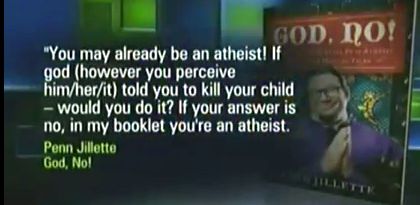


First let me say if you are going to do anything as extreme as kill your child because God told you to do it, you better be really, really, really sure it was God. And I'm going to tell you right here that if some voice told you this it wasn't God.

I have three children. They should not be here. My wife was told, assured, exhorted to even forget the idea, because she could never possibly have a child. She had all ready lost seven. But by the mercy of God she had three. I also want to point out that her having these children was not what turned me from Atheist to Christian. No, the first of these children came over a year after I turned to Christ. These miracles didn't lead me to believe in God, they simple confirmed it.

God is not going to ask me to kill any of my children.

Now I believe such a thing happened once to a man named Abraham. I admit, I have not memorized the Bible, so perhaps there is another such case I somehow forgot, but I think there was only Abraham. Abraham was told by God to take his son, the one promised by God to Abraham and his wife Sarah, his seed and her egg, and sacrifice the lad.

There are foreshadowings here pointing to the coming of Christ, God's only begotten son, who would be sacrificed for men, but unlike Christ, Isaac did not die. God told Abraham to stop as he prepared his son for death. In the film, "The Bible" on the History Channel, when God tells Abraham to take Isaac and sacrifice the boy, Abraham asks, "Why Lord, haven't I proved my faith enough."

Well, no, he hadn't. Abraham was promised a son by God, but instead of having faith this would happen, he took Sarah's advice and had a child by her maidservant, a boy named Ishmael. Ishmael would prove a thorn in Israel's side until this very day. So Abraham had not proven his faith at all by that act. His willingness to sacrifice Isaac did.

So you might ask, why wouldn't God ask the same of me. Well, for one thing God never told me to move from one place to another. God did not physically come visit my home, sit down to dinner and promise my wife she would have children. I never stood with God and argued with him about what he was going to do to some city (Reference Genesis 18). If you read the Bible cover to cover you will find God dealt with human kind in different ways at different times.

There is another reason. God talked with Abraham before the Law was given to Moses. That came a few hundred years later. The essence of the Law is the Ten Commandments. Although with the Resurrection of Christ many of the Mosaic Laws became moot, the Ten Commandments remains as valid now as then. One of the Ten Commandments is "Thou Shall Not Murder".

You see, my problem is not that love and morality are more important to me than my faith, because I am a human and to tell the truth my love and morality are not always what they should be. This is one of the reasons I needed forgiveness and salvation in the first place. No, it is that my faith in the mercy and justice of God is so strong that I know he would never ask one to break his own commandments. Thus I know God would never tell me to murder my children any more than he would tell me to seduce my neighbor's wife.

Now Penn Jillette says that reading the Bible cover to cover would make anyone an Atheist. He has said:


"I think because what we get told about the Bible is a lot of picking and choosing, when you see, you know, Lot's daughter gang raped and beaten, and the Lord being okay with that; when you actually read about Abraham being willing to kill his son, when you actually read that; when you read the insanity of the talking snake; when you read the hostility towards homosexuals, towards women, the celebration of slavery; when you read in context, that "thou shalt not kill" means only in your own tribe—I mean, there's no hint that it means humanity in general; that there's no sense of a shared humanity, it's all tribal; when you see a God that is jealous and insecure; when you see that there's contradictions that show that it was clearly written hundreds of years after the supposed fact and full of contradictions.  I think that anybody... you know, it's like reading The Constitution of the United States of America. It's been... it's in English. You know, you don't need someone to hold your hand. Just pick it up and read it. Just read what the First Amendment says and then read what the Bible says. Going back to the source material is always the best."

What I see is Penn picking and choosing from the Bible. When you do take the Bible in context from beginning to end you see these things, slavery, prejudice, hostility, war are the things of men not following the directions of God. God works within the framework of the real world, pointing us to what is better and right. Take for instance the statement, "When you see, you know, Lot's daughter gang raped and beaten, and the Lord being okay with that."  Really? Really? First of all, the offering of Lot's daughters (See genesis 19) to the mob came from Lot. This was a man's solution to the problem and the kind of wrong-headed thing we do when we take things into our own hands (just like Abraham and Hager producing Ishmael). The facts are that Lot's daughters were not gang raped and beaten. They were rescued, along with Lot and his family from that situation by the grace of God. God was not approving of such behavior. God destroyed Sodom for such behaviors.

I believe in God and Penn Jillette does not. I do not dislike Penn because of this. He has a God-given right to believe what he believes as do I. He says when he became an Atheist there were about 9% of Americans sharing his belief and now there are 20% and he calls Atheism "the fastest growing religion in America".  So we have twenty-percent who believe there is no God. So fine, for then if we take Penn's quote above they are left with no God, just rape and beatings and hostility and slavery and war and crime and all the other miseries that mankind inflicts upon itself and without hope. 

I have something even better than hope. I have faith.


Wednesday, January 12, 2011

If Kierkegaard had Seen More Trees Sartre May have Seen More Exits


This is a continuation of the posts "Sound of One Tree Clapping in the Theater of Time" and Roots of Our Tree Worn Useless by Time


The path goes forward toward an escarpment, raising the question of an exit.

But the path always goes forward, unless you have a strange proclivity for walking backward. And it has an exit, even if that was once the entrance. If I turn around I can retrace my steps back to where I began and the path before me will still go forward. Life always goes forward; the direction it takes is up to me.


There is always an exit.

On this spot one could simply leap off the overhang and it would be an exit one way or another.

I'm not planning on exiting that way nor turning around. I am also sure there is an exit somewhere along this precipice.

I have faith there is another way down to the creek other than risking suicide or a badly battered body. Sometimes we can't see the forest for the trees; sometimes we can't see the exits for the trees either.

Despite the title of this piece I'm no Existentialist, although Existentialists have many hooks to hang their hats, several of which I'd also hang my hat. Actually, They tend to pick and choose their hooks as well and have so many schools of thought defining them is like holding Jello. Kiekegaard was a Christian. Sartre was an Atheist. Søren Aabye Kierkegaard is considered the Father of Existentialism; Jean-Paul Charles Aymard Sartre is probably its best known icon.


I don't like labels. There's where you find no exit. Someone puts you in a box and there you are. You let someone stick a label on and you are letting someone else define who you are.


Hey, I'll give you a label. I'm old as dirt so label me dirt. Every time you turn over a spade-full you'll find something different. If you think you'll just find a lot of mud, that's fine as well. You get stuck in mud, you sink in mud; mud sticks to you and mud's hard to get rid of.


Speaking of soil consistency, this path is dirt. Fortunately it is cold and the trail is frozen and not muddy. Up on this ridge one wouldn't want a slimy walkway with the danger of slip-sliding away.


And what if I did slip and plunge off the ledge? Here I would be in tune with existentialism; that is, I wouldn't be looking to see whom to blame, assuming I was still in condition to see anything. The bell I rang tolls for me. No one else pulled the rope. What should I do, be like so many and look for deep pockets to sue?


I chose to wander into these woods. I can see how close the path comes to the edge of nothing along here and I should be taking my caution, especially since I am completely alone. The last thing I ever want is to come and find the park powers-who-be have erected a chicken wire fence to protect me because some fool was careless and stupid, but had a good lawyer (something of an oxymoron). I dislike these litigious souls who take risks, injure themselves in the process and then decide they have fallen into a money pit, the greedy, self-absorbed (fill-in whatever bad personal noun you please). I accept the existential premise of personal responsibility.


On the other hand, I don't believe in the Existential concept that the world is absurd.


I believe in God (you don't have to because that is another Existential idea called Free Will that I ascribe to), but belief in God is my bias. We all have a worldview based on a bias. If you don't believe in God, then not believing is your bias. You may have additional biases. It doesn't mean we can't like each other, only that we see things a bit different. We need to see that up front and accept it and then understand we may not agree on everything.


Therefore, disclosures said:


When God made the world it was perfectly fine until he cursed it and he didn't curse it because it was absurd. The curse came about because of the absurd behavior of people. Adam and Eve had everything and threw it away over a piece of fruit they didn't need. That is pretty absurd, but we see the same absurdity occur over and over throughout history right into our own times. When someone like a Tom Capano, who perceptibly had everything, murders a mistress and tries to blame another mistress, neither of which he really needed, is that not absurd?  I certainly believe living in this world is full of absurdities. And this just fits more Existential hat hooks, some things aren't rational and decisions can come with consequences and stress. 


But lets cut to the heart of why I don't consider myself an Existentialist. I don't accept that the basic  purpose of existing is the individual's lifelong search for Self.


I'm sorry, but I don't have to search for my Self. I've known my Self since I was at least twelve, if not earlier.  And since I know my Self from childhood, my lifetime search is for redemption. Some people worry about their alienation from their true self. Stop worrying, you and I want alienation from our true Self. Tom Capano didn't achieve alienation from his true Self and look what happened.


Go to a bar and talk with drunk people. They will say very outrageous things and when they sober up they will say that was the drink talking. That is not who I am. Wrong, that is exactly who they are, that is the Self reveled. When they are sober they control their true Self; when they are drunk the truth comes forth.


Existentialists believe one's human nature is chosen over the course of life as the sum of choices made. Baloney, human nature is set in stone and it isn't focused altruistically on your fellow man. If you think the natural nature of man is good, then you must be illiterate and can't read the morning paper. Human nature comes as your birthright, not as a choice and it just becomes a matter of when you know what it is and how well you keep it under control.   


Now I know many people will not agree with me. Or put another, I know I don't agree with a lot of people. A lot of people think a newborn baby is a clean slate and pure as new fallen snow (and how pure is that new fallen snow, by the way?). My guess is that people who believe that never had a baby and never raised a child. If you have had a baby, if you have been through the terrible twos and the fearful fours, then you have seen and experienced raw human nature.


The baby, the toddler, the child has to learn to control that nature, but they don't have to learn to have that nature.


Ah, we have found an exit from the cliff. The nature of this downward path was too steep and difficult  to gain traction upon. Somebody at some time realizing this put boards across the natural curve to provide foot holds.


We nail boards across our Selfs to allow us to exist civilly with each other.


Have you ever thought about these trails? Where did they come from? Who made them? Paths don't just suddenly appear because one person decides to hike through the woods. Have you even been in a woods and decided to make your own path? You leave the trail and cut across the humus. If you come back the next day can you see where you walked? Probably not. Even if you left some track when you passed through it doesn't take long for the wind, the rain, the snow and changing seasons to obliterate your footprints. I cut across the forest between trails at the end of this walk and you couldn't see where I stepped immediately after I did.


It takes someone repeating the course over and over or many people going the same way. It also takes time to wear a grove through the land. The trail goes where it does because in most cases the pathfinder followed the path of least resistance. Notice here how the path follows the natural curve along the rim down into the gorge below. It is the cooperation of nature and man. 


It is how God and man interact, I believe, in this world. 


We'll bridge that subject some other time. For now we have found the exit off the hill.


Sunday, August 1, 2010

Stranger In a Familiar land

The Kid and lived in town six months short of six years. It was all he knew or remembered at age six. Six months, six years, age six, 666, the Beast’s number, perhaps that was a sign.
He had gone to a private kindergarten in town, twice. He had started first grade at the East Ward Elementary School, right across the street from where he lived. There was no trouble there; he got along with his classmates and with Mrs. Warren, the hair-pulling disciplinarian. She never pulled his hair because he never misbehaved. He was a good reader and although Mrs. Warren made a point of showing that skill off, his classmates didn’t seem to resent it.
He had a lot of friends in the class; he had a lot of friends, period. They were all from his neighborhood. You didn’t wander far at age six. He never considered where these friends came from and he assumed they would always be companions as he grew. There was Tim and Billy, Denny and Gary, there were two Bobbys, there was Sandi and Iva and Toni and Judy, and others.
Although his father was away to war, he never felt loneliness. He lived with his mother and her parents and he had all those friends.
And then the war ended and his dad came home and moved The Kid out of town to a place between a swamp and a cow pasture. There it was lonely. It was void of others and isolated. His dad became a long-haul trucker and was home not much more than when he was in the Navy. The kid lived alone with his mother and his imagination. It may have been only two years, but perhaps two years that affected the remainder of his life.
After two years they moved back to town, back to the same house on the same street and back to East Ward School. It was a familiar land populated by familiar faces. What a shock when The Kid discovered he was a stranger there.
To be shunned, ignored and even bullied by those he had once played with was a new experience. It was hard to understand why his friends had morphed into antagonists in such a short time. True, some hadn’t become hostiles; they had simply moved elsewhere and disappeared from his world. Billy was in another town and Gary was on the West Ward side, which may as well been the dark-side of the moon, but most of the others remained. Iva was still his friend and playmate, but Iva was a girl. Eight-year-old boys have a hard time accepting a girl as there best friend.
In a way, this lack of friends was not a problem to The Kid. After two years of isolation he had come to be comfortable alone. He knew how to entertain himself, how to fill the hours without compatriots. Still, even a loner occasionally feels the need to talk with someone who is a peer.
The question for The Kid was how to make a friend. Those who had once been were more often now tormentors, laughing at his clothes, jeering at his lack of team sport experience, even picking on his hat.
In those days Philadelphia had two baseball teams. The Kid wore a Philadelphia Athletics cap, blue with an A on the front. The A’s had once been a great team led by the legendary manager-owner, Connie Mack. But the Kid moved back to town in 1950 and the A’s had fallen on tough times, while the Phillies were about to have a season that would take them to only their second World Series in their history.
So the taunting revolved around a silly cap. “Why ya wearing that hat? Don’tcha know the A’s stink? Why ain’tcha wearin’ a Phillie’s hat?”
The Kid begged his mother for a Phillies hat and he tossed away the blue cap for a red one, but nothing changed, they found a new target for teasing. It was an interesting insight into human nature. If you are the object of the ruling class’ scorn, you do not bend to appease them, for there is no appeasing them. What they tell you is the reason for their animosity toward you is only a convenient excuse. If you remove it, they only find another excuse and those excuses are only subterfuge to justify themselves. It is the deceits they play upon themselves to hide their insecurities and their own black hearts.
The Kid knew whatever he did, they were not going to let him play in their Reindeer games, and when they were forced to by the interference from adult authority, then The Kid would be chosen near the end of the choosing. So the ones to watch were those others also chosen near the end for he knew friends wouldn’t come from the in-crowd, but from his fellow outcasts.
What The Kid didn’t realize was a room back in the house in the swamp held the key to unlocking the door to his best friend to be.