Banner photo of Larry Eugene Meredith, Ronald Tipton and Patrick Flynn, 2017.

The good times are memories
In the drinking of elder men...

-- Larry E.
Time II
Showing posts with label On writing. Show all posts

Friday, October 16, 2015

Novel Uncompleted Turns Reality

Looking back from so many years later it may seem silly to say I never completed a certain novel out of fear. "Fear of what", you may ask, "that some evil doppelgänger of a character might spring to life like a Stephen King plot?"
No, it wasn't that, but something a little bit like it. Perhaps the plot would become reality and that would have been terrible.

It appears a silly notion because I am not a household name author. In fact, I am a barely known, barely noticed writer, and that not even as a novelist. I have in my lifetime had quite a few stories, poems, articles, reviews and other non-fictions bought and published, as well as a song, a couple plays, some cartoons and even photography, but never a novel.

It isn't I never penned (or keyboarded) a novel. I actually did a few, and in fact, I considered one of the earliest things I wrote, when I had just turned twelve, a novel. It really wasn't truly lengthy enough to fill the bill, but in did have chapters, so a novel I called it.  I not only called it a novel, I called my novel, IT.  Yes, I beat the aforementioned Stephen King to that title. It was a pastiche or perhaps a mishmash of Robert Lewis Stevenson's Treasure Island, Mary Shelley's Frankenstein and Doc Savage.

(It was not the only title Stephen King infringed off me. My wife and I did a kind of graphic novel in
1968 called Danse Macabre, a title he used a few years later. Of course, that title goes way back, so we all kind of borrowed it. I even had a book of classic erotica (the elitist terminology for old-time pornography) with that title. Mr. King's book was not a novel either. It was a non-fiction about horror literature. My wife and mine concerned the rash of civil rights riots occurring across America at the time.

We used pen names as you can see from the cover, "Jean O'Heaney & Eugene Lawrence".  I was using "Eugene Lawrence" as a non de plume on what I wrote in the Underground Press during the 'sixties. I also published under the byline "Loop" in that period of time.


Anyway...a couple years after It I penned a second novel called Attention, Teacher!.   That book was pretty autobiographical, dealing with my first couple years in junior high school; although, it was slightly exaggerated for dramatic effect and the names were changed to protect the innocent or more to the point, protect me from a beating. It also was a good bit longer than my first boyhood attempt, but still fell short. It might have passed for a short novelette or a long short story with chapters.

I probably could rewrite this one and make it into an honest novel about coming of age. I think it was pretty humorous, but maybe it would be best to keep it under wraps until certain friends of mine either pass on or go into senility; although, there is a good chance I won't outlast them to those ends.

Undaunted, I made another attempt at a novel at age 16. This was a much more serious endeavor, deeper and epic in scope. The title was, "Breadth of the Earth" it was conceived to be an allegory of the end of the world.  I sort of bogged down somewhere along the line with that one and it almost became the end of the novels for me. I felt more comfortable sticking with the short story, comedy sketches and poetry.

In 1960 I did pull together three novellas into a collection under the title, Smoke Dream Road. This sounds like a drug themed thing, but it had nothing to do with drugs at all. "Smoke" was a sic-fi story of a future totalitarian state. "Dream" was a radical reworking of my very first venture, the so-called novel, It. I probably rewrote that thing every year of my teens, each time getting further and further away from the original plot, as well as using up a lot of titles going from It to Quicksand Island to Dream of Horror to just plain Dream. Road was a horror story about a dead teenager trapped where he had been killed and a tale of vengeance, original title, "Hot Rod Road".

I actually like these tales, but I never got them into the computer and they are so long I've put off the retyping. I am not only getting old; I'm getting lazy. (By the way, if my friend, Ronald, ever reads this post, he may recognize his old home on Boot Road was used for the cover design.)

"Hot Rod Road", of course, fell into a common theme in my stories during my mid-to-late teens. I was a great fan of Henry Gregor Felsen's novels at the time and also Hot Rods were a part of life where I lived then. Hot Rods and my life experiences became the basis for the next two novels I did, Come Monday and Forty-Dollar Car.

The oddity in these two separate novels written five years apart (1964 and 1969 respectively) is both were based on the same events, yet they are about as different as could be.

Come Monday (originally titled, Ronald Candle) revolves around cars and three boys who are best friends, and has tragic consequences for all three. For anyone who wonders about writer's use of self in characters, two of the main ones are based upon your's truly. "Ronald Candle" was who I believed I was; "Casey Scott" was who I wished to be. "Jerry Wakefield" was based on my very close friend at the time, Richard Wilson. Rich and I were not only friends, we co-wrote a number of pieces and stole cars together.

Consider Come Monday a tragedy and Forty-Dollar Car a comedy, two sides of the same coin. There were two main characters in Forty-Dollar Car, Eric Walters and Frank March. Once more Rich Wilson was the model for "Eric" and I was the model for "Frank". If ever you stumble across a story I penned by accident or purpose and you see a character named "Frank March", you'll know that is my alter ego and the story probably has a lot of autobiographical information hidden within. "Frank March" is my "Nick Adams", and Forty-Dollar Car is very autobiographical. It is pretty close to non-fiction, except for the ending. I even stuck my mug on the cover along with the real forty-dollar car that Rich had bought when he was 16. (Richard Wilson, pictured left in 1957, prematurely died in 1994 at age 53.)

After Forty-Dollar Car I didn't complete another novel until 1998 with Gray. I consider Gray a dark
and frightening story. It tells of a stranger who shows up in this peaceful community and he is never known by any name except "The Gray Man". He is there for a very nefarious reason involving kidnapping and human trafficking. The theme is no where is safe from evil or terror.

And that word terror brings us to where this whole exercise was aiming from the beginning.

In the near 35 years between completing Come Monday and Gray, I did have several ideas for other novels that I outlined. There were two on which I even did a considerable amount of writing.

In 1978 I worked on Red Moon Rapist, a story about mistaken identity,  false accusation, political exploitation and news media sensationalism. It had some basis in the growing graphic depiction of sex in Philadelphia Art Theaters and the political career of Frank Rizzo. There were a number of events in my life that interrupted my writing career during and after that year. For one, our first child was born. Life interfered with art and I never got back to that book.

But  in 1966 I had been well along in a novel when I made a conscientious decision not to finish.

Why? Why did I do that?

Well, back in 1966 I was beginning to sell what I wrote pretty regularly both in the Underground Press and in the above ground press. I still held onto dreams of making it big as a writer, you know, best sellers, Pulitzers, National Book Awards, the Nobel Prize. The culture around me was changing rapidly, too. It seemed to be bordering on revolution and the assassination of President Kennedy three years earlier appeared to be a harboring of some downward spiral for this nation. By 1966 the Civil Rights Movement had grown and was about to bleed, Medgar Evers had been gunned down, marches had occurred in Birmingham and "Bloody Sunday" in Selma and the Black Panther Party just formed. The youth of the country was drifting away from old values. The Diggers were pushing against private property in San Fran, the Hippies were becoming a movement and the drug culture of LSD was taking root. Protests were also breaking out over the escalating Vietnam War and in 1965 President Johnson had behind closed doors signed an Executive Order removing the exemption from the draft for married men without children. There was a growing need for cannon fodder in Southeast Asia. I had received my own "Greetings" from Uncle Sam almost immediately. Chaos, anarchy and riot was blowing in the wind.

All this seismic activity socially was being reflected in art, in music, in theater and film. Along with everything else, an assault on the repressive stances on sex exploded around the cities. In Philadelphia came peep shows right in Rittenhouse Square and then a spate of "Adult" Bookstores. Nudity and sex was no longer in the shadows of the red-light districts.

And I began a novel about this upheaval. The book was called,
"Raab", and Raab was a popular folk singer, pattered after Bob Dylan (left), with perhaps a bit of Phil Ochs (right) thrown in, who grew in fame, but then dropped from sight as his music became the anthem for disenchanted youth and angry revolutionaries.

Eventually a group of these Raabite protesters turn more and more violent and resort to terrorism in their efforts to change America. They used attacks on malls, movie theaters, schools, anywhere that would cause people to fear living normal lives and they used a tactic of making it look like Black civil rights groups were behind these acts in order to foster a racial war.

Then the fear set in. What if I did finish this novel and what if someone did publish it and what if it sold well and what if...what if it gave some radical group ideas? What if the schemes of the villains in "Raab" inspired exactly that kind of terrorism.

So I File 13'd it.

Now it seems the repugnant ideas I had nearly fifties years ago as fiction are becoming reality.  I don't know if the reality can be so easily trashed.


Thursday, November 6, 2014

Back to the Beginnings: A Throwback Thursday Piece

To tell the truth, these last three years have been very…how shall I put it…distracting, hectic, off-putting; just the aggravations of life interfering with living that very life. It has been especially interrupting of my writing. Most of my life I wrote every day, maybe a lot or maybe a little, but every day, until 2012 and since then my output has shrunk to almost nil. I didn't think this possible. I thought writing was an incurable disease. It seemed to be a curse as much as a gift. I could NOT not write. But now I wonder if I can.

Maybe looking back to the beginning of the itch will refresh the rash.

I was twelve, just. It was the summer of 1953 and I had recently finished the sixth grade. I was sitting
on the floor of my bedroom playing with some toy soldiers, making up the plot of their latest skirmish with a tribe of plastic Indians. (It was 1953, after all, no one had replaced the misnamed term Indians with the misnamed term Native Americans yet. Quite possibly, in my twelve-year-old mind I might have referred to them as a tribe of plastic savage Redskins.)  My father came down the hall and began to ridicule me, a not completely unusual occurrence.

"You're too old to be playing with dolls," he said at some point. I never thought of the little toy people most we boys played with as dolls.

"I'm not playing," I said. "I'm writing."

He gave me a hopeless look and left me alone.

"I'm writing" was something that simply popped into my mind and out of my mouth, but it wasn't completely a lie. I had a vivid imagination and my little games were always elaborate plotted plays. Still, having said it, I figured I better write something.

Writing wasn't really foreign to me or far-fetched. I had gained some success and notoriety as a writer in grade school, though I didn't think of myself in that term, "writer", yet. I wrote my first short story as a third grade assignment and was highly praised by the teacher, Miss Ezrah, for my effort. In fourth grade I performed a puppet show, which I also wrote, in an assembly and it was a success. Finally, in the sixth grade my friend, Stuart Meisel, and I ( we two pictured left) had created, written, published and sold a weekly newspaper we called "The Daily Star". (Yeah, I know, "daily" and "weekly"are not the same thing.)

At any rate, I picked up a lined pad left over from school and began to write my first novel; that's what I called it - a novel.

The novel was titled, "It".

Some of you may be familiar with a bestselling novel titled, "It".

This wasn't that one. Stephen King wrote that one. Stephen King has a habit of stealing my titles. My wife and I wrote a book in the 1960s called, "Danse Macabre". Stephen King wrote a book in the
1980s called, "Danse Macabre". He's had better success with his titles than I had with mine.

King's "It" was about a group of kids (sometimes adults just to confuse the issue), who join together against an evil clown that becomes a monster. My novel was about a group of grownups (never children), who join together against an evil monster that was never a clown. He could have been a clown, but I didn't have a little clown top person. All the characters in my novel were based on my toy men, so the group was a tall cowboy, a shorter cowboy, a tin soldier and a one-armed cowboy, because one of my toy cowboys was broken.

The basic plot went like this. An explorer named Tom Reiser is found dead beneath a tree with his unfinished diary in his hands. Thus we are introduced to the tale by Reiser's diary entries. (This was the devise used often in the 19th century and I coped the form from Mary Shelley's "Frankenstein" (which is quite different from the Universal film version as I found out when I read the Classics Illustrated Comic book version) and Bram Stoker's, "Dracula" (which I am not sure was ever a Classics Illustrated Comic.)

By the way, as a caution, you can't always trust Illustrated Classics Comics as a shortcut to your high school book reports. Sometimes the comic book doesn't follow the classic exactly as I discovered when I used this trick in eighth grade. My assigned book report was "The Hunchback of Notre Dame". Somewhere through the first chapter I decided there must be an easier way and, aha! Classics
Illustrated. Don't think I always avoided Victor Hugo. I did read "Les Miserables", the unabridged edition, all 1,463 pages of it.

I do own a copy of the Classics Illustrated "Les Miserables". It is hanging on the wall of our Rec Room, which is an out of date name for a place where families and friends are supposed to get together and play games and stuff.

I have a Les Miserables Coffee Cup, too, which I bought when the play was popular on Broadway. I can't drink coffee anymore because of a medication I take, so I use the cup to take my medications, a cruel irony. Not being able to drink coffee is indeed les miserables.

Want to guess my favorite Broadway show?

But I digress, let us get back to It, the subject at hand; that is, my first novel at age twelve entitled "It".

We had poor dead Tom Reiser's diary and authorities trying to figure out how he became poor dead Tom. The clue was in his last entry and the mention of a mad scientist and monster (a bit of stealing from "Frankenstein" here) hiding out on a mysterious island (I also took some ideas from Robert Lewis Stevenson's "Treasure Island") surround by quicksand (a bit stolen from many episodes of "Ramar of the Jungle").

Eventually the authorities call on a group of sleuths (a mix of specialists in the mode of "Doc Savage"). They fly by helicopter to Quicksand Island, where the mad scientist lives in a castle, guarded by his monster. Here they join forces with a one-legged giant hermit, who lives in a cave upon the island, to destroy they creature and blow up the castle.

I don't have any original copies of this manuscript. I had first wrote a short version on a lined pad, but then expanded it into chapters, but I wrote these on onionskin paper and this long ago faded away and was lost.

I followed up "It" with a comic novel based on my first years in junior high school.  It had no monsters per se and was pretty autobiographic, just slightly exaggerated for comic effect.

As to "It", I rewrote the original idea over and over again as I grew up until in retained little of the story I outlined above. It eventually became a story of a teenager spending the summer on an island caring for his aged uncle. It is a tale of greed and the boy comes to a bad end.

The title also went through changes from "It" to "Quicksand Island" to "It, The Horror of Quicksand Island" to "Dream of Horror" to just plain, "Dream".

I groupd it with two other novellas I wrote in a collection called, "Smoke Dream Road".

There we have a Throwback Thursday look at how I decided to be a writer way back in 1953.
 Me and Peppy, 1953


Thursday, April 10, 2014

Horrors! I'm a Horror Writer. (Not Horrible -- Horror, Horror!)

The grouping on the left was sold on eBay a few years back for $1,800, meaning each issue was $100. That is a pretty good markup for magazines that had a newsstand price of $.75 when originally published in the 1970s. It was listed as "The Stephen King Collection", because it contained some of Stephen King's earlier stories. Mr. King had exactly twice as many stories within these volumes as yours truly. I wonder if it would have added value as the "Stephen King and Larry Eugene Meredith Collection"?

Probably not.

I seem to be garnering fame on the coattails of more famous authors, Stephen King, Agatha Christie, Robert Block, Nero Wolfe and Clark Ashton Smith. My name has more recently been popping up on its own. For instance the Internet Speculative Fiction Database, where I am an entry along with 70,966 other writers of Science Fiction, Fantasy and Horror. Plus my short story "Conjured" ("Startling Mystery Stories", March 1971) was mentioned in a book examining the horror comics and pulps of the 1960s and 1970s, World of Eerie Publications (2010, Feral House) by Mike Howlett.


I got a complete two-page synopsis review of my short story, "The Last letter of Norman Underwood" in Brien J. Frost's, Essential Guide to
Werewolf Literature (2004, University of Wisconsin Press). It is nice to be elevated to the level of "Literature".

This variation on the werewolf tale of mine originally appeared in "Magazine of Horror" in January 1969, nearly 11 years after I had written it at age 16 and it was the first horror story I sold, unless one considers my anti-Vietnam War "Poem to the Boys on the Flat" a horror story as well, which was published in "Psychedelphia Period" in 1968. "The Last letter of Norman Underwood" was also published in a Spanish anthology in 1968, La Chica de Marte y Otros Relatos (The Mars Girl and Other Stories, Gemini, 1968) with the title "La ultimo carta de Norman underwood".

A story I sold to "Magazine of Horror" in 1969 (published January 1970), "The Writings of Elwin Adams", also showed up in an European anthology a few years after publication in the United States. In this case the book was published in France, 13 Histoires  D'Objets Malefique (Marabout, 1975, Andre Gerard - Editor).

Now as a matter of fact, horror stories make up a small portion of all my writing, both published or unpublished. Even among my fiction they are less than a quarter. So how did I get branded as a horror writer?

Well, duh, for bringing it up so much myself, like in the first half of this essay. Honestly as a teenager it was all I aspired to. Yes, my highest ambition was to be a hack pulp writer, which I suppose I accomplished. It is easy to step over a bar set low enough, but the real challenge in life is to set a bar you have to reach up for and pull yourself over.

I didn't write strictly terror tales then either, but most were and the others tended to be about juvenile delinquents or guys with hot rods. But still, how did this innocent, Christian lad get hooked on this darker fiction in the first place?

Partly it was a story we read in our fourth grade class at East Ward Elementary School. It was Edgar Allan Poe's "The Tell-Tale Heart". That is the first story I can remember really gripping and intriguing me. It drove me to the library looking for more Poe, but I failed in my effort for I was restricted to the Children's Room and Poe was considered too adult, too upsetting for a nine-year-old.

Somewhere about that same time I saw a dramatized version of Poe's "The Gold Bug" on TV and this
whet my appetite even more, although "The Gold Bug" isn't a horror story per se. I did manage to get a paperback of some of Poe's stories and when I got a bit older I badgered my family for more. My grandmother found me a ten volume set, The Richmond Edition, The Woks of Edgar Allen Poe, published in 1904. Volume six was missing. I still have them, so they are now 110 years old. It appears volume eight has also went missing. Volume Ten's cover has really faded and that was a favored volume. It contained all of Poe's verse, which turned me on to poetry.

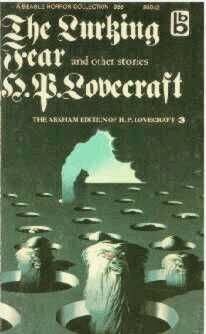
My friend, Stuart Meisel gave me a paperback that he assured would scare me. It was The Lurking Fear, a collection of short stories by H. P. Lovecraft, and it did scare me, but it also inspired me.

But I think there was more to my choice of content then just Poe and Lovecraft, plus the Universal monster movies recycling through our local theater at the time. I think much had to do with the monsters lurking in my own life, the bullying and abuse I faced most days at school, the fear of my father and the times of loneliness. I suffered from nightmares nightly.

Creating supernatural menace put me in charge of the demons and allowed me a world I controlled. Perhaps the demons within, those desiring vengeance on my tormentors, had an outlet not in some violence against anyone real, but in a bizarre world where vampire and werewolves and other outer-worldly creatures recked havoc on fictitious surrogates for my enemies.

Either become a writer or a serial killer; I think I made the right choice.


Saturday, December 29, 2012

Among the Great Books -- Not!

I have been slogging through a book for a couple weeks now. I do not use the word slogging loosely. Reading this book in like walking through deep mud in loose shoes. You go so far and then must go back to find something you lost.  Whenever you pause to look around you aren't sure where you are. Still you slog on determine to find some solid ground somewhere.

So why am I reading this thing?

Because I promised a friend I would.

No, he didn't write the book. He's a much better writer than the author who did.

I really don't like critiquing other people's work. When I have engaged in doing so I look for the positives as much as possible. After all, I'm no prospect for any literary prizes myself. Still, I do know some basic dos and don'ts about the trade. Unfortunately, this author seems to get the dos and don'ts confused.

One illustration stands out that represents the entire problem with the piece. In this instance, the author has described his panic at finding his young son missing after the boy's school dismissed early because of snow. Finding his child is not at the school, he says this:

"Noting that cell phones didn't exist, we drove to grandma's house..."

This is truly amazing. This person took a moment to reflect on something not yet existing. Now it is always a little difficult to know for certain where in time this person is, but this particular instance appears to be around 1977. The first commercially available cell phone appeared in 1983, but certainly many times in the mid-seventies during a crisis, say a flat tire on a back road, our first thought was noting that cell phones didn't exist.*

Sadly, the author has a plethora of interesting material that could have been woven into a gripping read.  He would have been better served if he had been exposed to some honest critiques before publishing.
Noting that writing classes do exist, he should have driven to one.


*Technically, by the mid-1970s a cell phone did exist. It had been first used on April 3, 1973. It weighted two pounds and cost $3,995.  As stated, the first commercially sold cell phones were made in 1983 by DynaTAc (called mobile phones at the time). The battery would allow for a half-hour conversation before recharging, which took ten hours to accomplish. 


Monday, February 6, 2012

Quiting the Writing Game

Okay, don't anybody gets too excited that they will not have to read anything by me again. I said, " The Writing Game" not writing.

It is easier for an alcoholic to give up drinking than a writer to quit writing. Writing isn't like an addiction; it's more an incurable disease. One doesn't give it up anymore than someone gives up cancer.

I'll continue writing until they pull the keyboard from under my cold, dead fingers. I've been writing professionally for 60 years if you count the newspaper Stuart Meisel and I wrote and sold in the school hallway in 1952-53. It's been 55 years if you count it from the song "My Little White Lamb" my first New York published piece. I have been published somewhere or other in every decade since.

I have written almost every day since I was 12 years old. It may turn into gibberish if I go senile, but someone would have to shoot me to stop me. (Now I fully understand some people may say I already write gibberish. To them I say, "@&#*!" Just typing gibberish, translate at your own risk.)

The Writing Game has very little to do with actual writing. The Writing Game is what you play when fame and fortune is what you think you want. It is the desperate rules you follow to be published and see your name in print. It is the conventions you cow tow to in order to impress an editor. In other words it is pandering to please someone else's dictates of what writing is, but it is not writing.

In every art form their exist a coterie of elitist snobs who claim privy to what is and isn't proper. Well, there is another kind of privy and that is where their opinions really belong. If we depended on the considerations of these mutually declared haut monde of culture we probably would not have the great variety of art we enjoy. Like most elitist these person's main purpose is to keep things to themselves, for to share is anti-privileged  They tend to cling to the last best thing or speak mumbo-jumbo to declare something unfathomable as insightful. We must remember these people generally have stood in the doorway of evolving art for centuries and one wonders how many artists they have killed figuratively speaking over the years.

One must remember Van Gogh sold only one painting in his lifetime. Kathryn Stockett was rejected by 60 agents before one agreed to market her novel The Help. We probably would never have heard of such people as Beethoven, Jack Kerouac, William Faulkner, James Joyce or Jackson Pollack if those elitist who think they uphold the pillars of the media had their way during their times.

Now don't misunderstand, I am not trying to place myself on the level of those I just mentioned. As a teenager I was content to dream of being a hack writer of horror stories. Basically I achieved that and had some success as a pulp writer. If anything I have written rises about that level, then fine. I don't care. I've quit the writing game.

I have seen my name in print many times and it is no big deal. I am tired of changing things to suit some editor or to avoid upsetting the politically correct applecart. We have the internet now and the freedom to write what we would write to the best we can write it. If some read my words and enjoy them or think about them that is enough. If people read my words and dislike what I wrote then they are totally free never to read my words again. That won't stop my words.

What finally persuaded me to quit the writing game was some criticism of a story I wrote. It was made by a college professor, someone very much in a position to poison young mind. Her criticism was not of my style or content per se. Her statement was, "You didn't describe if your character was white or black, American or Canadian or whatever nationality or race; therefore, I could not relate to your character."

Is this what we have come to? This kind of bigoted need of superficialities to understand a story? These things did not matter in my story. The main character could have just as easily been of Asian ethnicity. The main character could have been a black man or a Hispanic woman, these random accidents of birth had no bearing on the story. It was about a human being dealing with life. If the color of her skin had a bearing on the plot I would have put it in there.

I thought, "Gimme a break! Are you kidding me?"

No, from now on I write what I write. Read it for what it is worth. If you like it, come back and read some more. If you don't like it, then go away. That is the freedom we all have now.


Friday, July 22, 2011

Hot and Hazy: Words Writers Write and Bloggers Blab, Great Blue Herons, Man Boobs and other Rambles, The Series Continues

I was going to call this series "Hot and Bothered". It seemed a good enough theme. A heat wave of possibly deadly proportions settled over the area for the week. It is 82 degrees out as I key this at 6:30 AM. It is supposed to reach, according to The Weather Channel, 103 this afternoon with heat indexes up to 115. For Arizona this is a shrug; for here it is abnormally hot. Plus we have humidity.

Therefore Hot was certainly suitable to use in the title and theme.

Since it was a series containing several posts dealing with "bothers", some for me, some for others, it also seemed appropriate using Bothered.

However, putting these words together not so much. Given the slang connotation, one long in existence and in the mind of many, the combination of "Hot and Bothered" would conjure up images not so proper for a PG rated Blog.

It is one of my pet peeves that so many fine, upstanding words have been gutterized into sexual and drug-culture slang. But this is the mind of man and such vulgarizing has always occurred and always will I imagine. Still, it is something a writer must be aware of. Nothing can kill your piece more than having everybody giggling like adolescent 15 year-olds, beer and bong-infested Frat boys or those...well, jackasses from Jackass, just because you use some street code for a private body part or sexual act.

Actually using the wrong word in any context can destroy your effort. Not only can this change your meaning, it is a distraction to the reader.  It is akin to attempting to speak in an unfamiliar language. You try to impress a beautiful French lady by saying she has the face of a flower —  "Vous avez le visage d'une fleur!" Instead, you purr in her ear, "Vous avez le visage d'un furet!"

Comparing her face to that of a ferret will probably not get you the reaction you hoped for.

Believe me I have been guilty of the wrong word faux pas many times. It can be quite embarrassing, even harm your credibility or reputation.  I wrote a poem called "Exhibition", which became quite popular at readings, but only after I changed one line and eliminated one word. The first time I ever read it publicly I was totally humiliated because of that word. I was describing a painting of a nude woman, which was very much paramount to appreciating the humor in the poem. My original line read something like:

"With breasts unrobed and arms and legs akimbo".

I finished and immediately a fellow in the audience said, "She must have been quite the contortionist to have her legs akimbo." This stole all the meaning and craft from my effort and brought him a laugh at my expense. I had wanted to show the woman was quite exposed and thought the word akimbo meant "spread wide apart". The word actually means to have your hands on your hips and your elbows pushed out and forward. If the lady had also had her feet upon her hips with her kneecaps pushed out and forward she would have been a contortionist indeed.

I changed that line to read:

"With arms down, breasts disrobed and legs audacious."


This is using the wrong word, a technical malfunction either from vocabulary deficiency or spell-check deception. It can be corrected by carefully proofreading or having someone else look over your work. But should an author be concerned about the actual content of their writing?

The obvious answer is yes. A lot depends on your audience. If you are writing a story for a children's publication you certainly want to avoid the use of certain expletives and subject matter; whereas, If you are writing for "Hustler" you will not be telling the story of a cute, fluffy bunny-rabbit's adventures in the cabbage patch.

But that is marketing. Something you do if you are out there trying to sell your stories to whatever magazines are left buying work from freelancers. The old world of words has changed. It isn't the same in many ways since I was a young man. One great difference is there is no longer an editor or publisher standing between you and having what you write in the public forum.  The Blog is here and good, bad or indifferent, Bloggers are everywhere.

Which is what I am today and probably what readership I have is also. So we are free to write what we please, put down what is in our mind, be it grand philosophic thoughts or the mundane deeds of our daily life. Some things don't change, though. What do we dare say or what should we not say in our Blog? We have no editor to put a check on whether we cross some line of good taste. We don't have some style booklet or subject framework of a newspaper or a magazine. We have nothing between what we key on the screen and the whole wide world except some form of a button saying, "Publish".

Do I have any rules for writing?

First, if you are overly concerned about what people will think of you, don't ever consider writing. It isn't going to matter how inconsequential or bland your post, chances are somebody, somewhere is not going to like it, not going to like you and is going to be highly insulted and offended for some reason over something you wrote. If this fact bothers you, then write in your journal and keep it locked up in a drawer. If everyone has to like you or agree with you or never utter a negative criticism, this is not the game for you.

I have been doing this a long time, long before the Blog, the Webpage, the World Wide Web or the Internet ever came along. I'm not a household name, hardly rich and famous and not in demand for interviews on the Today Show, but nonetheless, I am a professional writer. Why so? Because I have been published and paid for my work and that is what a professional is. I have been so in seven decades, my first published pieces in the 1950s and my last just this year. The only decade of my life in which I was not published was the 1940s, so I guess I wasn't a child prodigy. Actually, my first published-for-pay articles were when I was 11 years old. Yes, I have put my hide up on a fence post for public potshots for a long time indeed.

I've been peppered with some literary buckshot over the years. I had boxes of rejection slips. I've been praised and vilified. I had a handwritten rejection slip from a magazine editor some decades back. Now normally a handwritten rejection is a positive thing. If an editor takes the time to personally comment on your piece, even if they don't buy, it means you show promise or they want to see more of your work. Not in this case. This editor called me some very nasty, and I might add unprofessional, names and told me my story had insulted the intelligence of every person living in the Southern United States. I had the feeling if I had hand delivered my opus the good citizen's of that state would have tarred and feathered me at best.

So Rule Number One: grow a thick skin and a sense of humor.

Rule Number Two is be true to yourself and it is only second because if you don't adopt Rule Number One, you shouldn't be writing anyway. This is especially so if you are writing a Blog. When I was young and hungry to be a much-published and potentially rich writer, I wrote as a mercenary. I tried to write to the market and what I thought some editor wanted. Just like any job, sometimes you have to do it the boss' way even when you know your way is better. Not so anymore. I am an old man and I made the decision that what I write from now on will be what I want to write. In other words, I will be true to myself and write my way. I'm Blogging. No one has to read it. Besides, writing to please others eventually pleases no one.

This doesn't mean you never listen to criticism or stop trying to be a better writer. We all can learn to be better and we all make mistakes. It means, though, my content is going to be true to me and my style is going to be true to me and I'm not changing my voice because someone thinks it is not simple enough for today's reader.

However, in writing a Blog, one must be cognizant that it is out there for anyone who wishes to read. It may be someone on the other side of the world you will never meet. It may be many such strangers who pass through your domain, read your thoughts and never comment. It may also be you next door neighbor, the gang down at your favorite hangout, fellow employees where you work, your boss, your boss' wife, your best friend, your worst enemy, your parents, the people in your parent's church, or your church if you have one. It can be anyone and everyone.

This knowledge of who might be reading can become a stumbling block and keep us from good writing, true writing. I have three rules for dealing with this situation, unless, of course, you are the rare bird who truly doesn't care what anyone else thinks of you and isn't worried if everybody in your life comes to despise you.

My last rules:

Write nothing consciously or maliciously to hurt another person or betray a trust or reveal a confidentiality between you and another.

Write nothing that may harm you.  This means give it some thought before you push that publish button. For instance, did I say something that if my boss reads it I will lose my job? Or, did I say something my friends will find so insulting they will no longer be my friend? Maybe you don't need that job and don't care if you lose it and maybe you feel you don't need friends, but if you do, then maybe you want to hold off writing what you just did until another day, like publish posthumously.

This doesn't make you a sell-out or a coward. It just means you seriously consider the consequences of what you do. If you can live with the consequence, then go forth. If you will lose sleep even considering the consequences, 86 it.

My last rule is think hard and deep and long before jumping on a fellow Blogger because you disagree or feel offended by their Post. I have never known two people in my life that agreed 100% of the time on 100% of everything. There is also no right not to be offended. Part of the problem in this country anymore is everyone gets too easily offended. People get shot because someone felt they offended them somehow, perhaps they raised an eyebrow at the wrong time. Choose your battles  is what I am saying. Some are worth fighting and some are better ignored. Also remember, you want the freedom to write what you think and in your way. Give others the same freedom, even if sometimes it hurts, because most likely, you wrote something at some time that hurt someone else and they gave you a pass.

Besides I would bet that 80%, maybe even higher, of the things people get bend out of shape over and offended by are misinterpretations and not substance.

If you keep these simple rules in mind you can freely write in the way you wish about what you wish. But most important of all, be true to yourself.

Now just as a coda, I recently had a story criticized by a college professor no less. I will consider some of what was said, but whether I will change anything I don't know. I'm not impressed by the number of letters behind someone's name. One of the criticisms really bothered me though. It concerned my main character: "Is she black or white? American or Canadian? As a person, she is totally lost to me."

What the...!!!!!

This is how you determine a person? By the shade of their skin or their ethnicity? Perhaps I failed to shape this character as a living, breathing person, but the color of the characters skin or where they came from had absolutely nothing of pertinence to do with either the character or the plot or the theme of the story. This is something I have spend much of my life fighting against, this judgement of who a person is by such superficial things as race, sex, religion, etc. I made a determination several years ago not to identify my characters by race unless this had a true baring on the plot. This constance stereotyping, pigeonhole approach on film and in literature is part and parcel of continuing the suspicion and divide between we people. We need to show people as people first, not as some template of race, sex, etc.

I am surprised this professor did not assume the character was Jewish because her name was Goldie, a possible stereotypical Jewish name in some people's mind. Her name was Goldie because every female character in the story was purposely given a color as a name, Goldie, Rose and Amber. These names were part of the sub-theme of the story, beyond that they meant nothing as far as nationality, religion or whatever.

When I create a character I will give as much description as necessary for the tale. I gave Goldie's age, for that was an important detail, but I didn't give much else. I didn't say what color eyes or hair she had, how tall she was, even if she were pretty or plain, because these didn't matter. Let the reader fill in the blanks sometimes.  Give the reader the freedom to see themselves  as the character. What was the magic of radio? You couldn't see the characters, so their looks were seen in your head they way you imagined them.

If you are white, you can imagine Goldie as white; if you are black, you can see her as black. It does not matter, she is a human being facing a psychological crisis in her life. Actually, Goldie didn't even have to be a woman. It could have been a man, perhaps with a few adjustments. It could have been an Asian-American woman. Frankly, the main character could have been a Drag Queen, although I suppose if it had been about a Drag Queen people would have read more into the story than intended and taken it away from what was my subtext.

At any rate, write what is in your heart and head and don't lose sleep over what others think as long as you've been considerate to their secrets while bring true to yourself.


TO BE CONTINUED -- NEXT: The Great Blue Heron and Violations on the Trail.


Wednesday, March 9, 2011

Bloggin' and Walkin' and Complications Thereof

Okay, so I've been reading some others talking about why they Blog. It's their therapy. It's their relaxation. It's their addiction. Yeah, well it may be all of that, especially the last. I have always claimed writing was a curse or disease with no cure. And sometimes it is just plain hard work.

I mean, there are things you need know and don't. For instance, I don't know if the word is blog or Blog. Is Blog a proper noun or just some generic thingamabob? I'm always capitalizing the word, but maybe I shouldn't. A writer is supposed to know such a thing, is he or she not?

Why don't we have a neutral word for he and she. See, there is another style book question. Do you stick with he or stick with she when making general statements or must you alternate? On the other hand, must you always use both? It'd be much easy if we had a pronoun like hesh or something. A writer is supposed to know such a thing, is hesh not?

I writer ought to be writing, too. Have you noticed my production was down these last few days. There are a couple of reasons. One has to do with writing. I joined a writers' group and got self-conscious about my grammar or lack of it. I bought a new book for the purpose of brushing up on such things as whether I sat that book down or I set that book down. I did this because some of my time has been taken up reading and critiquing eight other writers' work for the meeting this Friday.

And then I took a walk. Yes, I know, I am always taking walks, but in this case I decided to do another taping. Now I had some video snippets of my stroll to put together. Ah, ha, I said, I will make one big film this time. So I worked at stitching these snippets together, adding special effects, music (something that would come back to haunt me) and a narration. Beautiful, it came to just 30 minutes and some things timed out just perfectly and I felt I nailed the ending. All that was left to do was the upload to YouTube to finalize the effort. This is when I learned YouTube limits videos to 15 minutes.

I had to cut my opus up into three parts (I was afraid splitting it in half was cutting too close to that 15 minute barrier).  It took more effort that you can believe. I basically had to start all over for there was no way to slice and dice my finished epic. I had to reassign the strips, re-add the music and redo the narrative. This took time, a lot of time, but at long last I finished and all three sections uploaded to YouTube without a hiccup.

Except I got an email notification saying one of my videos may contain copyrighted content. I try my best to not use any such animal. The only thing it could be was the music. The pictures, the film, the narrative were all original by me. When I looked at my playlist on YouTube, I saw several marked as possiblily using copyrighted material. Now I had used classical music as background and figured that was written before 1922 so would be public domain. However, I guess the performance of the music was  what was copyrighted.

I went in and deleted all my videos where I used music. I then removed all the music from my masters and loaded the altered films back to YouTube. Bingo, any warnings went away, but so did some of the spark. I felt the videos needed something beyond my dreary voice and shaky filming.

Once again I deleted all my videos from YouTube and once again I reproduced them, this time using bits of music supplied by Apple, supposedly in the public domain. If I receive any notice on these, then I guess music will not be in the background of my tapes, unless I start composing my own and pluck it out on my son's guitar.

At any rate, below is my latest effort. It is called "Cauffiel in the Wind". (And you need ask yourselves, did "hesh" capitalize the correct words in that title?) And, by the way, you set the book down on the table next to where you had sat to read.

Oh, and I suggest you turn off my music player so you can hear the videos.


CAUFFIEL IN THE WIND

TO THE PIKE

TO THE BOULEVARD

TO THE HOUSE AND BEYOND


It isn't easy Bloggin' with a lap full of cats, either. 

Sunday, February 13, 2011

Sticking My Toe in Again

I have joined another writers group. I'm hoping it was a good idea. I do so with apprehension. One wouldn't think I would be nervous about such a thing. I was in a few groups several years ago, until the book stores began to purge themselves of such gatherings. It seems one such chain has returned to holding such events. Of course that chain is in a lot of financial difficulty right now so who knows how long this will last.

Anyway, I took the plunge or at least stuck my big toe in the literary waters. Hopefully there aren't any sharks swimming about beneath the surface.

This is a critical group. I am not overly fond of the term "critical". It has a somewhat negative aura about it. When you look the word up the first definition is "expressing adverse or disapproving comments or judgments." Well, we don't want to subject ourselves to that! The second definition is somewhat better, "Expressing or involving an analysis of the merits and faults of a work of literature, music or art." Still a little daunting. I prefer the term analytical. I am hoping the comments are encouraging, kindly, and where there is any criticism it is of the constructive kind.

It is always very easy to find fault, to disparage, but the object is to help grow what talent comes, not to destroy careers before they are a career. We don't want any Simon Cows...oops, sorry...Simon Cowells ruining young egos in order to show off his own caustic wit. No, I always believe the object should be to lift people up to as high as they can get.  You know, if you are better at something than someone else, you lift them on your shoulder and boost them up, not raise yourself up by standing on their shoulders. I believe if someone has a passion for an art and even a modicum of talent they can be improved into some success. A key here is often that word passion. Some people say they want to be an artist, but have no real passion. They may even have great natural talent, but without wanting to eat and sleep the art, they probably won't have the staying power to make it.

Now granted, some people want to be what they cannot be even if they are loaded with passion. Yet they lack something that makes success possible and it is probably best if someone takes them aside and saves them a lifetime of heartbreak. The key here, though, is takes aside, not humiliate them in front of the world. For example, if I may continue the American Idol theme, take myself. I have a passion for music. I love to sing. I am the type of guy who inside is like a character in a musical, I have a desire to breakout into song at any moment. Problem is, you don't really want to hear me do it. I have a definite tin ear, born with it I'm sure, a little trouble distinguishing sounds and no hope of staying on key.

Someone might say, "But you played instruments." Yes, I did. I played trumpet. I can play a little one-handed piano. I taught myself to play guitar. How could I play them if I have such a terrible ear? Simply because I can read music. I was fine as long as the music was in front of my nose. You see the note on the staff and you just press the right key or plunk the right string. I could get along wonderfully, unless the instrument wasn't in tune. If it was out of tune I might not even notice and if I did, well, it was nearly impossible for me to get it tuned up, especially the guitar.  I was not going to have a career as a singer no matter how passionate I was or how long I practiced.

Anyway, what are my apprehensions about joining a writers group?

Most of my apprehension comes from the requirement to analyze and comment on other people's work. I tend to be very positive about what others do, which is not always helpful, but I am very uncomfortable saying something is "bad" in some way. For me it is much easier to take criticism than give it.

I am also in a different place than the others in the group. I am older, generally much older. It is not that the group is a bunch of kids, it isn't, but there is probably no one there within twenty years of me and for most of them the gap is probably thirty or more years. I am at a point where I am not one bit concerned with getting published. Oh, don't get me wrong, it'd be nice, but I am not writing toward that goal. I write what I write and I always have been a bit off skew with others in what I choose to write.

You see, one of the problems with writing (and the same can probably be applied to many other areas as well) is you can't write for the writing or for the reader or for yourself. If you wish to be published, you are writing for an editor. Thus a lot of discussion groups hover around what editors like, what editors look for, what tricks can be used to get the editors attention and what things won't even get your manuscript read by an editor.

Simple thing, send in a handwritten manuscript and it'll come right back with a form rejection. So a person may be the greatest writer since Shakespeare, but without a keyboard and printing device, no one may ever see what they wrote. I realize some handwriting is difficult to interpret, but if a manuscript arrived clearly readable, but hand lettered is it that much trouble to give it a look see?

When I first started writing everything I did was pen (sometimes pencil) on composition paper. I didn't have a typewriter. Where could I go with what I wrote?

I just don't want things to be grammar, spelling, and things that don't fit some textbook outline of how a story should be written. Grammar, misspelling, use of the wrong word, those are little technical things easily fixed. Nice to have them circled for correction, but I hope it doesn't become the main focus. As far as what a textbook says, come on, every noted great artist became so because they broke out of the textbook rules for their genre in their time.

What I am interested in is: Does the story work? Are the characters real? Do they talk like real people? Does it grab your interest? Do you understand the story? Do you understand what is really going on? Would you read it?

One last thing I have found in past groups such as this. There will be many conflicting opinions. There will be many counter ideas thrown across the table. What you look for in all of this babel is the grains of good wisdom and use that. You need to be able not to take advise as well as consider it. You can begin to get totally lost and destroy your own work if you try to take everyone to heart.

I sent in my first piece today. In about four weeks we meet again and I will see what happens. Meanwhile I am looking forward to receiving the works I must read and comment on. It is always fun to see other's approach to this little storytelling gig.

Wednesday, January 5, 2011

Now What? Looking Ahead.

Well, another year has come. What is ahead? Adding another digit on time will mean I'll be 70 this year. It is a nice round number, rolls off the tongue much easier than all those sixty-somethings, 67, 68, 69. 69 is one of those numbers that always brings a secret smirk. I'll be happy to reach 70. Wasn't that a lifetime limit once? (Some say even Biblical: Psalm 90:10a "The days of our years are threescore years and ten.") I know as a child somebody 70 was a real old person at the end of their alloted three score and ten.

I don't see that gray-beard on the bridge as my old man look, but as my rugged Ernest Hemingway look. Ernest never made it to 70. Didn't make 69 either. He pulled a trigger at 63 and messed up his walls something awful.

So what am I planning for the year ahead. It certainly isn't the Hemingway solution, I don't even own a shotgun.

We never quite know for sure the what and when of our final solution, do we?  Therefore, it isn't worth fretting; however, I thought mine was to be flocked to death by geese on the first day of this new year.

Off for my morning walk, January 1, just after dawn, I parked at Alapocas lot Number 2. As I got out of the car a small V of geese came over the adjoining golf course to my left. They corrected their coordinates as I exited my car to fly directly above. I don't like geese flying overhead, not with the reputation loosey-gooseys have.

Nothing happened, they soon disappeared, but then another little gaggle came across the fairways straight on my course, and then another and another. Little patrols of feathered formations each flying exactly overhead as I walked down the hill from the lot. It was as if I was ground control.

Then the clear blue sky cleared of all birds-on-the-wing for the short time it took me to almost reach the underpass on the street. Suddenly there was a commotion like you never heard. It shook the earth this grand honking cacophony. I turned in the direction of this sound of geese honking in full throat, many geese.

Over the hill they came, this tremendous swarm like some invading air force. I thought the birds had revolted, that Alfred Hitchcock's profile would appear on the wall of the underpass and I would disappear as bloody pulp beneath beating wings and pecking beaks. It really was an awesome and noisome sight.

(I counted and there are over 300 geese in my photo and I didn't even capture the rear guard.)

Then the  geese broke off into groups and went flitting here and yon. All coming back after a big New Year's Eve gathering, I suppose, a bit tipsy, a bit confused as to how to start the year.

So where does one, goose or man, begin a new year? I'll just start where I left off the last year.

I will take my usual early morning walks on my non-work days. I did so today and the rest of the photos accompanying this diatribe were taken on the new trail I tried. (I mean a new trail to me. The trail itself was as old as dirt; in fact was dirt. So, since I am also as old as dirt the trail and I had common ground and got along famously.)

This time I crossed the Rubicon, the Brandywine Creek anyway, to the other half of Brandywine Creek State Park. I have never walked that portion. I decided let's give her a go, me lad.

I remembered to tuck my cell phone in my pocket for the first time, too. It just occurred to me that I never tell anyone which park I am headed off to walk. What if something did happen or I got lost? No one would know where to begin looking for me and I knew no one would even suspect I headed to this particular place.

Anyway, we all know I am going to go on trudging down some woodland trail alone, that's just my nature, but isn't new news.

I don't think I have any new news actually.

Wife, working, walking, writing are pretty much the four big Ws of me life.

Wife will be a nice round number this year as well, fifty years married. I don't foresee any changes there.

Work, well, work I must.

Just where do I intend to go in my writing going forth?

For one thing, I want to get back to doing entries in my "Night Writing in the Morning Light" Blog, which I haven't yet, and continue adding to "Nitewrit's Own Harmony", which I have.

I wrote a post covering Jesus' reading of Isaiah and being accused of blasphemy as a result and almost getting thrown over a cliff;  my little examination of "Jesus Is Rejected in Nazareth", mostly from Luke 4:16-30. It is an adventure story.

As for "Drinking With Elder Men", I collected related posts from last year into several books. There are seven of them.

A Writer Walks and Writes of Walking (Rambling thoughts as I went ambling)
Bends of the Brandywine: Adventures of The Kid as a Kid (A kind of autobiography)
Lava from the Lair (Some of my past published essays and commentary)
Life, Death and the Lonely Art (Title pretty much describes the subject matter.)
Modern Inconveniences: Living with Frankenstein (My struggled with today's technology)
Pretzels for Lunch (My Life in Philadelphia)
This Old Man (Everything else)

If someone has an interest in reading these narratives, here is what you do. Once in my blog, go to the right hand side and down to the title, "Keepsakes:  Related Post Subjects" This is an index (Labels if you prefer). The books are listed first. Simply click on a book and its chapters will pop up. Click on the chapter you wish to read.

I will be doing the same thing with whatever I manage to produce in this The Year of Our Lord 2011.

There will surely be another volume of rambling stream-of-consciousness thoughts illustrated by photos from my hikes. I can't help myself; its what I do.

I have no title for it yet, perhaps the "Frigid Photographer".

No, that won't work for the whole year. In a few month it will warm up, the trees will bud and next thing you know I will be happily sauntering about in just T-shirt and shorts; not even sox.

So perhaps the "Naked Photographer"?

Of course, that would be deceptive, but "Near-Naked Photographer", I don't know? Still, when I look at the list of my "Most Popular Posts" or my stats, there were two essays I did last year that rank at or near the top.

"Mirror Mirror on the Wall Don't You Show Then What you Saw" and "There Is Nudity In This Post" both spoke of or hinted at nakedness and my readership spiked up when both appeared. Now I know what draws the public curiosity, so "Naked Photographer" might be just the thing to draw an audience.

There has already been The Naked Cook","The Naked Archeologist" and "The Naked Cowboy" and they all wear clothes. Well, the Naked Cowboy isn't exactly dressed, but even he wears tighty-whities and hides behind a guitar.  Maybe I could employ the common tease from the 1950s men's magazines. I could peek out from behind a bush and the reader can imagine what they wish.

The other grouping I have decided to do I have called "Contankery Road", and that first post of this year, "So New Year's Begins-2011", would qualify to be in it.

"Contankery Road", that's the working title anyway. It may change by 2012. It may change by tomorrow. It has changed a couple times already. I had it, "Contankery Row", but then decided "Road" worked better. I've also considered "Down the Cantankery Road". Cantankerous means bad tempered, uncooperative and argumentative, as in "a crusty, cantankerous old man".

This was kind of a cantankerous old trail I was on this morning. I came to this fallen sapling across the trail early on and fully expected a limbo band to pop out from behind a tree.

"Yo, ho, don't you know?
Yo gotta get down; gotta get low!"

Did I bend over backward and go under?

Are you crazy? Didn't you read the first paragraph. I'm almost 70, for Pete's sake! No, I stepped over it.

Now we return you to "Cantankery Road". I started out calling it plain "Curmudgeonry", but  a curmudgeon is a bad tempered and surly person. I don't feel I am really very surly.

I am not bad tempered or uncooperative or argumentative for that matter. That is why I am still unsatisfied with that title. I may not be either a curmudgeon or a cantankerous old foggy.

I am really a pretty even-tempered dude who doesn't much dislike anyone.

But "Even-Tempered Road", where's the excitement in that?

Maybe if I described what kind of content this collection will contain someone would have a better title suggestion. There won't be any prize for coming up with one though.

I will be writing about certain issues of the times where I have questions. Now I don't want anyone to get confused. I don't do political, don't like politics, don't like politicians and won't indulge in polemics with anyone.

After all, you're wrong, I'm right, and that's the end of it, you twit!

That's how political arguments always end, isn't it?

Anyway, back to the non-political statement on the floor that sounds a little political. I want to write about issues that might sound political, but they won't be because I am interested in knowing what's what, not pleasing somebody's agenda, even my own, if I have one.

Today there is a mother-lode of talking heads and loud-mouths in the Media telling us what to think. This side says that and that side says this and consequently nobody says much of anything helpful. So I have questions — about everything - I'm going to ask my questions. Who knows, someone may have an answer.

But I won't argue with you. You want to argue, find somebody else. There are plenty of political rant Blogs out there in the cyber world with people who would love to take you on or may agree with you and embrace you.

What kind of questions?

How about questions about the law that will soon go into effect banning the incandescent lightbulb? Will the CFLs really save energy? Will they create "Green Jobs"? Are they safe to use? What about all that mercury? Is there all that much mercury?

How about questions about electric cars? Will they really save all that energy? Will they create "Green Jobs"? How far can you drive? How do you refuel; that is, recharge? How long does a recharge take? Will these really do away with carbon fuels? Are they practical?

How about the recent report on improved employment. Is the report looking at prunes and seeing plums? Is the fact first-time unemployment claims peaked in October 2010 really meaningful? Is the fact first-time unemployment claims decreased in December really meaningful? Has the unemployment picture been altered forever?

You know, little trivial matters like those.

We'll see how it goes.

It may be difficult for me because some of those questions touch on controversy. I may express an opinion that another doesn't like and I don't like to be disliked. If you had been paying attention, you will remember I actually started two previous posts off exactly the same way ("On My Fences" and "Lost in Transition"):


"Perhaps the biggest handicap in life is wanting everyone to like you. It fences you in and is a hard rail to climb over. It isn't logical and it borders on insanity.  It's a syndrome. It is self-suffocation.

"And along the line The Kid caught this disease."

I had intended to explain that quote in a later chapter of The Kid's life, but somehow never got around to it.

And unless you are particular;y dense, I'm sure you figured out The Kid is just the youthful personification of this Old Goat. Despite learning very young that if people are going to dislike you it isn't going to matter what you say, I did catch that want-everyone-to-like-me disease.

What else will I scribble about?

Speaking of The Kid, I will certainly continue with his life as he graduates high school and moves into adulthood, gets married, goes to work and all that good stuff.


I may write more about some of the eateries The Little Woman and I go to, assuming we can afford to eat out in 2011.

And I will certainly continue to write of the absurdities of living as they happen.

I hope some Gentle Readers will be there in that distant Blogospeare.

Hmm, the trail is getting a bit spooky looking. I will have to do a post on just what I got myself into down these overgrown lanes.