Banner photo of Larry Eugene Meredith, Ronald Tipton and Patrick Flynn, 2017.

The good times are memories
In the drinking of elder men...

-- Larry E.
Time II
Showing posts with label A BOOK Pretzels for Lunch. Show all posts

Wednesday, August 14, 2013

Where Did All the Flowers Go?

My flower child wife in 1967, during the innocent days of love and peace.

It is hard to pin down that decade. It wasn't really the 1960s. The first few years of the 'sixties were like a slow fade out of the Rock 'n' Roll revolution of the 1950s. Did it begin in February 1964 when the Beatles were the vanguard of the British Invasion upon the musical shores of the United States? This date certainly marked the beginning of a whole new creative breakout within the arts. I'm inclined to place it a bit earlier at the assassination of President Kennedy on November 22, 1963, and end it on August 9, 1974, when Richard Nixon left the White House in disgrace. Those dates certainly seem to border my own entry and exit of the Psychedelic Philadelphia period.

Although aspects of the movement date back to the Bohemians and the Beats, and small contingents of self-called Hippies exist today, as far as what people call the Hippie years was a very short period. It basically blossomed as a sub-culture with the January 1967 Be-In at San Francisco and the following Summer of Love. Its death began at Altamont in 1970.

The term Hippie was apparently coined in a 1965 newspaper article by journalist Michael Fallon about
the migration of Beatniks into the Haight-Asbury area of San Francisco. The exact meaning of the term is vague and uncertain. If it derived from "Hip" or "being in the know", it was a misnomer. I think Hippies were naive and escapist. The 1960s were hardly the "Decade of Peace and Love ". They were rather chaotic and violent, with police dogs, firehoses, cities rioting as the civil rights movement burned across the nation, and bloody and deadly as the Vietnam War raged overseas. Sticking flowers in the barrels of rifles ignored human nature and eventually someone pulled the trigger. The resulting images of My Lei in November 1969 and Kent State in May 1970 made this all too clear.

I suspected at some point the FBI or some such authority was reading my mail. My envelopes were coming to me opened or partially resealed. Why bother with me, pretty much a nobody. Who knows in those times? My wife and I had attended various protests in the city. We had been on a thing called "Pollution Trail" during the very first Earth day, riding about the area in a bus with fellow demonstrators, stopping at those places we considered the worse offenders against clean air and water, singing at them, shouting at them, getting our pictures taken by the mews media. I was writing for ultra-revolutionary underground publications, as well as letters to the editors of local newspapers, debating ministers and sending angry complaints to CEOs. I had supported and voted by write-in for Dick Gregory in the 1968 Presidential election. I subscribed to left-leaning magazines, such
as "Evergreen Review" and "Avant Garde".

One day I found a subpoena sticking from our mailbox. I was summoned to court on the grounds I had fraudulently registered to vote. This was in August of 1969. I had just begun a new job, circulation manager at North American Publishing Co. (I also wrote book reviews for their education industry magazine "Media & Methods"), and I had to take a day off from work to appear in court. When my wife and I moved to Philly we had registered as Democrats. She did not receive a subpoena, I did. I attributed this to the fact she listed her occupation as "Private Secretary" at U. of P., while I listed mine as "Writer". Arlen Spector was running for Mayor on the Republican Ticket, an office he would lose in a close race. The Republican Party was making an attempt prior to the election to take away the votes of students in the University City area on the belief they were mostly Democratic voters and I was swept up in their net. This event became the basis for my story "Toward Last November".


The people I knew or met and the situations of my life often became stories and that time frame was a productive period for me and 45% of my short fiction was penned between 1963 and 1974. The stories directly concerning my Psychedelic Philadelphia Days were collected in Keep All the Animals Warm (2004).  These were autobiographical  with "Cold", "Singing in the Streets", "Subway Stop", "City Scenes", "Tea and Coffee" and "Toward Last November" being especially so.


So where did the flowers in my bouquet go?

Diane, who wished to be a writer, just kinda drifted away.

Girard was older than the rest of us, married, divorced and father of a daughter who didn't understand the situation. He was a writer and trying to be a free spirit, but never came out into the nights and haunts with the core of our group. His situation with his family became the kernel of my story "Christmas Last" in my collection Daily Rhapsody (1971). It is the danger of being friends with a writer, your life becomes fodder for the mill of the writer's imagination. (Half of the stories in "Daily Rhapsody" were about people I knew at either ARCo ("Beach Boy", "Christmas Last", "Papier-Mache", "Most Admired Man in Rounke's Bar") or Lincoln Bank ("Fat Gal").

I do not know the final destinations of most of the core group, other than some apparently dropped their artistic dreams.

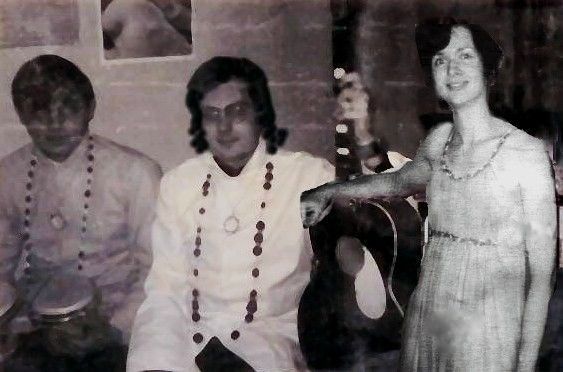
Jane (pictured right), who I often traveled up to Temple University with, for she lived in North Philly, may have defected to Cuba, but I really don't know. She was studying art and was active in the Black activist community. She was the one who introduced me to an editor in the Underground Press. Her boyfriend was a photographer in those same publications and by 1970 he had defected to Cuba. Jane kept urging me to not take day jobs, to trust my talent and live by it. Sometimes, perhaps more so, I wish I had listened to her.

Jim, who wanted us to start the band "Ethereal" became a Doctor of all things, perhaps the last thing any of us would have expected.

Joe (pictured left with my wife) and I had collaborated on a few pieces, but he was never fully committed to the kind of life the rest of us dreamed about. He was content to sit in Jim's basement or go to the Square with us. His number came up in the draft lottery and he ended up going to Vietnam, where he was wounded and heroic. After he came home he married and named his first child after me, stayed with ARCo and moved to Los Angeles when they moved their headquarters there.

I lost contact with him sometime after 1980.


I do not know what happened to Dot, the poet (pictured left), or to Michael and Maureen, the Actors (pictured right). I have googled the
names, but turned up nothing. If Michael and Maureen ever fulfilled their hopes of the Broadway Stage I do not know.

Part of the breakup lies with me. By 1970 I was getting published regularly and had also begun selling stories to the international pulps, "Magazine of Horror" and "Startling Mystery Stories". In a way I had moved beyond the group. The chatter in Jim's basement and around the Rittenhouse Fountain was always about some future time when we'd all be famous in our
fields. It was talk of projects we planned to do. It was talk and not doing. But I was doing. More and more I was writing and less and less going to these get-togethers to gossip and dream.

And then we moved from the city and after that the decade called the "sixties" had disappeared into the mid-seventies and everything changed and new eras began.

We lived during those Philadelphia days near Clark Park. Clark Park had the distinction that Charles Dickens once spoke there on his American tour. The Park was on the edge between the West Philadelphia communities and the Universities. During that decade it was decided to make the park a symbol of Love and Peace. It was the darling of the media for a while, but in the end it remained Clark Park and nothing more. (I based my story "Community Park" on it.)

Writers can't help but write and all the world becomes ink for their pen.


Saturday, August 10, 2013

Hangin' at Jim's and other Hip Hotspots


"I think we should start a band," said Jim one night well into a second or third pitcher of Screwdrivers. That was our beverage of choice, easy to make, vodka and orange juice.

We met often in Jim's basement somewhere on the 1500 block of South Carlisle Street (pictured left). There was an old piano off in a corner, varied chairs and a beat up old sofa, some battered tables here and there, the main one holding the Screwdriver pitcher. It was dimly lit and filled with smoke, for we all smoked. I sometimes puffed on a pipe, like my father before me, but more often I lit up an extra-long, brown-paper wrapped Nat Sherman. This must have been before I quit my job and had money because you had to order Sherman cigarette and they weren't cheap then or now. I actually gave up smoking while still at ARCo. This is where most of us in our group had met originally.

This "we" were kindred in circumstance and desire. Most of us worked at ARCo during the day and attended college at night, and all had aspirations to the arts, with the possible exception of Joe, who was my closest friend at the time who went where I went and Lois, my wife. Girard, Diane, Jim, Dot and I were writers. Maureen and Michael were actors. Jane was an artist. Dot and I were also poets and Jim was also a composer, which is why that statement came that late evening.

The name we chose was Ethereal and Lois would be our lead singer. She would wear delicate and flimsy clothes that would leave the audience guessing if she were naked underneath her gown. (Pictured right, the core of Ethereal l. to r., Jim, me and Lois.) Jim would write the music and I the lyrics. It never came about, but we were quite serious for a while.


When not hangin' in Jim's basement, we would meander down to Rittenhouse Square and waste the night away gathered at the center fountain. I looked at images of that fountain and they all show its basin full of clear water. I remember it usually drained and dull looking, if filled with anything then it was brittle fallen leaves from the bare trees that dotted the landscape. I seem to remember those Philadelphia years more in winter than any other time of year, as in my photograph of the Square on the left.  We'd be there in the grim, cold nights, shivering in our bellbottoms and pea  jackets trying to look cool instead of cold.

The people of the park would float about us in the fog of their own breath, the colors of their varied costumes, for what were the outfits of that time but costumes, all turned to ash in the garish light of the lamps. People like us, I suppose, escaping that plastic world either by their artistic dreams or by the chemicals they ingested. They waltzed in the early hours, dancing almost, happy in their delusion of freedom, chatting, chanting or chattering into the wee hours, and we stayed until those wee hours, until the life drained away from many faces and the motions slowed and when faces came close you saw either the dilation or the desperation in their eyes. In the last moments the Gay men would drift through like a little steady stream, not in bunches usually, but somewhat detached from each other, strung out like a ribbon. They didn't linger, they just passed through our midst and went wherever they went as they came from wherever they came. It was by then the hour the bars closed. And then at last we too drifted off in our own directions.

Lois and I lived to the west, across the Schuylkill River and on clear nights we walked home. It seemed safe once upon a time in Philadelphia to do that. We would walk many places in the evenings without much apprehension for there were always crowds about then. I''ve walked in many city at late night and felt that way because things were alive and people were out, New York and New Orleans' French Quarter. I fear the streets in dead cities. Atlantic made me nervous. It was like an episode from The Twilight Zone where all the people disappered. Even on a Sunday afternoon the streets were eerie for their emptiness.

We would walk or ride the trolleys or the El to the coffeehouse theaters. Our favorite was The Trauma,
down in the middle of a block on Arch Street (Pictured right). The Trauma didn't sell alcohol. but you could say the smoky air was intoxicating.


I read recently a piece saying The Trauma closed because it couldn't compete with the Electric Factory, which had opened "several blocks north". In actuality, the Electric Factory opened at 22nd and Arch in an abandoned tire warehouse only about a half block down the street from The Trauma. As far as what put The Trauma out of business this is the story as I learned it at the time.

In the same year, 1967, as The Trauma opened Frank Rizzo became Philadelphia Police Commissioner. Rizzo was a tough cop with a vendetta against the alternate cultures of the time and political ambitions. (I'll speak about how Rizzo's ambitions effected me directly in a later post.) Rizzo liked to see his name in the headlines as single-handedly fighting the evils of the city as he saw them. It was said that he personally padlocked The Trauma. At any rate, he led the effort to shutter these "dens of inequity that drew the wrong kind of people and ruined the neighborhood for decent residents." Thus The Trauma, which drew both Hippies and outlaw bikers to it venue had to go. My wife and I had stood in line with members of The Warlocks to attend Tim Buckley's concert at the Trauma.

Not long after The Truama closed a barroom opened on the site, thus bring a better clientele to the neighborhood. Although The Electric Factory still exists, it too shut down at that location in 1973, the year Rizzo became Mayor of Philadelphia. It was resurrected in 1995 several blocks north of the Arch Street location on 7th Street near Spring Garden in a former electric company (how appropriate).

We also traveled out to Manayunk to a theater called Kaleidoscope, a place with a Psychedelic facade and theater seating. Acts such as Earth Opera played there. My most vivid memory of being at Kaleidoscope was it having co-ed rest rooms. Remains of the Kaleidoscope remain inside a warehouse (pictured right).

It was in the square and on these streets that I collected my stories, sometimes autobiographical and sometimes about my friends and sometimes about these strangers who touched me now and again. I'll speak to the roots of some of those stories in my next post.


Thursday, August 8, 2013

Psychedelic Philadelphia and Me

We moved to Philadelphia in the late sixties. I was unemployed; that is, I wasn't employed by any place that gave me a regular paycheck. Some months before it seemed to me a good idea to quit my job at ARCo and spent my days writing a novel and sending out stories to various magazines and collecting the resulting rejection slips.

My wife procured a position as private secretary to the head of University of Pennsylvania's Chemistry Department making her our main provider. I was picking up some pittance writing term papers, speeches and other essays for college students too lazy to do their own assignments. As a result I was carrying an A average in three schools I never attended, Community College of Philadelphia, LaSalle University and St. Joseph's University. I was just establishing myself as a local writer with "Philadelphia After Dark". None of this together paid enough to support one person much less two.

I dickered around with pen names on the theory of preserving my private life under anonymity. One didn't want to be pestered in public once those prizes, such as the Pulitzer and Nobel, started rolling in. A writer could have the best of both worlds, fame and fortune under some phony byline and peace and quite under his given moniker. If Mark Twain walked into a saloon and said, "Howdy, I'm Sam Clements," they probably bought him a sarsaparilla and told him tales of life they would never have revealed to the famous author. I considered being "Lem Brown", which sort of preserved my family links as well as my initials.

Ghostwriting for others never reveled my name at all, of course. My client's signature goes under the title and they get the credit. No one would ever know my involvement, unless I told, as I am, or they told, which they wouldn't. They couldn't very well saunter up to their professor and say, "By the way, I hired someone to write this for me." They'd find their golden A had quickly become a red F.

I signed the essays written for "The Communicator" as "Loop" and underground publications, such as "Psychedelphia Period", as Eugene Lawrence. It was too little too late. I was on the newsstands in "Philadelphia After Dark" under my full name. When my stories started to sell to a wider market it was under my full name and just about everything there after.


These were days when between writing assignments I would wander from trolley stop to trolley stop looking for dropped change. A quarter would buy a bag of soft pretzels at any street vendor, a bag containing three. Quite often this would be both my breakfast and lunch, a mobile meal I could consume as I walked about the city. I'm afraid this is a habit that has stayed with me; both eating soft pretzels and walking about.

(I titled a collection of essays about Philadelphia Pretzels For Lunch, as a matter of fact.)

Always a walker, it became a nessesity when we lived in Philly. It was the cheap way to get around. My assignments from "Philadelphia After Dark" took me hither and yon about town, from Quince Pye on the tiny alleyway of Quince Street East of Broad (the picture on the right is of that location as it is today) to the Pocket Playhouse at 2601 Lombard.

The actors of the Pocket Playhouse lived together in a commune somewhere on the Hippie Streets between Waverly and South off 26th Street. Those
Hippie streets of deteriorating buildings, second-hand clothing stores, bell, book and candle vendors, head shops along with the Pocket Playhouse and the colorfully painted sidewalks are gone now, covered by brick townhouses and gentrification. The Hippies displaced by the Yuppies and even the Yuppies probably displaced now.  It isn't the same as when I and friends oft visited to buy psychedelic posters and cheap clothes.

South Street retains the reputation of hipness, but those streets then were sweeter and more innocent, often joyful, while South Street today is gaudy, noisy and jostling. (Photo on the right, titled "Buttermilk Toast on South Street" was taken in 1968; photo on left is South Street today.)


We lived in West Philadelphia, the area known as University City, because of the institutes of higher learning located there. There was a dormitory of the Philadelphia College of Pharmacy right behind our building. We rented a studio apartment on Chester Avenue just off 42nd Street. The Commodore still exists as an apartment house. What its clientele is today, I do not know, but then it was students, Hippies, druggies, prostitutes and us.

We moved into the "No pets allowed" apartment with a hamster and an Iguana, sneaking their cages in at midnight. Coming in we heard the Super's voice down the hall. We dashed into our digs and shut the door only to discover the hamster had escaped. Not long after we heard a woman scream and thought someone found Hammy. But the little beast showed up three days later, its back greasy from being under the refrigerator.

Women's screams were not unusual. The pair down the hall sometimes broke the night calm with her screaming in the hall, attacked by invisible critters in her drugged state, he trying to ease her back to their room.


There were different screams at night above us. A prostitute lived there and from our bathroom you could hear every sound of her business. We had the most erotic bathroom in Philly. It was common, too, to hear the clickety-clack of a big wheels, ridden up and down the hall at 2:00 AM by the 8-year old son of the other prostitute, who shared the same floor with us.

(Left: Lois at the Commodore, 1969)


"I think we should start a band," said Jim one night well into a second or third pitcher of Screwdrivers.  Ah, but this brings us to who we hung with and where we did the hanging. We will save that for the next time.


Saturday, October 30, 2010

PRETZELS FOR LUNCH


ONE: PHILLY AND FEAR

O Philadelphia; My Philadelphia

(Note to Gigi:  I hope nothing I write about Philadelphia will discourage you from visiting. It is a wonderful city, one I have deep affection for, which is what most of this post is about. There is so much to see and do from a traipse through our nations founding in Old City to the vista from the marvelous Art Museum steps to the venues of Penn's Landing by the Delaware River to the exotica of South Street to the incredible Institutes of history and science such as the Franklin Institute to the tranquility of Boat House Row to the statuary in the Rodin to the culture of theaters and the Academy of Music and all the delicious restaurants in all their variety. Please visit!)

Readers, please go visit and spend a peaceful moment with a nice lady named Gigi at her "In the Throne Room" Blog. You can click here or on the Post title to get there.


The picture above was taken on Independence Mall in 1966 looking toward Independence Hall where both the Declaration of Independence and the Constitution of the United States were signed. The city was named by its Quaker founders after one of the seven cities mentioned in Revelation. It was one of the only two the Lord did not have anything against, the other being Smyrna (which is a town here in Delaware, by the way). The name means Brotherly Love (Greek: philos = love; adelphos = brother). It is often called "The City of Brotherly Love", but is more affectionately known as Philly.

It has seen a lot of changes since William Penn bought the land from the Lenapes in 1681, since the Founding Fathers signed those two documents in 1776 and 1787 and since my photo was snapped in 1966. For instance, skirt lengths have changed several times since this photo was taken of my wife in an Old City Colonial Garden that same year. (In her outfit, she almost blends into the garden.)

Not all the changes have been been good. There have been two serious social phenomena lately. One is the sudden appearance of Flash Gangs. These are large groups of young people who suddenly appear anywhere at anytime, their gatherings coordinated through the use of social networks, such as MySpace and Twitter. Some, perhaps most, mean no harm. They do it just as youths have always done such things, just to see if they can, to have a laugh or to meet each other. But others, too many others, come to terrorize and harm. They bump and shove other pedestrians to the ground; some turn to vandalism and looting.

This has reached a point where my wife and I, and others we know, who use to be regular visitors to Philadelphia think twice now about going there to walk, shop or dine.

The other phenomena is even more disturbing for this involves grade school aged children , 11 and 12 year olds for instance (both boys and girls), playing a savage game called "Catch and Wreck". Aimed mainly at people they think are homeless, groups of preteens swoop upon them, knock them down to beat them with sticks or whatever is handy. Certainly, Philly has had its share of the homeless these last few decades, you sometimes step over them in the street or see them sleeping on the park benches, so these become easy prey, especially if elderly. (Photo on left is a homeless man sleeping near Carpenter Hall, 2006)

These things sadden me, for I have a long love affair with The City of Brotherly Love. But I suppose in a city with one and a half million people resident and another 4.3 million living in the immediate metropolitan area, the fifth largest in the country, one can expect some will practice decidedly unbrotherly behavior. However, the nature of the acts seems to be becoming more random and evil.

But enough of that. I want to write about my long tryst with Philly.

It goes back a long time, almost to my very beginning. My first memories are of Christmas visits. At some early age, my mother and grandmother began to take me on jaunts to see the Philly festivities of the holiday season. We lived in a town that had once been the halfway stopover for stages rolling between Philly and Lancaster. At the edge of our town was a milestone left from those times. It look every bit like an old white tombstone and carved upon it was, "35 Miles to P." Obviously such a thing made for a number of semi-gross jokes, but it meant there were 35 miles from our town to Philadelphia straight down the Old Lancaster Pike, Route 30, The Lincoln Highway.


We didn't go straight down the Old Lancaster Pike, however. It was an adventure getting there in the late 1940s - early 1950s. We caught a bus on what was called the Short Line and rode it to the county seat seven miles away. There we boarded a trolley that went along Rt. 3 into the edge of the city and the 69th Street Terminal.


In those days there would be a giant sliding board erected for the season fronting the terminal. It wasn't really a favorite of mine, for you had to climb a twisting staircase to the top and I was afraid of heights. Neither those particular trolleys or the slide exist anymore. Well, I know for a fact the trolleys disappeared on that line decades ago and I think the slide is gone. Anyway, at the terminal we would change to the Elevated-Subway Rail Line for the final leg into downtown Philadelphia, emerging from underground onto Market Street in front of the Old Wanamaker Department Store. Alas, Wanamaker's is also among the departed, although the store itself survives as a Macy's. 


John Wanamaker founded the store in 1861 and it was the first department store in the United States. It had a great inner court on the first floor with a center piece of a great eagle statue. At one time the the most familiar saying between friends was , "meet you at the eagle", and you always knew where to go. 


The grand court was rimmed by a mezzanine overlooking it from a half-story up. In 1959 I was attending an IBM Technical School in Philly and a fellow classmate and I, who had become friends, had went into Wanamaker's before we were to catch the train to his hometown in Jersey. We dawdled a bit too long and had to rush out to make our transportation, but we got lost. Thinking we were headed for the exit down to the train platforms below the store, we accidently ran into the the large and opulent Ladies Room upon the mezzanine, dashing through red faced to the screams of the patrons. 


The Grand Court was where we often started those Christmas visits of my boyhood. Among the cosmetic and perfume counters were fountains and at Christmas the waters danced in sparking colors to Christmas music. The show went on every half hour for about fifteen minutes and at some point a great board that hung above when depicted Frosty or Rudolph or the Nativity in animated lights.


A decade after I was married, Wanamaker's had a "Breakfast with Santa" each week. As far as I am concerned it was a Rip-off, part of the ever increasing commercialization of the holiday. It cost something like $12 for a child to eat with Santa and they weren't given much for that. Nonetheless, my wife worked there at the time (and she said those repeating Christmas shows all day use to drive her crazy since she worked a perfume counter in the Court) and she became a Holly Dolly. Yes, at Santa's breakfast he was accompanied by a bevy of beauties rather than elves. These were supposedly dolls who came to life. On those mornings my wife would ride the subway to work in her Holly Dolly makeup and Baby Doll nightgown costume, a special Christmas treat for the early morning commuters I am sure. My wife, a former model, at nearly six foot tall, had great legs (and yes, that is a mini-skirt she is wearing, the style of the times). 


After the fountain show at Wanamaker's, we would wander slowly down East Market Street, below the wreaths and silver bells and red ribbons hung upon the lampposts, gazing at mechanized displays through display windows. Oh, there is Tiny Tim upon Bob Cratchet's shoulders, or Scrooge cowering before a Spirit. Over there is a round, plump St. Nicholas filling a stocking or a clusters of busy elves building rocking horses in toy land.


Always in front of the Reading Railroad Terminal at Twelfth stood a vendor straight out of Dickens, a somewhat sooted figure with fingerless gloves roasting chestnuts in a large round pan, selling them by the bagful. I wasn't into chestnuts, but I'd probably get a Philly Soft Pretzel at a corner stand or perhaps a hot dog. 


We would hit each department store, all gone now, as we moved to tenth and ninth to the great Gamble's at eighth, where the Thanksgiving Parade ended and Santa Claus would ascend a long ladder upon the back of a fire truck several stories. He would pause and wave, then climb through an open window into his kingdom until Christmas Eve. We would eventually visit him there with our wish list.


But we had Lit Brothers to peruse and Strawbridge & Clothier. There were all these giant electric train displays, little engines sparking at the side and hissing steam from their stacks, on the S-gauge American Flyer two rail (like the real thing) tracks or the O and .027 gauge three rail Lionels. 


There was the Enchanted Village to enchant us and the Magic Lady to wave her wand in greeting, the crowds and smells and chimes and joy of childhood Christmas, ending in the grand finally at Gambles, waiting nervously in line to visit the Big Guy of the jolly laugh and the red suit.


But Christmas wasn't the only time this boy experienced the wonders of Philadelphia. Halfway around the year, six months later came my birthday and on my birthday we made that bus-trolley-elevated-subway trip again. This was my wish, the thing that always topped my birthday list. One year we might go back into history. We would take the tour of Independence Hall to see the neat little chamber of desks each with their quill pens and inkwells and then touch the Liberty Bell. The Bell was inside the Hall in those days and yes, back then they allowed you to touch it. In later years they moved it and today it sits in a glass enclosed shrine of its own.  You are no longer allowed to touch it since they found the many hands were wearing away its surface. Oh, it is so important we not lose our touch on freedom or rub away the surface of liberty itself.


We'd go to Carpenter Hall, to the Marine Museum, to Betsy Ross' house with the thirteen star flag flapping by its door. Once we even made the trek north to 7th and Spring garden Streets where Edgar Allan Poe had once lived. Not a big house and I suppose appropriately gloomy. His beloved young wife and cousin, Virginia Clemm and her mother lived with him along with their tortoise-shell tabby, Catterina. Poe was my inspiration to write poetry and stories and he wrote some of his most famous in Philadelphia, "The Gold-Bug" (the first I had ever read), "Tell-Tale Heart", "Pit and the Pendulum", "The Black Cat" and "The Fall of the House of Usher" among others. It is thought he began "The Raven" there. How could I not go there. I even had my own Poe-ish look in the 1970s when I too lived in Philly as a writer.


It wasn't just the Colonial and Revolutionary or literary history that drew me. It was the museums as well, the majestic Philadelphia Art Museum, looming above those steps later turned into the cliche of running up them to dance with waving arms by the "Rocky" movies. It seemed so vast and sacred with its high-ceiling rooms and echoing halls festooned with the brushstrokes of genius.  
 
On Logan Square, where the magnificent fountain that cooled the heated youth in summer stood, was the spooky Academy of Natural Science. I could gaze upon Caribou and Mandrills, safely stuffed and mounted behind glass or see the villages of the Lenape recreated or a skull of an Neanderthal. The greatest thrill was to stand beneath the gapping jaws of a bony Tyrannosaurus Rex, which I anticipated with almost as much glee as gazing at the wrapped bodies of long dead Egyptians at the University of Pennsylvania Museum. 


But the piece d'resistance was the Franklin Institute. Outside you were greeted by missiles and rocket ships, inside you were greeted by unlimited invention. There was a giant ball on a giant chain that hung the length of the stairwells swaying over compass points. There were mechanical devices and engineering marvels that you could actual touch and operate. It was like an amusement park for the imagination. It had everything. Eventually it even had a heart, a great big huge heart that actually beated that you could walk through, from ventricle to ventricle. How cool was that! (My wife was to work at the Franklin Institute many years later.)


Built into one side of the Institute was a round building, the Planetarium. You sat in seats that encircled an open floor. In the center of this arena was a great machine like something a mad scientist might use in the Saturday matinee serials at our local theater. It was black and resembled a giant ant reared up on its back legs. But when the place went total black, this ant whirled to life and on the domed ceiling above appear all the majesty of God's universe. Oh, the beauty of these projected night sky stories with their meteorite showers and flashing comets, with rising moons and exploding stars. How could you watch the precision march of the constellations or understand the necessity of distance and gravity that had to be exactly so between suns and planets to hold it all in place, yet still deny the existence of an intelligent Creator? I was in love with astronomy as much as the other sciences I adored as a boy, chemistry and entomology. I bought the museum's books on the stars and had my own backyard telescope. And while at the Institute you could go up to a shed like room at the very top and gaze through a great telescope into space. 


How could a boy not fall in love with the City of Brotherly Love with all these enticements and lures.  I couldn't help myself. I waited with biannual excitement for these trips that were made throughout my childhood years.  But I clasped the city to my breast even more in young adulthood and that is next time.


All photos by the author, except the American Flyer and Lionel ads.


TWO: TWISTS

Big City Land of Opportunity

In my high school years the trips to Philadelphia dropped off. I'm not sure there were any once we left my boyhood town in '56.

There had been a few occasions when my dad took the family, and sometimes a friend of mine as well, into Philadelphia to a movie. But all the films I remember him taking us to were before we moved north into the country.

There was, "This is Cinerama", an experiment in 3-D films that didn't required special glasses, but that was in 1952 and I wasn't even out of grade school yet. We went to see "Oklahoma!" in Philly, but that was in 1955 and he took us to see "Giant", with James Dean and that was 1956, the year we changed addresses.

But trips to Philly were about to begin again, but for a different purpose.

When I graduated high school I had little in the way of promise. My parents had started as early as junior high telling me to forget college. I don't know if they just didn't believe in higher education or it was the cost. I know both my mother and grandmother thought I read too much and that reading could somehow damage the brain. Don't ask, I have no idea why they thought that. I just knew there was no way for me to go to college if my parents weren't going to pay for it. I didn't know there were some alternatives except having a scholarship. I had good marks in my senior year, A's and B's; mostly A's, but I didn't win any academic scholarships and no one was recruiting me. I wasn't going to get a athletic grant either. I had only participated in Track 'n' Field and I was a mediocre player on a mediocre team. Our team  won one meet and I just threw the discus further than any other contestant one time, unfortunately I couldn't keep my balance, fell out of the circle and was disqualified. There weren't going to be any college coaches picking up the phone and dialing my number.

What I wanted to be was a writer and a cartoonist, but wasn't getting much encouragement about this "childish fantasy". My mother had sprung for me to study art through a correspondence course ("just don't say anything to your father.") when I was in 11th Grade and I continued it for two years before I dropped out. I had started well enough with straight A's, but after a year my enthusiasm began to wane and I practiced less and was getting slower and slower in returning my lesson work. Oh, I could draw realistic vases, pieces of cloth, rocks, wooden boards, horses and bunnies and dogs. I even got to where I could do a good sketch of a human hand, which believe it or not, is one of the more difficult things to draw, but all the emphasis was on commercial art. I wanted to draw funny little pictures over punch lines, not toasters and shoes for department store flyers or design wallpaper and bed sheets. I dropped out with a B average. There was value in those earlier lessons teaching such things as point of view, proportion, perspective and shading. I was able to use techniques I learned in art in my later careers.

There was a bit of a recession at the end of the Eisenhower years. My friend Ron (of the "Retired in Delaware" Blog) and I sometimes went out job hunting together, sometimes not. Ron joined the Army. He wanted me to join with him on the "Buddy System", but my parents were against the idea and wouldn't have signed the papers. (Back then you couldn't do such things unless you were 21 or older without parental approval.)  Doors of opportunity were shutting all around me. (As you can see in the photo I didn't have much fashion sense. Art training hadn't helped me there, so not much future as a couturier.)

Frankly, I wasn't suited for anything. I had worked at various jobs since I was in grade school, but they were not skill-building positions. In my high school years I worked on farms in the summer, enduring stoop labor along with the migrants. I picked tomatoes and strawberries. I knew I didn't want to do that the rest of my life. I had worked as a truck loader in the tomato fields of the Amish, worked for Proctor & Gamble hanging Mr. Clean samples on doorknobs, worked as a caretaker and house sitter, a car washer, a snow shoveler, a babysitter, a paperboy and a celery scrubber. There wasn't much there I saw as a lifetime career choice. (Although I had really enjoyed being a paperboy and though perhaps being a mailman would be the greatest job in the world.)

And I had always swore I would never work in the confines of a business office. Like ugh!

I went to a lot of local companies, Kiwi Shoe Polish, Mrs. Smith's Pies, but no one was hiring. But I began to notice in the Want Ads there were a lot of listing for something called a TAB Operator, what ever that was? There were a real lot of such listings, I mean columns full, so I was curious and one day I saw a little ad which said "Be a TAB Operator! Learn how to operate IBM Keypunches, Sorters, Collators, etc. Get in on the ground floor of the job of the future today..."

Because this involved operating machines, albeit ones none of my family had ever heard of, my parents allowed we to go to this school; after all, operating a machine was a real job. The only thing, this school, The IBM Automation Division of Florence Utz Schools, Inc. was in Philadelphia. I was about to resume my long time affair with Miss. Philly.

This was a scary proposition. I had been to the "Big City" many times once upon a time, but always with my parents. I didn't feel confident enough to drive there, so I would be going by train (there were no buses, trolleys or elevated-subways anywhere near where I now lived.  The closest public transportation to Philadelphia was the Reading Railroad.

I had only ridden a train once in my life (not counting those subway cars) and I was very young at the time.  It wasn't a passenger train, it was a freight pulled by a steam engine. My grandfather had taken me on a ride in the caboose with the rail workers. That rail line doesn't even exist anymore. Today where the tracks were is a nature walk called the Struble Trail.

In the midst of July I drove five miles to the nearest Reading Station and caught my ride. I've always had a certain anxiety about missing such things as trains, planes, boats, buses, so I was there early. Not much confusion at this little station. Two tracks, one running west, one running east and each with a platform along it. There was one ticket master. It was a piece of cake. The return trip would be a little more adrenalin raising. Reading Terminal in Philly seemed huge. There were rows of ticket windows, rows of boarding doors and platforms and rails. There were crowds of people going in all directions and constant announcements of arrivals and departures in some unintelligible garbled language struggling to be English.

Once on the Philadelphia Street I felt a familiarity. It was East Market Street, where the Christmas lights had lit my childhood, where the Magic Lady and Uncle WIP and Santa Claus dwelled. The school was along this boulevard, on the same side as the terminal on the block right next to City Hall. I found it easily.

It was not on the ground floor. It was up above a store front somewhere. You used an elevator.

There was another new experience. I think I had been in some elevators in those big department stores along this avenue, my mother or grandmother holding my hand, but I can't remember that for sure. There certainly had been no need for elevators in the small towns and little villages I had lived in. A skyscraper might be the hayloft of a barn where I came from. I wasn't sure how you operated these things.

I need not have worried. Back then you had elevator operators. The doors opened and this old guy (he looked old to this 18 year old kid anyway) yelled, "Going up!" He was dressed like the movie ushers I had seen with a little round cap upon his head held on with a chin strap. I stepped inside and he leaned his head into the corridor, looked both ways, stepped back and pushed shut a lattice-like gate, then the outer door closed with a bang.

"What floor?" he asked.

"Eh?"

I told him again. I'm a low talker, I admit it.

He turned this lever with a handle and we rose with a sudden shutter, clanging and swaying till he turned it the other direction and we stopped with a jolt. He swung back the gate, the door opened and I went to school in the city.

I made a friend almost immediately, a fellow named Tom. He was going to be in my class here and he was also studying art through a correspondence course and he wanted to be a cartoonist. (He's the one with whom I accidently invaded the Ladies Room at Wanamaker's with.)


I liked the school, I enjoyed figuring out the schematics to program a job, to wiring it into a control board, to running these strange machines. I graduated at the top of the class six weeks later, an accredited and accomplished IBM TAB Operator.

Here we go, man, I am about to be a star in the Job of the Future! (By the way, the last time I saw anything related to the Job of the Future, it was on display at the Smithsonian Institute as the Job of the Past. Talk about feeling old!)


I signed up with an Employment Agency and began my pursuit of a TAB Operator position. This should be easy. There seemed to be thousands of such positions in the want ads everyday and with a crackerjack employment agency looking out for me, how could I miss. What I couldn't miss was the old bugaboo, the Catch-22 of the entry level jobseeker. It was either I wasn't experienced enough or I was too experienced.

"Oh, we're looking for at least six months hands-on experience, sorry."

"Oh, six-week school experience? We want someone we can train. We couldn't pay you want you'd want, sorry."

Pay me what I want? I just wanted to be paid. I didn't have some figure in mind. I once was paid a penny and a half a newspaper, 15 cents a basket of strawberries, I had no idea what the value should be for six-weeks of TAB Operator training.

It looked like my job courtship in Philadelphia was about to crash to an end even before a chance at engagement. Goodbye big city lights, back to the country nights.

Next: Working Philadelphia.


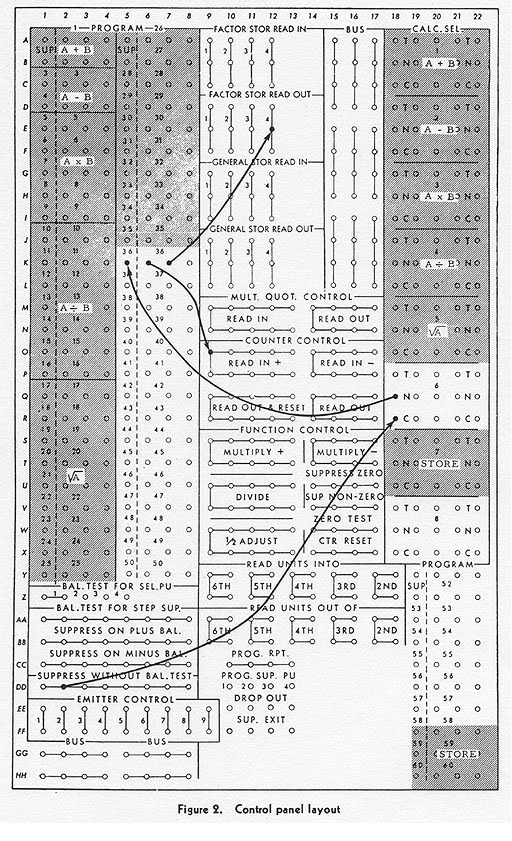
The illustration at the top of this Post is the control board for programming an IBM 604 Card-processing Electronic Calculator. Once upon a time I could have wired this thing up to do varied tricks.

Working Philadelphia


After six weeks of school I had a tentative skill and a modicum of city sophistication (HA!). I was later to learn I still had too much country bumpkin trust (which isn't all that bad to have) and naivete about employment agencies. (We'll come back to that in another Post.)

What I still didn't have was a job.

One day the phone rang, and when you are job hunting you always answer the phone. It was a friend from high school. He and I had collaborated in both writing and performing and sometimes socialized in the teen world beyond the classroom. He wanted a favor.

He was job hunting, too, and wanted to be a telephone linesman, but had to go to Philadelphia to take some qualification tests. He had never been to the big city, but knew I had and wanted me to go with him. Well, my calendar wasn't completely full...wait, oh yeah, my calendar was pretty much empty, of course I'd go.

I don't remember exactly, but I think the telephone company building was somewhere around 15th and Chestnut. It seemed futuristic when we entered, a lot of glass, a long bright waiting area to anguish in while fretting over the coming ordeal. I had no desire to be a linesman. With my fear of heights shimming up telephone poles wasn't a good fit, but as long as I was there I might as well take the tests. It was something to do while waiting for my friend.

There were two to take. One to see what your electronic aptitude was and one to test your mechanical attributes. I passed the electronic test just fine. It must have been my electric trains. Every year I had built an elaborate platform layout for my trains. I didn't just plug them in and run the transformer, I build a main control board and wired up all my little Plasticville buildings with lights that I could bring on in stages. Overhead I hung a thin sheet of plywood drilled with pinholes and behind the holes I strung more lights. My switches allowed me to simulate day and night along with the gradual rising and setting sun and the appearance of stars in the night sky. Perhaps that and the TAB training gave me enough basics of electronics to pass that test.

Not so well in the mechanical test. I had nothing to fall back on there. The only thing I learned in school     shop had been to count my fingers when I left.

Unfortunately my friend failed both. It made for a morose trip home. I don't know what happened to my friend. Actually, I know what happened, I just don't know why. He became, I've heard, a reclusive alcoholic and he died in his early thirties. Sorry I couldn't have done more than just take you to those tests, my friend.

Another time the phone rang and it was the agency. They had an opportunity in Philadelphia with a major company. The job was as a TAB Operator in the Data Processing Department, was I interested? Why ask? Wasn't that the description of my one educational highlight I had listed on their file card? I was off to Lady Philly again.

The building was located at 260 South Broad Street. It towered up 21 stories. I had another elevator ride, but in this one I was on my own. This was the big time, a company so cutting edge they had automatic lifts where you selected your own destination from a panel of lit buttons. The decision to shut or open the door and go or stop was totally up to weight sensors and electronic switches. It was a smoother, faster ride than that one at the TAB school and instead of groans, creeks and stomach rumbles all you heard was a whooshing sound. On reaching a floor a gentle "ding" let you know,

I was given a battery of tests at Personnel, back in a time when we were still "persons" and not "human resources" sounding akin to a plug-in component on the assembly line. The telephone company had two tests, here there must have been ten, motor skills, logic, mental agility and mental depravity, aptitude and attitude, whether you took your egg yolks hard or over easy, not to mention a lot of questions about race and creed and genders that are illegal to ask today.

After the wait for scoring, I was called to a little room by a lady who held my fate in her hands. She had good news, bad news and good news. I had passed all the tests, indeed had done exceptionally well. However, I was applying for a position as a TAB Operator and the lowest such level in the Data Processing Department was a Grade 6. It was company policy not to hire people at any position above an entry grade. Generally this meant men began as Grade 3s in the Mailroom and woman started as Grade 2 Messengers. (See how times have changed, sometimes for the better?  This is why tyrannical governments don't like keeping we old people around. We can remember what once was.)

But, she continued, I had done so well in the tests, rather than starting as a Mail Clerk sorting bails of envelopes and toting barges of correspondence all day, perhaps I would be interested in a Grade 3  Junior Clerk position in Sales Accounting. Would I? Perhaps? I practically sang, Yes. Thus I began a nearly ten year stint with the Atlantic Refining Company later the Atlantic Richfield Corporation (aka ARCo) and by then well up in the Fortune Top 50 (not just the 500, the 50).

I'm not going to spend time discussing my jobs, which is not what these Posts are about. These are about my affair with the Quaker City. I'll save my struggles, successes and sufferings working for The Man for another time. I will tell instead about another love affair I owe to joining Atlantic.

I began at Atlantic late in 1959 and almost immediately met this cute little Irish Lass named Pat.  She was a twinkling delight, a pretty smile and blazing red hair. She wasn't five feet tall. She worked in the Credit Department on the same floor as I, the sixteenth. We kept meeting each other at closing time hoping for an unfilled elevator to ever stop at our floor so we could leave. As shy a person as I was, she must have struck up most of the conversations, but at sometime while somewhere between floors I mustered up the courage to ask her out.

We became a regular thing. We really liked each other and by the end of spring had become serious indeed. Serious enough it showed, because one morning she met me as I arrived at work with tears streaming down her cheeks.

"We can't see each other anymore," was her greeting. (Strike up the Soap opera organ music here, please.)

"Why?"

"My parents say we can't because" (low ominous cord)  "you're not Catholic," and with that she dashed away into the Ladies Room.

I certainly wasn't Catholic. I wasn't much of anything. I would have said I was a Methodist if someone pressed me on my religion, but I didn't go to church anymore, didn't pray, didn't read the Bible and more often than not would snarl at anyone trying to foist religion upon me.

Pat and I hardly ever spoke to each other after that morning. We might nod politely in passing, but she was obedient to her parents wishes despite the true heartbreak she felt that day. I admit I felt betrayed and was angry. I felt it was a silly reason for a breakup. She and I were in love and I felt she should have defied her folks and stuck with me. But technically we were both still children under our parents control. Remember what I said last Post, you were not legally an adult until age 21 in those days, and we were but 19.

As I stood stunned on the spot, this tall girl came out of the Ladies Room and approached me. She asked if I was all right. I said yes, though my body and expression was yelling something else. I then stomped off to my job.

I had passed that tall girl in the hall everyday. She also worked in Credit with Pat. We had always said hello in passing, but what I didn't know was she was telling people I was the most stuck up guy in the world. Recall how I told you I was a low talker? She would say hello and I would say hello, but she never heard me. She thought I just ignored her, yet she kept giving me her friendly hello anyway, and despite me being "the most stuck up guy in the world", who probably deserved to be dumped by that sweetheart Pat, she still showed kindness and concern that morning; very odd.

As I waited for an elevator that evening at one end of the corridor while Pat waited at the other, I discovered this tall girl standing right beside me. I am six foot, she stood eye to eye with me. We entered the same car, pressed close by the crowd that jammed in before it got away. We rode down together and on the sidewalk outside turned in the same direction, so we walked along and began to chat. Several blocks down, she went through the subway entrance between Walnut and Chestnut Streets and I continued on to the train terminal.

This ritual continued on each day at quitting time. I'm not certain how many days it took, but one rainy afternoon we walked the route underground in the subway concourse. At the platform I paused as she started for the turnstile and blurted, "Would'chaliketogotothemoviesSaturdaynight?"

I figured if she said, "yes", fine, but if she said "no" then she could go right through the turnstile and I could continue on and save us both a lot of embarrassment.

What did she answer? I'll put it this way. I'll have been married to that tall girl for 49 years come this September.

That's a lot longer than I lasted at ARCo. I left short five months of ten years. Maybe I should have held out those last few months. Ten years would have vested me for a pension, but hey, life's about living not pensions. I'd went about as far as I could at Atlantic. I mean that in terms of job level. If I had stayed I would have went very far indeed, for in a few years ARCo up and moved their headquarters out of Philadelphia to Los Angeles. I've been to the plaza where they went and would have hated it there, no place to take long walks.

So I left. I was moving into a new life. I was taking a risk.

Next Time: Psychedelphia - Hip, Hip, Hippy!

Psychedelphia: Hip, Hip, Hippie!


Things began to change in the 'sixties, both in society and in my life. Our married life began as an idealistic stereotype out of a 'fifties sitcom, some laughs, a few tears and mostly tranquility.

I was 2o, she was 19. We bought a house halfway between our families, a four-bedroom Cape Cod sitting on the crest of a hill. 

We had a new 1960 Studebaker Lark.

We had money to eat out at a "good" restaurant if we wanted, take a vacation trip each year and pay all our bills on time.

It wasn't because we were well-to-do. Neither of us had come from more than blue-collar lower middle class homes. Our families hadn't given us money to start married life on, beyond her dad paying for the wedding and mine giving us some living room furniture. No telegram had come announcing an unknown rich uncle had died and left us his fortune. I had a high school diploma and a certificate from a TAB Operator School that qualified me for a job I was never to actually have. She had a high school diploma and an Associate Degree in Secretarial Skills from Peirce College (now University). She was a former teenage model, I was a former jack-of-all-unskilled-labor-writer-wannabe.

But we both worked at Atlantic Refining Company in Philadelphia at above average pay for the times. I was making $64 dollars a week when we married and she made $68. That's right, she made more than me. She had started at Atlantic right out of High School. It had taken me half a year to get there. Even though she had to start as a Grade 2, one level below where I began, she was now one Grade above me. As two single "minors" living with our parents, we had saved enough to have the $3,000 needed for the 20% down payment and settlement costs on that $11,000 house. (Can hardly buy a low-end new car for that these days.) We bought a green one.

Together we made $572 a month before taxes, which were relatively low in those times. Our mortgage, including interest and insurance was $98 a month. The car payment was around $55 a month, but for only 24 months. Our utilities bills came to $20 a month. A meal for two at a fine restaurant, including cocktails, was $12. Our monthly round trip train fares to Philadelphia were around $30 each. We had no credit cards, other than my Atlantic Gas Card, and no other loans beyond house and car. You do the math. Yeah, you pay those major expenses and you're left with just over $200 a month for groceries, gas for the car (at 24 cents a gallon) and entertainment. The majority of that money left could be used for entertainment if we wished. That is why we could take vacations. Our Honeymoon had been a ten-day trip through New England, Canada and New York State. We started on the trip with $500 in my wallet and came home with around $150, and we had stayed in nice motels, eaten at the better restaurants and visited a lot of tourist attractions.

Don't think we ignored savings. When I got married I had told a friend my plans and they included having $10,000 in the bank by the time I was thirty. That was considered a lot of money then.  Atlantic had something called the Credit Plan and I joined it the day I was hired. They automatically deducted a percentage of your pay and invested it in the Credit Plan and they put in fifty cents for every dollar you did. You had a choice of how it was invested, either at a set interest rate or in the purchase of Atlantic Stock. I choose the stock, probably one of the smartest ignorant choices I ever made in my life. When Atlantic merged with Richfield and became ARCo, the stock took off and doubled and doubled and doubled again. By age 27 I had $15,000 worth of stock.

But we didn't have the house anymore and at age 30 I didn't have $15,000 in stock anymore nor did I have $10,000 in the bank. I had zip, zero, nana. And a lot of bad experiences in my memory bank.

What happens when 52% of your income suddenly is gone, but your expenses haven't materially decreased? Something has to give, that's what. 

My wife lost her job. My wife got pregnant. My wife had a still birth -- at home -- alone. (I've told this story in earlier posts, check out Best Days in the labels. Best Days: Oasis in the Valley of Death)  We put the house up for sale. We had black friends. My wife's best friends were an inner-racial couple. Our friends visited. We got threats. Someone was going to break all our windows, do other things, worse things. The real estate market was in a slump. We finally sold the house at a lost. We moved in with her father. We bought an iguana. (Read "Ian") She took a job at a nearby hospital.  She got pregnant. She fell on the sidewalk of the local political party ward healer who hadn't shoveled as the township ordinance dictated. I complained to the township authorities. The ward healer called me a liar. I complained even more when my parents visited and almost had an accident because of a missing stop sign that had never been replaced. The ward healer threatened to punch me in the nose.  My wife's family started getting threatening calls if I didn't shut up. They begged me to, so I shut up. The threats were that serious and would have happened. My wife lost the baby. We bought a VW Beetle. Her father was spying on us and searching our room when we weren't there. We bought a hamster to keep the iguana company. She had an affair with an orderly at the hospital. We separated. I moved back with my parents. I dated a couple other women. I went on a ski trip with one.  I quit my job at ARCo and lived off the stock sale. I wrote a novel. I took a dollar an hour job with a chewing gum company working 20 hours a week. I slung wads. I welded bubblegum. I came home covered in powered sugar. I wanted my wife back. We made a kind of peace. The guy she had the affair with began stalking her. I quit the gum factory. We tried to seek religion, but felt unwelcome at mainstream churches. We tried to join the Catholic Church but the night we were to meet with the Priest he stood us up and we said forget it. We tried non-mainstream churches, but all they wanted to do was protest the war. We tried the Ethical Society and found it silly. I got into Satanism, then Buddhism and finally Atheism. She had a fight with her father. 

And yatta-yatta-yatta we moved to Philadelphia and became hippies. 


Our new home was an old apartment building in West Philadelphia, in what they called University City. It was eclectic to say the least. Tight behind it was a dorm for the Philadelphia College of Pharmacy. They partied a lot. We would look out our window into the wall of the dormitory. In our building were some students from the University of Pennsylvania and Drexel living off campus, but it wasn't exclusively students. There was a prostitute plying her trade in the apartment above us, drug-addled hippies in a crash pad down the hall, a couple with a Saint Bernard and Black Panthers meeting in the lobby. 


My wife got a job as a Secretary at the University of Pennsylvania, and I spent my time writing or studying. [And the politicians tried to take my voting rights away.] By this time I had somewhat established myself as a writer, although I wasn't making a life-supporting wage doing it. I had also discovered a few years earlier there were alternative ways to go to college and I was enrolled as a Sociology Major at Temple University, going to classes in the evening two or three times a week. 

Although working at a large corporation through the 'sixties, we had been gradually embracing a more Bohemian lifestyle away from the office. My hair kept getting longer. My boss told me I looked like a "Beatnik". Our friends were a group of wannabes like us, writers, poets, musicians, actors and artists. We used to meet many nights in the basement of a South Philly house to discuss politics, civil rights, Vietnam and the great art works we would one day do while downing pitchers of Screwdrivers amidst a constant cloud of stagnating smoke. Now living in the city, with me not tied to a 9 to 5 job we spent more time hobnobbing in the Hippy culture, hanging about the fountains of Rittenhouse Square evenings, strolling the psychedelic shops on West Lombard and South Street, attending folk concerts at the Trauma with Warlock Bikers and and potheads, the Mainpoint on the Main Line with the suburban pretenders or at the Kaleidoscope in Conshohochen with its coed restrooms. When we weren't "hangin'" we were protesting or arguing with preachers over the existence of God or engaging in social activism ( Earth Day Activity: Pollution Trail ) .


I didn't stay unemployed for long. Between paying for college, that VW, the rent and going to those coffee houses it didn't take long to see an end to that Atlantic Stock money. I went to work for a publisher, managing a circulation department and writing book reviews for one of their magazines ( Review: John Neufeld's "Edgar Allan" )


And in all this, I expanded my love of Philly. I walked a lot to where I went. I walked to jobs I held, walked to writing assignments, often walked north to my college classes and just walked around to walk around. I had jobs during those years in West Philly, Center City, South Philly and North Philly. I rode the subways and the elevated, the buses and the trollies. And of course I began exploring a lot of the sleazier activities that cities offer and was slipping further away from the fingers of a God I denied existed.


And my wife lost another baby.


But many of these things are for other posts at other times. This series was supposed to be about a love affair with Philadelphia, not about how I began racing down the stairway to Hell while there. So next time some final brighter views of my favorite city.


 To read semi-autobiographical/semi-fictionalized accounts of some of the things mentioned in this post go to: Six Stories of the Sixties