Banner photo of Larry Eugene Meredith, Ronald Tipton and Patrick Flynn, 2017.

The good times are memories
In the drinking of elder men...

-- Larry E.
Time II
Showing posts with label Rock 'n' Roll. Show all posts

Sunday, April 17, 2016

TV and Rock 'n' Roll, the Great Retreat from Reality

My grandfather had bought the family’s first TV in 1950. It was such a novelty at that time I would get up at six o’clock in the morning and watch the test pattern. Television did not broadcast around the clock. It went off overnight. At six o’clock it would begin its day. There would be snow on the screen before that hour. Then this pattern of varied lines of different thickness appeared for a few minutes, followed by the playing of the National Anthem with a picture of the flag waving in the wind. Each station, all three of them (The first three major networks were NBC, CBS and Dumont, but by 1948 ABC had replaced Dumont) did this. One channel followed the Anthem with a show called, “Thought for Today”. This featured a Priest or Pastor giving a brief “thought” on some Bible verse. All this was in glorious black and white. (Although the earliest coast-to-coast TV broadcast in color had occurred on New Year’s day in 1954 (Rose Bowl Parade), the cost of sets was pretty prohibitive for several years. Very, very few homes had a color TV before 1963.

In those early days we watched everything. We watched a lot of roller derby and wrestling. My parents took it very seriously, especially my Grandmother. She would get so mad at the referees when a Villain pulled something from his shorts and rubbed it in the Baby Face’s eyes that she was ready to climb in the ring and show ‘em what for! My family’s favorite was Argentina Rocca, but mine was Ricki Starr. (left)
Ricki's shtick was ballet. He wore ballet slippers and would do pirouettes and leaps about ring to warm up. His wrestling moves were performed with the grace (pretty much) of dance moves and he would befuddle his opponents by glittering out of their grip or leaping away from there grasp. I thought he wsa hilarious.

Wrestling must have been easy to broadcast because there was a lot of it on. One of the first big TV celebrities was a wrestler known as Gorgeous George. He was maybe the first to come out in dyed blond curls and fancy robes, the Liverace of the Wrestling Ring. He was also a Heel and everyone was supposed to hate him. (Hmm, think Donald Trump in wrestler's tights.) 's
TV shows bloomed like dandelions between 1950 and 1956. It was on all the time in my home. My grandmother and mother (when she wasn’t working) couldn’t miss their “soaps” during the lunch hour. There were four soap operas popular in my boyhood. Their titles together sounded like a plot summary: They “Search for Tomorrow” through “The Secret Storm” until “The Guiding Light” leads them to “The Brighter Day”.

At night my family camped in the living room around the TV like pioneers around the campfire. If my father was home we had to watch what he wanted, which was mostly Westerns. Starting in 1955 Westerns began to dominate the programming, beginning with the best, “Gunsmoke” Eleven Westerns debuted on TV in 1955. (There were a total of 88 over the decade of the 'Fifties.).
My mother and grandmother preferred the variety shows and sitcoms, “Ed Sullivan Show” (Originally called "Toast of the Town"), “Bob Cummins Show”, “I Love Lucy”, “The Honeymooners”, “Your Hit Parade”, “Burns and Allen”, Adventures of Ozzie and Harriett”, “Jimmy Durante Show” “Red Skelton” and “The Jack Benny Show”. They also never missed “Candid Camera”, “What’s My Line?”, “Death Valley Days”, “The Big Story”,“Lawrence Welk” and of course, dum de dum dum, “Dragnet.” My grandmother liked Milton Berle, but my grandfather hated him. Every one lived in suspense week to week to see how contestants would do on “The $64,000 Question”. We didn’t watch “Twenty One”.

My folks didn’t like “Your Show of Shows”, with Sid Caesar and Imogene Coco. My grandmother complained Coco was too silly, but I really think Caesar’s humor went over their heads. It was too intellectual for their tastes. Woody Allen, Mel Brooks, Carl Reiner, Howie Morris, Larry Gelbart and Neil Simon all wrote for that show. It did a lot of dialect humor, which may be something they couldn’t do today due to political correctness, the modern version of McCarthyism.
One of my favorite shows was “Alfred Hitchcock Presents”, something that would influence my writing. I liked “The Cisco Kid”, “Truth or Consequences” and “Annie Oakley”.
I had moved away from “Howdy Doody” and a lot of the children programming I had watched in Grade School. Sometimes I watched “Kukla, Fran and Ollie.” I watched “The Mickey Mouse Club”, but mainly when it had the “Spin and Marty” serials. Everybody always talks about Annette
Funicello, but the Mouseketeer I had my crush on was Darlene Gillespie (pictured left). I couldn’t take my eyes off her. She and her husband went to prison in 1998 for a check-kiting scheme. (Her mugshot on the right.) She doesn’t do so much for me today.

Having lived seventy-five years it is interesting to hear the misinformation about times I have
lived through. This makes me wonder how much of the history taught me was similarly wrong. For instance, if you go to a 1950s themed party or restaurant you will see women wearing Poodle Skirts. These skirts are often referred to as a symbol of the early Rock “n’ Roll era. My wife and I were both teenagers of the beginning Rock “n” Roll era. She lived near Philadelphia and I was in the suburbs and country thirty miles away. Neither of us ever saw anyone wearing a Poodle Skirt. Reason being is that by the early 1950s the Poodle Skirt had peaked and was on its way out. A former actress who became a fashion designer named Juli Lynne Charlot (pictured left) designed the Poodle Skirt in 1948. “Teen” and “Vogue” magazines featured it on the covers in 1950, but by the early fifties it was out of fashion. Poodle Skirts as a symbol of the 1950s is not right. It is more appropriate symbolizing the period 1948-1952 after the Bobby Soxers. It should be associated with Vaughn Monroe and Johnny Ray more than Elvis Presley.

Elvis is another example of a distortion in popular culture. Today commentaries on the 1950s and Rock ‘n’ Roll make it sound as if Presley was the creator of Rock ‘n’ Roll. Elvis Presley didn’t have his first hit record until February 1956 with the song “Heartbreak Hotel” and Rock ‘n’ Roll had a pretty good grip on the music scene by then. Elvis may have become the biggest star of the genre in the late ‘fifties, but people like Bill Haley, Joe Turner and Ike Turner were the true pioneers. There are those who say Presley’s 1954 recording of “It’s All Right, Mama,” was the first Rock ‘n’ Roll song. This is ridiculous. Big Joe Turner had already topped the charts with “Shake, Rattle and Roll” by then. Probably the first recognized record as Rock ‘N’ Roll was “Rocket 88” by Ike Turner released in 1951. (Chess credited
Jackie Brenston and his Delta Cats on the label. The Delta Cats did not exist and Brenton was the Saxophone player for Ike Turner's band. Brenston did do the singing on the record. They may have done this to get White radio airplay. Jackie Brenston was White. Ike Turner was Black.) Gunter Lee Carr had a dance novelty in 1951 called “We’re Gonna Rock.” “Moondog’s Rock ‘n’ Roll Party” began broadcasting on radio in 1951 as well and “Bob Horn’s Bandstand debuted in 1952. Presley can’t even lay claim as the first “White” star of Rock ‘n’ Roll.  Bill Haley’s “Crazy Man, Crazy” had charted in Billboard by 1953.


The other big fallacy perpetuated today about Presley is that his first TV appearance was on the Ed Sullivan Show in September 1956. Sullivan garnered a lot of publicity with that silly ban of not showing Elvis from the waist down and now people associate that with it being Presley’s first TV performance. Presley’s first Television performance was on “Louisiana Hayride”, March 5, 1955. That was a regional TV show, though, not national. Sullivan was not the first national appearance either. 

The first time I ever saw Elvis Presley was on January 27, 1956 on the nationally broadcast “Stage Show”, a TV show produced by Jackie Gleason and starring Jimmy and Tommy Dorsey (picture left). I sat up and took notice. My grandfather took notice as well; he wanted to turn the TV off or maybe throw his shoe through the screen. Presley appeared on national TV shows three more times after that before he ever appeared with Ed Sullivan. He was on The Milton Berle Show twice, once in April and once in June 1956. This gave my grandfather even more to rage about since he also hated Milton Berle. Elvis did his version of “Hound Dog” for the first time on the June Berle show.
Elvis appeared on “The Steve Allen Show” singing “Hound Dog” to a Bassett Hound in July 1956. Allen didn’t think Presley had any talent and played his appearance for laughs.

Sullivan had actually totally banned Presley from his show, but when he saw how popular Elvis was getting he had to relent. He showcased Presley, at least his upper half, in September 1956. He had him on again in October and in January 1957, when he actually “dared” to show Presley had a pelvis.


Stuart’s plan’s for a Rock “n” Roll band may have ended on a sour note, but he and I weren’t through with music by a long shot, as we'll see in the next chapter of my life.

Thursday, April 14, 2016

Music Calms My Savage Beast or Breast or Whatever...

Before TV we had records. There was a large console radio/record player belonging to my parents that played 78 RPM records. Music provided another world that I could escape to from the day after day depression I was beginning to feel. There is a saying that music has charms to soothe a savage breast, which I thought was savage beast. Apparently I am not alone in my mistake, this seems to be a common misquote, just as the saying is often attributed to either Shakespeare or The Bible.  You know, when in doubt of a source Shakespeare and The Bible are always good guesses. This particular quote is from neither, I fear, but is the first line from a play by William Congreve titled, The Mourning Bride.
Some of the guys who terrorized my streets at times may have been savage beasts, and music  may have given me respite from them, but it also was an alternative to the savage breast if you count those imaginary pirate ladies that haunted my imagination. Often, since much of my time at home was alone, I simply plopped down on the floor before the great music console and listened to my parent’s records, an eclectic collection.
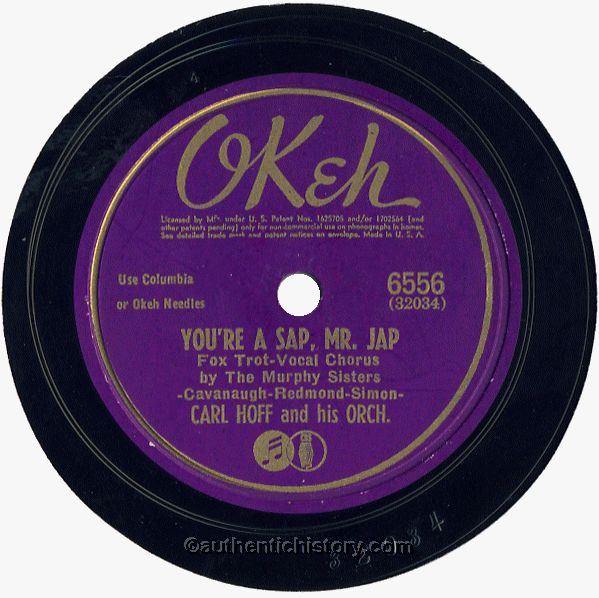
It ranged from my dad’s varied Hillbilly singers, such as Montana Slim (Real name: Wilf Carter), Patsy Cline and Hank Williams, to recordings of Horace Hite and his Californians, Fred Waring and the Pennsylvanians, Kay Kyser, Woody Herman, Ella Fitzgerald, Paul Whitman, Jo Stafford and Bing Crosby. Think about it, from Bill Monroe and the Blue Grass Boys to Vaughn Monroe crooning “Ballerina”. Not to mention such hits as “We Gotta Put Shoes on Willy” and “You’re a Sap, Mr. Jap”. You can throw into this mix a guy that quickly became one of my favorites, Spike Jones & his City Slickers (pictured).

I received a portable record player between Grade School and Junior High. What they considered portable then was often heavy enough to need a hand truck to move.

The size of the player was not the only difference between my player and my parent’s console. Mine would play 78 and 45-RPM records. A 45 was about half the size of a 78, except for the hole that was many times larger. The record player had a removable spindle to allow for this center hole differential. This also allowed me to own my own records.
I bought a lot of Gateway Record covers of hit songs down at Newbury’s. Gateway was a knockoff record company and their recordings were half the cost of the big name labels like RCA, Decca, Columbia or Okeh (which became Epic Records in 1953). I figured if I liked a song it didn’t matter much who sang it, but I did mix in some name artists when I could afford it.
There was a new sound on the market at this same time. The  songs were mostly covers of older Rhythm ‘n’ Blues songs sung by White bands. The lyrics were sometimes “cleaned up” a bit. This kind of music was really catching on by 1954 and ‘55. Alan Freed, a disc jockey known as Moondog (pictured right) is credited with the term Rock ‘n’ Roll. Freed was the king of the airwaves for a period, but his career plummeted in the Payola Scandals of 1960.

Rock ‘n’ Roll had also taken over afternoon TV. After school I would turn on the TV for a local show out of Philadelphia called “Bandstand” hosted by Bob Horn (pictured left). Horn had a show on radio called “Bob Horn’s Bandstand”. He moved to TV in 1952, replacing movies on Channel 6. At first he showed short films, the grandfathers of music videos. He didn’t like this format. There was another radio show at the same time called the “950 Club” hosted by Joe Grady and Ed Hurst. (Remember those names they will come up again.) The “950 Club”, despite being a radio show, invited teenagers to dance to the music in the studio. Horn stole that idea for his TV show and “Bandstand” became ahit and Horn a area star.

Horn hosted the show from 1952 to 1956. He ran afoul of the law by then. A teenage dancer accused Horn of statutory rape. They never convicted him on this charge, but he was convicted for drunk driving. His DUI got him fired on July 9, 1956. Walter Annenberg, owner of both WFIL and The Philadelphia Inquirer, hired a 30-year old TV host, who looked like he was about 18 years old, named Dick Clark to host the show.

An example of the revamped Rhythm “n’ Blues songs was “Hound  Dog”, a big hit on the R&B Charts in 1952 for Willie Mae “Big Mama” Thornton. The first successful Leiber and Stroller song, it became a big hit again in 1955 when released with slightly altered lyrics by Freddie Bell and the Bellboys. (In 1958 it would again be a hit when done by some southern boy with the odd name of Elvis.)
The musician who really put Rock ‘n’ Roll on the map in the early 1950s, though,  was a guy from Boothwyn, Pennsylvania (not far from where I now live) sporting a strange loop of hair on his forehead. Bill Haley and the Comets (pictured left) had a string of hits, including “Shake, Rattle and Roll”, “Dim, Dim the Lights” and what would become the signature song of the era, “Rock around the Clock”.

Stuart, Ronald and I had been making little recordings of our own at the Farmers’ Market. Stuart said to me one afternoon, “Let’s start our own Rock ‘n’ Roll band.” (Have you notice that Stuart was quite the idea man. I’d say he still is, but we'll wait to many, many years in the future to continue that thought, if we ever get that far.)


I wish I had a picture of our band. We were closer to a Salvation Army Band than any Rock Band you ever saw. There was no guitar in sight. Our drummer was Bill Brookover, who had but one snare drum to beat rhythm upon. Most of the band was brass, Teddy Miller on Trombone, Stuart Meisel on his Baritone and I on Trumpet. Gary Kinzey may have snuck in there on his Saxophone. We practiced in one of the parlors at Stuart’s house and at one point we tried playing back on a plank platform we built in the woods. We didn’t build this for our band; it was all ready there. Perhaps it was the remains from our old lean-to. We were downright awful. We probably scared every squirrel and chipmunk out of Downingtown. Our attempt at Rock fame and fortune did not last for long.
Rock ‘n’ Roll wasn’t completely dominating the charts yet. One of the biggest hits of 1955 came out on October 17. Tennessee singer-comedian-actor Ernie Ford sung it. “Sixteen Tons” stayed at the top of “Billboard” so long the TV show, Hit Parade was running out of ways to present it each week. The song became one of my earliest poem parodies since “The Ballad of Peppy the Pup”. I wrote “Rich Man$ $ixteen Ton$” in ’55.

Some people say a man is made out of mud.
A rich man is made out of money he loves;
Money he loves and dollars and cents --
A wallet that’s thick and a safe that’s strong.

He loads sixteen tons of cash every day.
Sixteen tons and that ain’t hay.
Saint Peter don’t you call him,
‘Cause you all know.
You can’t take it with you,
            So he won’t go!

As much fun as it was fooling around with music with my friends that fall, I still had to face my worse school year to date, Ninth Grade. I think the school photos captured my descent through junior high.
A photographer took class pictures every year in public school. I have my portraits showing my changing features for each grade except those at West Whiteland. West Whiteland is the black hole of my life. The records of those years are gone and the memory erased from my brain. I didn’t even find any photographs among my mother’s collection.
This photograph is sixth grade and I am looking straight on at the camera for the last time. My face is getting the roundness it took on in early puberty.

Seventh Grade was my first year wearing spectacles. I use that older word because glasses made you a spectacle of ridicule in the 1950s. Note how my head is turned and tilted to my left. Here was another setting apart from others. The photographers would no longer take me full face because the glasses lens reflected their lighting.

My face grew gaunt by eighth grade and even my faint smile disappeared. At least the photographer had my head at a less awkward angle. I believe you can see some of my growing inner torment in this picture.

I had been going to Clarence Miller’s Barber Shop since dad forced my first haircut on me as a toddler. I had been to a couple other barbers briefly during grade school. I went to a new young barber who had a shop somewhere on a cross street off of Chestnut near Pepperidge Farm. His name was Tony. It was at the time when the “Teddy Bear” cut was popular. I don’t know why I needed a different barber for that. The barber basically ran his electric clippers all over your head and left you with a layer of fuzz.
The other temporary barber was my grandfather’s idea. He took me to this barber on the West Side. This man’s shop was next to the pool hall and he charged a quarter less than Miller. But I always came back to Clearance.
As Rock ‘n’ Roll took hold of the music scene haircuts changed. There was more variety. I had never been satisfied with the way Miller cut my hair, but as a kid was reluctant to correct my barber. Now I demanded a different cut, one of the new styles appearing on the scene. They called it the “Hollywood”. They cut the top like a “flattop”, even and bristly, but left the sides longer, then swept it up and back. I also left my sideburns longer.
Other kids even razzed me about the sideburns. It isn’t like I had Muttonchops down to my chin, but sideburns were another little different between us; that is, they were weird for about a year until Elvis Presley made a splash and then everyone suddenly had them.
I choose Ping Pong as my club in Ninth. I had never played the game before as far as I know. Ronald was also in that club with me. Whether he choose it because I did or vice versa I don’t know. There were three separate Ping Pong clubs with nearly fifty kids altogether. Near the end of the year they held a Round Robin tournament among the three clubs. I finished fifth.

I was fairly good in any sport requiring a net except Basketball. (Boys didn’t play Hockey, which was strictly a girl’s sport in those days. I probably would not have played Hockey well.) I was good at Volleyball, Badminton and later Tennis.

It may have been a mistake not returning to Audio Visual Aids. Ninth Grade Classes were something I really wished to escape from. They were a horror for me and they were coming soon.