The Grade
school train was coming to the final station. In the fall of 1952 I began Sixth Grade. I
was 11 years old. It may sound as if my life was improving from what I have
written in the last chapters. It might even sound as if I was becoming a leader
and gaining confidence; “I started the
bike racing, I started the Ditching Club”. It was more a matter of timing and coincidence than
confidence. Those things would have come about just by the nature of kids being
kids. Somebody would have started racing bikes, but I happened to be there
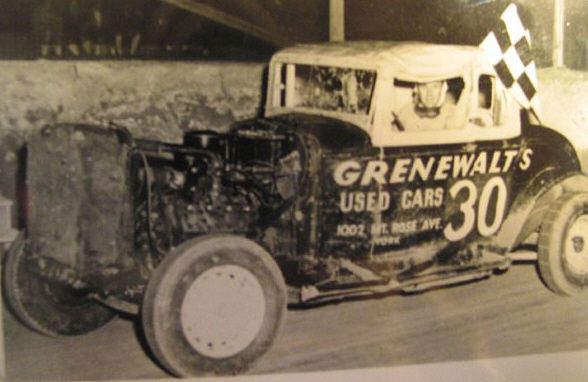
first because I was fortunate enough to be taken to live stock car racing before
anyone else. I had such enthusiasm for these races that it spelled over as I
talked about it with a couple friends (of what few I had) and they thought
racing would be fun to do. It is that way with boys. You give us anything that
moves and we want to see who can move it fastest.
The Ditching Club came because I had seen a Destruction Derby
the same week Gary Kinzey tried to wreck me during a race.
 Gary Kinzey and Michael Myers were among the first to begin
racing with me around the blacktop. Gary’s smaller bike put him at a disadvantage. As several more kids began racing against us, Gary (right, I have no photos of Michael) slipped further back in the pack. We were racing this particular day and I was passing him. He decided he was going to knock me over as I went by. He rammed me with his bike, but he hit my rear wheel. He didn’t realize this was the driving force of a bike. My rear wheel absorbed the shock and its force knocked his front wheel to the side. He lost control and crashed.
Gary Kinzey and Michael Myers were among the first to begin
racing with me around the blacktop. Gary’s smaller bike put him at a disadvantage. As several more kids began racing against us, Gary (right, I have no photos of Michael) slipped further back in the pack. We were racing this particular day and I was passing him. He decided he was going to knock me over as I went by. He rammed me with his bike, but he hit my rear wheel. He didn’t realize this was the driving force of a bike. My rear wheel absorbed the shock and its force knocked his front wheel to the side. He lost control and crashed.
The
Destruction Derby and Gary’s foolish attack clicked together in my mind. I
actually suggested it as a form of duel. It is also in boys to want to play
rough and batter each other around, which was the allure for the others. This
trying to knock each other off bikes became an instant fad.
As a fad it lost its appeal fairly quickly. As guys began to
see the dents and scratches to their bikes and the bruises and abrasions on
their elbows they began to drop out. The racing petered out after that as well;
perhaps it was too tame now. Besides I had begun to spend less time riding
around the school ground as Ronald and I explored the outer limits beyond
Downingtown.
The stock car season was winding down as well. As much as I
enjoyed that activity, it too had become a bone of contention between my father
and I.
Let’s talk about fear. I have many times mentioned being
scared of this or that. I was fearful of the hissing steam engines, I couldn’t
sleep with the shades drawn, I was afraid of getting my foot caught between
railroad tracks and I was frightened by deep water in the swimming holes. I
sound like quite the wimp.
We use a lot of words loosely to convey feelings that aren’t
as intense or true as the words imply. How many times in life to we say we
“love” something? We just love to use the word love. I love “raindrops on
roses”. I love “whiskers on
kittens”. I love green Jell-O. “I love Napalm in the morning.” I loved this
song, that song, every other song.
We don’t love these things; we like them.
How about expressions of fright?
“I was scared to death by that sudden thunderclap!”
Really? What we mean is the thunder startled us.
When I came to a railroad track I wasn’t afraid to cross over
it because of what I saw in that “Dick Tracy vs. Cueball” film. I was simply
careful where I stepped. I wasn’t as afraid of the deep water as I was reacting
to my father’s approach to teaching me how to swim.
 I wasn’t really fearful of steam engines. I didn’t run for my
life when one was sitting across
the sidewalk downtown. If I could walk around it to go on my way, I did. When
my grandfather offered me the ride in the train cab I didn’t refuse because I was scared of the engine or the steam. It was because I had to climb that little ladder to up above my head. I was truly afraid of height.
I wasn’t really fearful of steam engines. I didn’t run for my
life when one was sitting across
the sidewalk downtown. If I could walk around it to go on my way, I did. When
my grandfather offered me the ride in the train cab I didn’t refuse because I was scared of the engine or the steam. It was because I had to climb that little ladder to up above my head. I was truly afraid of height.
There are two types of fear, the rational and the irrational.
Rational fear is a built in defense mechanism. Fear warns us of danger or risk.
We need some fears or we will become reckless in situations that could harm us.
A fear of deep water for a person who can’t swim is natural. One knows they
could drown. Fear of height for the average person is also normal. Being
careless on the edge of a cliff can lead to falling to your death. Normal,
rational fear may make us cautious, but does not totally interfere with doing
things or bring our life to a halt in certain situations.
Most
of my childhood fears were normal and I got over them or didn’t let them
control me. My fear of height was a phobia. It was irrational and debilitating.
It caused me to miss opportunities, to be miserable where others had fun, to
avoid some everyday situations and to bring insult and teasing my way. I don’t
know what caused it; I just had it.

My dad had no qualms about heights what so ever. My father
did not view mine as an anxiety disorder. He saw it as a weakness. I was
just being a sissy. If I wasn’t such a pantywaist I’d climb up that ladder and
find out there was nothing to be afraid of.
 He even used my fear as a threat. There were these water tank
towersalong the road near Philadelphia. My dad always threatened to take me up on those towers and leave me there until I got over my fear of height. If my father did ask me to ride with him I was reluctant because I really believed he might do that.
He even used my fear as a threat. There were these water tank
towersalong the road near Philadelphia. My dad always threatened to take me up on those towers and leave me there until I got over my fear of height. If my father did ask me to ride with him I was reluctant because I really believed he might do that.
How did this cause more agitation between my dad and I at the
stock car races?

The
racetracks had bleachers, not stadiums. The seats were wooden planks bolted on
the top of a metal frame. One plank was what you sat upon and a second plank
was where you put your feet. If you moved your foot back a few inches or
forward too far it dangled over open space. There was row after row of this configuration. You could see down between the rows to the ground below.
I refused to go any higher than the third or fourth row.
Frankly, I couldn’t. When I did I broke into a cold sweat, my heart raced, my
body shook and I could not think of anything but how high I was. If I had a
seat any higher than the fourth row I would sit like a frozen statue, afraid to
move, clutching the board edge with both hands with my knuckles white. I was
even scared to breath hard, but so scared I couldn’t stop breathing hard. It is
difficult to explain to anyone who has never had a phobia how terrifying and
paralyzing the fear is.
 My
father liked to sit up at the very top. He was angry with me for not wanting to
go higher. It ended up with me sitting alone while my parents sat where my dad wished. This would have been fine if he could have understood my anguish and let it be what it was. But he could never let it go. He would always be on my case about being a fraidy cat or “a worrywart like your mother.” He would say things loudly when we arrived, such as, “Well, Gertrude, you gonna sit with the men or the girls today?”
My
father liked to sit up at the very top. He was angry with me for not wanting to
go higher. It ended up with me sitting alone while my parents sat where my dad wished. This would have been fine if he could have understood my anguish and let it be what it was. But he could never let it go. He would always be on my case about being a fraidy cat or “a worrywart like your mother.” He would say things loudly when we arrived, such as, “Well, Gertrude, you gonna sit with the men or the girls today?”
Summer ended.
Going into Sixth Grade was going back into the lion’s den.
The claws of ridicule were as sharp as ever.

There was the telling comment Mrs. Yost wrote on my report
card at the end of the first marking period, “Needs more appreciation.”
I might have needed it, but I wasn’t going to get it.
However, there were two things that probably saved me that
year, two things I enjoyed and looked forward to coming to school for.
 Mrs. Yost assigned yearlong responsibilities to some of us
that first week. One such was Safety
Patrol. Safety Patrol members acted as hall monitors and as crossing guards.
They wore a white belt and strap with a badge to show their authority. Bonnie
Walton and the two Mary Janes, Chudleigh and Sabellico, were members. So were
Denny Myers and Jack Swarner. Now Denny and Jack were officially sanctioned
bullies.
Mrs. Yost assigned yearlong responsibilities to some of us
that first week. One such was Safety
Patrol. Safety Patrol members acted as hall monitors and as crossing guards.
They wore a white belt and strap with a badge to show their authority. Bonnie
Walton and the two Mary Janes, Chudleigh and Sabellico, were members. So were
Denny Myers and Jack Swarner. Now Denny and Jack were officially sanctioned
bullies.
Stuart Meisel and I were the Flag Monitors. This teaming up
led to “The Daily Star”.
I admit I was somewhat taken aback and a bit hurt when I read
Stuart’s account of “The Daily Star” in his autobiography, My Story:
“In Sixth
Grade, I decided to print a school newspaper. I was given access to the school
mimeograph machine. This was BX time. [He footnoted this as Before
Xerox.] Using
a mimeo required you to type onto a special type of paper called a master.
Then, you would lace it on some totally yucky (or depending upon your point of
view, totally cool) jello-like [sic]
substance. Then you hand-cranked the machine, and voila, there is your
mimeographed page. From a friend Larry Meredith (more about him later), I was
able to get one of the items that I wrote in my (using the term loosely)
“newspaper”. So, here it is --
Ya-Ha-Whoey.
“YA-HA-WHOEY
“(By Stuart R. G. Meisel)”
[And he then wrote out the complete lyrics
of the song.]
–Page 25, My Story by
Stuart G. Meisel, 2004.
Since these two things, “The Daily Star” and “Ya-Ha-Whoey”,
occurred over 60 years ago I will chalk it up to memory failure, but I share
credit on both these endeavors and I have always credited Stuart as a co-writer
when and wherever I have referenced the newspaper or the poem. Here is my version.
Everyday
when we retrieved the flag to hang or brought it in at end of day we entered
the school office. Something in the office caught our eye. It was a mimeograph
machine. People used a mimeograph to make duplicates before the invention of
the photocopier. I think it was Stuart who suggested it after seeing that
machine, but we decided to publish a
newspaper.
 We approached Mrs.
Yost (pictured right), who was also the principal of East Ward, with the idea. We wanted to publish a school newspaper, print it with the mimeograph and sell it to the other students. Surprisingly, she agreed to let us. She taught us how to use the machine and told us when we could have access to it.
We approached Mrs.
Yost (pictured right), who was also the principal of East Ward, with the idea. We wanted to publish a school newspaper, print it with the mimeograph and sell it to the other students. Surprisingly, she agreed to let us. She taught us how to use the machine and told us when we could have access to it.
Stuart
and I named our newspaper “The Daily Star”, even though we only published once
a week.

We wrote about things going on at school, told some jokes and
did a crossword puzzle. Stuart got annoyed because his mother wanted us to
print these little anecdotes from the Reader’s Digest. We wanted strictly
original material done by us. This was my first writing collaboration with
Stuart; it would not be my last.
 In
fact, another collaboration was the aforementioned “Ya-Ha-Whoey” and it was not
for and never appeared in “The Daily Star”. It was written more than a year after we left Sixth Grade. One night I was at Stuart’s house and we were watching “Disneyland” on TV. Mr. Meisel was sitting in a chair wearing his usual smoking jacket. Stuart and I were lying on the floor. The show that night was a series of “Goofy” cartoons. Goofy would often yell, “Ya-ha-whoey” if he went down a ski-jump or fell over a cliff.
In
fact, another collaboration was the aforementioned “Ya-Ha-Whoey” and it was not
for and never appeared in “The Daily Star”. It was written more than a year after we left Sixth Grade. One night I was at Stuart’s house and we were watching “Disneyland” on TV. Mr. Meisel was sitting in a chair wearing his usual smoking jacket. Stuart and I were lying on the floor. The show that night was a series of “Goofy” cartoons. Goofy would often yell, “Ya-ha-whoey” if he went down a ski-jump or fell over a cliff.
 I admit, I was much more interested in writing for “The Daily
Star” than doing my daily math
homework. My marks were suffering. I had been throughout Grade School an A Minus or B Plus student, although my trend was downward. Now I was barely floating about C level. I was also getting unsatisfactory in “self-confidence”, “takes group responsibility”, “starts and completes work on time”, and “tries to do his best”, as well as the perennial “works neatly”.
I admit, I was much more interested in writing for “The Daily
Star” than doing my daily math
homework. My marks were suffering. I had been throughout Grade School an A Minus or B Plus student, although my trend was downward. Now I was barely floating about C level. I was also getting unsatisfactory in “self-confidence”, “takes group responsibility”, “starts and completes work on time”, and “tries to do his best”, as well as the perennial “works neatly”.
The school gave eye tests. An ophthalmologist visited the
school one day a year and performed these. I couldn’t get as far down the chart
as most. The school informed my parents I needed glasses, but of course they
did nothing about it that year. Spectacles cost money.
I finished Sixth Grade with a 2.64 average, just barely
enough for a B minus.
My grades were not going to improve in Junior High, even with
glasses. Before I left Sixth Grade I got an introduction to what Junior High
would be like, and it was not encouraging.
The lyrics of "Ya-Ha-Whoey"
by Stuart G. Meisel & Larry E. Meredith,
Downingtown, Pennsylvania, 1954-55
 Stuart & Larry, 2011

The lyrics of "Ya-Ha-Whoey"
by Stuart G. Meisel & Larry E. Meredith,
Downingtown, Pennsylvania, 1954-55
Grandpa was driving down the
mountain on an icy day,
When his car hit the curve,
it began to sway.
Off of the road it found its
way
And as he went over you
could hear him say:
“Ya-ha-whoey!
Ya-ha-ya-ha-whoey! Ya-ha-ya-ha-whoey!”
And they lay him away that
day.
As up the first hill the
scenic started to creep,
A lady stood up to see how
steep.
When she saw she began to
leap
And as she fell out you
could hear her speak:
“Ya-ha-whoey!
Ya-ha-ya-ha-whoey! Ya-ha-ya-ha-whoey!”
And they lay her away that
week.
A man went up into a tower
that’s tall.
He took a wrong turn and
started to fall.
Though he had a voice what’s
small,
As he went you could hear
his call:
“Ya-ha-whoey!
Ya-ha-ya-ha-whoey! Ya-ha-ya-ha-whoey!”
And they laid him away in a
hole.
A man went up to tie a
noose.
He did not know the ladder
was loose
And as he fell from his
roost,
You heard him call like a
stricken moose:
“Ya-ha-whoey!
Ya-ha-ya-ha-whoey! Ya-ha-ya-ha-whoey!”
And six men gave him a
boost.
A man went up to a scaffold
real high,
A way to roofs simplify.
Got too near the edge, sweet
old guy,
And as he slipped, you could
hear his cry:
“Ya-ha-whoey!
Ya-ha-ya-ha-whoey! Ya-ha-ya-ha-whoey!”
And they laid him away to
lie.

 Stuart & Larry, 2011