Banner photo of Larry Eugene Meredith, Ronald Tipton and Patrick Flynn, 2017.

The good times are memories
In the drinking of elder men...

-- Larry E.
Time II
Showing posts with label Hippies. Show all posts

Wednesday, August 17, 2016

University City Universe


By March's end I was working at Philadelphia Gum and doing a lot of freelance writing of one kind or another. Loop was departed, but Eugene Lawrence and the real me still lingered on growing callous on the tips of our hunt "n" peck fingers. Eugene was starting to recede. I was surfacing from the underground like a worm seeking a brighter day. I was living sort of, more or less, at the Bucktown home of my parents, and crashing different heres and theres when not.
Romantically, technically,  I was squiring three women about town, so very Hugh Hefner of me.  My little harem consisted of Mary Ann DiPiti, Janice Griffin and clandestinely, my wife. I was spending more and more time with Lois trying to convince her we needed to go back together. My only condition was we couldn’t continue to live at her father’s.
I went home on the evening of April 4 and told the family I had rented an apartment in Philadelphia. This terrorized my mother, who viewed the big city as the most dangerous place on earth. It had been scary enough that I worked in a metropolis for ten years, but living there was certain death. I spent all the 6th moving things, kitchen stuff and books, out of my parents’ attic and taking them to the new apartment anyway. Lois was along to help in the evening.

On April 14 Lois spent the evening with me at my folks’ watching the Academy Awards on TV. At 2:00 AM her grandmother died. She was buried on the 16th.
Zoe Schnell Raab was Lois’ maternal grandmother. After Lois’ mother died, Zoe became a substitute mother and her protector. Lois was only 18 at the time. She moved into the Cobbs Street house, telling her other daughters, “I’m not leaving that girl in the house alone with Harry.”
Zoe was already aging when Lois was born. She was 60. So by the time Dorothy Raab Heaney died, Zoe was 78. Her husband, Lois’ grandfather, Maurice Penrose Raab died a month and a half after Lois was born, so Lois never knew her maternal grandfather and Zoe was a widow a long time. Zoe was 87 when she passed away.

Both of Lois’ paternal grandparents had died before 1950 so her memory of them is fairly short. Her grandfather shared the same name as her father. He was the son of an Irish immigrant who settled in and became a policeman in Brooklyn. How the senior Harry Heaney met his wife remains a mystery? She was a Native American, a member of the Creek tribe. One of the problems is the family wouldn’t talk about this fact. They were prejudice against Native Americans and ashamed one married into the family.
Actually, Emma wasn't the only Native American in Lois' family tree. There was also Lota Lowe Kent down in Texas.

We had a big fight with Lois’ father over renting the Philadelphia apartment. He didn’t like the neighborhood; but he was a man of many dislikes. He threatened to disown her if she went there with me. He also accused us of stealing from him, which was patently untrue. Lois on the other hand said he had been spying on us, sneaking into our room and going through our drawers, where he might have seen some interesting photographs of us. She had remained adamant about his snooping, although I never thought he was doing such a thing. At any rate, we left on not the best terms.
We moved onto Chester Avenue between 42nd and 43rd Streets, a block above Clark Park and the statue of Charles Dickens. This was within an area known collectively as University City. The campuses of the University of Pennsylvania, Drexel University and the University of the Sciences were all nearby.  Dorms for the Philadelphia College of Pharmacy (part of the University of the Sciences) was just around the corner from us. Most of the block were apartment building on our side of the avenue and a lot of students lived in them.

We moved into the center of the block in a building called The Commodore. It was owned by an elderly lady, who did most of her business dealings through the Superintendent, a man originally from Jamaica. The lease was not overly restricted, but it did contain a clause stating “No pets”.
We owned a hamster and an iguana.

We decided we could sneak our pets into the apartment at midnight when no one was around. We had just come up the steps into the hallway. I was carrying the larger cage containing Ian and Lois had the smaller with our hamster. We had overs over both. It had ben dark and empty on the street and the hallway seemed quiet and deserted in the dimmed down overnight lights along the hall. We sort of tiptoed in and were past the lobby and first apartment door when we heard the Superintendents lilting accent talking to someone and moving our way. We rushed to get our caged animals into our apartment before he came into sight. Fumbling wth the keys while balancing our large burdens, We just made it inside and shut the door as we heard these other people pass by. The Super was helping them move
 “Who moves at midnight,” I asked.
Lois gave me a look. Well, we were.
We set the cages down and I threw off the coverings.
“Where’s Hammy?” asked Lois.
The hamster cage was empty, I mean the wheel was there and the wood shavings, but no hamster. I dashed to the door and threw it open. There sitting in the middle of the hall carpet was Hammy looking up at me. I scooped him up and in.
This was not the first time we lost Hammy. We hadn’t been there very long when Lois discovered the little Houdini had slipped his cage. We frantically searched the apartment without success, and then we heard a scream from other apartment. We both looked at each other.
“There goes Hammy,” we said in unison.
We thought that was it. People would think he was a mouse and stomp him. Three days later I was making myself a sandwich and there came Hammy, skittering out from under the refrigerator. He was a covered in grease, but otherwise unharmed.

Our apartment was not large. The rent was $90 a month. We were on the first floor at about the middle of the building. We had two windows close together, looking out at the wall of the apartment building next door across a narrow alleyway where the trash cans were stored. The entry for opened into the main room. This served as the living room, bedroom, rec room, meeting room and office, and home to Hammy the Hamster and Ian the Iguana. My desk and typewriter were in one corner. A small TV sat on a folding tray in front of the windows.
There was an eat-in kitchen to the left of the entry door, which may have been used by the Victorians. It had just enough space on the side for a small table and two or three chairs. One of our first tasks was cleaning the kitchen, which contained grease and dust left over from the Continental Congress days. Lois then painted the kichen a dark blue with some Pennsylvania Dutch designs upon it. It didn’t help very much.

To the right of the entry door was a wall of glass panels behind which was a large closet. You went through the closet to get to the bathroom, and what a bathroom we had. It was nothing to look at, but it had magic sound abilities, allowing us to listen to every word and movement of our upstairs neighbor, who happened to be a prostitute. Our bathroom was one of the greatest erotic broadcasting booths in Philadelphia. 
So, let’s talk about the occupants. First of all, there was the Superintendent. He turned out to be a pretty friendly fellow. It didn’t take him long to discover we had pets, though. He didn’t say anything about our animals, although, from time to time he threatened to eat Ian. He said they ate Iguana in his country and it tasted like chicken. It seems every exotic meat in the world, whether Iguana or alligator or boa constrictor, tastes like chicken. I somehow have my doubts.
The lease may have said no pets, but the interpretation must have been pretty liberal. There were several beasts in the building, not counting the ones living in the walls. Every day this young couple would come down the stairs from their apartment to walk their enormous St. Bernard.  (The Commodore is now called The Lexington. Ronald and I visited the area late last year and other than the name it hasn’t changed at all, although the neighborhood looks a bit shabbier.)
Now, the prostitute upstairs was not the only one. I never saw her, but boy did I ever hear her, Besides more censorious sound emanating from above, there was the constant tap-tap-tap of her high heels. She apparently had no carpets and she also apparently never took her shoes off. You knew she was home by the parade of tapping across the ceiling (lucky only audible in the bathroom). I don't think she even took her footwear off to provide her special services.
There were at least two more prostitutes plying their trade both on our very floor.  One night I was awaken by a strange sound. I looked at the clock and it was after 2:00 AM, yet out in the hallway I heard this very distinct “Click-click-click”. It went down the hall, then back up, back and forth. I got up and peeked out the peephole and there was the young son of one of the prostitutes riding a Big Wheel up and down. One of the pedals rubbed against the side and was the source of the clicking I had heard. This kid was plopped in the hall whenever mama brought a client home.
One afternoon I came home and another  boy of another trick turner came running out of the doorway just as I got there, almost crashed into me. He went off yelling, “Mama, mama, the cops took daddy away again.” I really don’t know beans about his daddy, never saw the man and don’t know if their was a legal marriage or not.
Other than “working women”, we were generally surrounded by students from the various institutions within walking distance of the address. Most of these I only saw entering or leaving with books under their arms. Most seemed to be female, but there was a young couple down the hall from us and I don’t know if they were students or not. Our hallway went straight so far, then it did a kind of dogleg off the the right and continued on from there. This couple dwelt in the corner of the dogleg. Our hallway could be a hotbed of noises in the night. Besides the kid and his Big Wheel there might be this couple out in the hall. She would be screaming at invisible beings, yelling, “Get them off me, get them off me” and he would be wrestling with her, trying to drag her back to their room. I happened to come in one day and their front door was wide open. There was no furniture inside their apartment except for mattresses strewn wall to wall across the room.
Despite the motley nature of the occupants, I never had any trouble with anyone. I generally felt safe at the Commodore; however, Lois harbored a constant feeling of apprehension. It wasn’t so much our neighbors than the fact we lived on the first floor in easy reach of anyone lurking in that little back alley.
Now there was also a chapter of Black Panthers who held regular meetings in our front lobby. I passed through several times and we always said hello. One day they came to my aid and helped me get my refrigerator up the front steps.
It was an eclectic neighborhood; ideal for a writer.

I had told my parents I rented an apartment back on April 4. I hadn’t mentioned Lois and I were living in it together. I imagine they guessed as much since Lois kept showing up at their place with me. I didn’t tell my parents I had quit my ARCo job and was now making four bucks an hour part time at a Bubble Gum Factory until May 5. That was the same day Lois and I had the big blowout with her father.
Finally, on May 12, Lois began working at the University of Pennsylvania as a secretary to
the two heads of the Chemistry Department, Dr. Donald Fitts and Dr. Hank Hameka. The pay there was much better than what she made at the Title Company, plus now she could walk to work. I forget her exact salary, I think it was around $90 a week, but it was what we were basically living on. I wasn’t making a great deal writing.
My days were fairly routine. Lois would leave for work and I would spend the morning typing out manuscripts. I would break for lunch. Since our cash was growing thin I would go out and wander the nearby streets around the trolley stops. I was looking for dropped change in the gutters and I usually found enough to go buy some lunch at O’Malley’s Grocery on the corner of Baltimore and 42nd Street.
I was having some rouble with the car. Often it would not start without a push. Still we daringly went places in it and took our chances. One night we had been our particularly late and we had a different kind of trouble having nothing to do with the car not starting.  It was somewhere around 2:00 AM and we were headed home. Our route took us through Valley Forge Park. It was extremely lonely there at such a wee hour of the morning and somewhat eerie. One expected ghost riders and the Hound of the Baskervilles to come bounding across the empty fields. I was coming down Route 23 completely alone on the road when from behind came a police car with its lights blinking and its siren breaking the early morning silence. I pulled over on the shoulder and the cop pulled up behind me. He strolled up to my window.
“Do you know how fast you were going?” he asked.
I had no idea. It was a 35 mile an hour zone, but you wouldn’t think it would matter all that much this time of morning. The park was a virtual empty wasteland. “I don’t know,” I said, “maybe 45-50 miles per hour.”
“I clocked you at 90,” he said.
Man, I thought, I don’t think so. I don’t think this Beetle could do 90, especially with the hills in here.
He said, “Just a minute,” and he walked back to his vehicle and got in. I figured he was checking out my license plate or something, but then he suddenly pulled out, swerving around my car and hightailing it down the road. I sat for a few minutes then we left, somewhat shook up by this encounter. I expected I was going to get a ticket in the mail.
We were even more shook up a few weeks later when a rogue cop was arrested. It seems he had recently shot a Rabbi and his wife and then later attempted to kill some others driving through the park late at night. It turned out he hated Hippies and he had mistaken the Rabbi for a Hippie because he had a beard. The Rabbi was also driving a VW. I do not know why the cop sped off  the time he stopped me, but I have always believed Lois and I were very lucky that night.


Joe wasn’t quite so lucky. He was on a plane flying to Seattle. By the middle of July he would be 12 miles north of Saigon in a place called Zion and a member of the 1st Infantry in Vietnam.

Wednesday, August 14, 2013

Where Did All the Flowers Go?

My flower child wife in 1967, during the innocent days of love and peace.

It is hard to pin down that decade. It wasn't really the 1960s. The first few years of the 'sixties were like a slow fade out of the Rock 'n' Roll revolution of the 1950s. Did it begin in February 1964 when the Beatles were the vanguard of the British Invasion upon the musical shores of the United States? This date certainly marked the beginning of a whole new creative breakout within the arts. I'm inclined to place it a bit earlier at the assassination of President Kennedy on November 22, 1963, and end it on August 9, 1974, when Richard Nixon left the White House in disgrace. Those dates certainly seem to border my own entry and exit of the Psychedelic Philadelphia period.

Although aspects of the movement date back to the Bohemians and the Beats, and small contingents of self-called Hippies exist today, as far as what people call the Hippie years was a very short period. It basically blossomed as a sub-culture with the January 1967 Be-In at San Francisco and the following Summer of Love. Its death began at Altamont in 1970.

The term Hippie was apparently coined in a 1965 newspaper article by journalist Michael Fallon about
the migration of Beatniks into the Haight-Asbury area of San Francisco. The exact meaning of the term is vague and uncertain. If it derived from "Hip" or "being in the know", it was a misnomer. I think Hippies were naive and escapist. The 1960s were hardly the "Decade of Peace and Love ". They were rather chaotic and violent, with police dogs, firehoses, cities rioting as the civil rights movement burned across the nation, and bloody and deadly as the Vietnam War raged overseas. Sticking flowers in the barrels of rifles ignored human nature and eventually someone pulled the trigger. The resulting images of My Lei in November 1969 and Kent State in May 1970 made this all too clear.

I suspected at some point the FBI or some such authority was reading my mail. My envelopes were coming to me opened or partially resealed. Why bother with me, pretty much a nobody. Who knows in those times? My wife and I had attended various protests in the city. We had been on a thing called "Pollution Trail" during the very first Earth day, riding about the area in a bus with fellow demonstrators, stopping at those places we considered the worse offenders against clean air and water, singing at them, shouting at them, getting our pictures taken by the mews media. I was writing for ultra-revolutionary underground publications, as well as letters to the editors of local newspapers, debating ministers and sending angry complaints to CEOs. I had supported and voted by write-in for Dick Gregory in the 1968 Presidential election. I subscribed to left-leaning magazines, such
as "Evergreen Review" and "Avant Garde".

One day I found a subpoena sticking from our mailbox. I was summoned to court on the grounds I had fraudulently registered to vote. This was in August of 1969. I had just begun a new job, circulation manager at North American Publishing Co. (I also wrote book reviews for their education industry magazine "Media & Methods"), and I had to take a day off from work to appear in court. When my wife and I moved to Philly we had registered as Democrats. She did not receive a subpoena, I did. I attributed this to the fact she listed her occupation as "Private Secretary" at U. of P., while I listed mine as "Writer". Arlen Spector was running for Mayor on the Republican Ticket, an office he would lose in a close race. The Republican Party was making an attempt prior to the election to take away the votes of students in the University City area on the belief they were mostly Democratic voters and I was swept up in their net. This event became the basis for my story "Toward Last November".


The people I knew or met and the situations of my life often became stories and that time frame was a productive period for me and 45% of my short fiction was penned between 1963 and 1974. The stories directly concerning my Psychedelic Philadelphia Days were collected in Keep All the Animals Warm (2004).  These were autobiographical  with "Cold", "Singing in the Streets", "Subway Stop", "City Scenes", "Tea and Coffee" and "Toward Last November" being especially so.


So where did the flowers in my bouquet go?

Diane, who wished to be a writer, just kinda drifted away.

Girard was older than the rest of us, married, divorced and father of a daughter who didn't understand the situation. He was a writer and trying to be a free spirit, but never came out into the nights and haunts with the core of our group. His situation with his family became the kernel of my story "Christmas Last" in my collection Daily Rhapsody (1971). It is the danger of being friends with a writer, your life becomes fodder for the mill of the writer's imagination. (Half of the stories in "Daily Rhapsody" were about people I knew at either ARCo ("Beach Boy", "Christmas Last", "Papier-Mache", "Most Admired Man in Rounke's Bar") or Lincoln Bank ("Fat Gal").

I do not know the final destinations of most of the core group, other than some apparently dropped their artistic dreams.

Jane (pictured right), who I often traveled up to Temple University with, for she lived in North Philly, may have defected to Cuba, but I really don't know. She was studying art and was active in the Black activist community. She was the one who introduced me to an editor in the Underground Press. Her boyfriend was a photographer in those same publications and by 1970 he had defected to Cuba. Jane kept urging me to not take day jobs, to trust my talent and live by it. Sometimes, perhaps more so, I wish I had listened to her.

Jim, who wanted us to start the band "Ethereal" became a Doctor of all things, perhaps the last thing any of us would have expected.

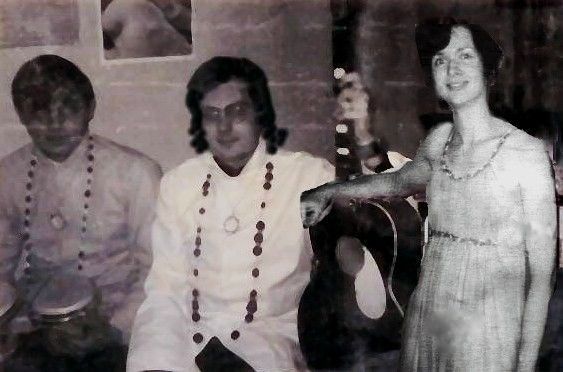
Joe (pictured left with my wife) and I had collaborated on a few pieces, but he was never fully committed to the kind of life the rest of us dreamed about. He was content to sit in Jim's basement or go to the Square with us. His number came up in the draft lottery and he ended up going to Vietnam, where he was wounded and heroic. After he came home he married and named his first child after me, stayed with ARCo and moved to Los Angeles when they moved their headquarters there.

I lost contact with him sometime after 1980.


I do not know what happened to Dot, the poet (pictured left), or to Michael and Maureen, the Actors (pictured right). I have googled the
names, but turned up nothing. If Michael and Maureen ever fulfilled their hopes of the Broadway Stage I do not know.

Part of the breakup lies with me. By 1970 I was getting published regularly and had also begun selling stories to the international pulps, "Magazine of Horror" and "Startling Mystery Stories". In a way I had moved beyond the group. The chatter in Jim's basement and around the Rittenhouse Fountain was always about some future time when we'd all be famous in our
fields. It was talk of projects we planned to do. It was talk and not doing. But I was doing. More and more I was writing and less and less going to these get-togethers to gossip and dream.

And then we moved from the city and after that the decade called the "sixties" had disappeared into the mid-seventies and everything changed and new eras began.

We lived during those Philadelphia days near Clark Park. Clark Park had the distinction that Charles Dickens once spoke there on his American tour. The Park was on the edge between the West Philadelphia communities and the Universities. During that decade it was decided to make the park a symbol of Love and Peace. It was the darling of the media for a while, but in the end it remained Clark Park and nothing more. (I based my story "Community Park" on it.)

Writers can't help but write and all the world becomes ink for their pen.


Saturday, August 10, 2013

Hangin' at Jim's and other Hip Hotspots


"I think we should start a band," said Jim one night well into a second or third pitcher of Screwdrivers. That was our beverage of choice, easy to make, vodka and orange juice.

We met often in Jim's basement somewhere on the 1500 block of South Carlisle Street (pictured left). There was an old piano off in a corner, varied chairs and a beat up old sofa, some battered tables here and there, the main one holding the Screwdriver pitcher. It was dimly lit and filled with smoke, for we all smoked. I sometimes puffed on a pipe, like my father before me, but more often I lit up an extra-long, brown-paper wrapped Nat Sherman. This must have been before I quit my job and had money because you had to order Sherman cigarette and they weren't cheap then or now. I actually gave up smoking while still at ARCo. This is where most of us in our group had met originally.

This "we" were kindred in circumstance and desire. Most of us worked at ARCo during the day and attended college at night, and all had aspirations to the arts, with the possible exception of Joe, who was my closest friend at the time who went where I went and Lois, my wife. Girard, Diane, Jim, Dot and I were writers. Maureen and Michael were actors. Jane was an artist. Dot and I were also poets and Jim was also a composer, which is why that statement came that late evening.

The name we chose was Ethereal and Lois would be our lead singer. She would wear delicate and flimsy clothes that would leave the audience guessing if she were naked underneath her gown. (Pictured right, the core of Ethereal l. to r., Jim, me and Lois.) Jim would write the music and I the lyrics. It never came about, but we were quite serious for a while.


When not hangin' in Jim's basement, we would meander down to Rittenhouse Square and waste the night away gathered at the center fountain. I looked at images of that fountain and they all show its basin full of clear water. I remember it usually drained and dull looking, if filled with anything then it was brittle fallen leaves from the bare trees that dotted the landscape. I seem to remember those Philadelphia years more in winter than any other time of year, as in my photograph of the Square on the left.  We'd be there in the grim, cold nights, shivering in our bellbottoms and pea  jackets trying to look cool instead of cold.

The people of the park would float about us in the fog of their own breath, the colors of their varied costumes, for what were the outfits of that time but costumes, all turned to ash in the garish light of the lamps. People like us, I suppose, escaping that plastic world either by their artistic dreams or by the chemicals they ingested. They waltzed in the early hours, dancing almost, happy in their delusion of freedom, chatting, chanting or chattering into the wee hours, and we stayed until those wee hours, until the life drained away from many faces and the motions slowed and when faces came close you saw either the dilation or the desperation in their eyes. In the last moments the Gay men would drift through like a little steady stream, not in bunches usually, but somewhat detached from each other, strung out like a ribbon. They didn't linger, they just passed through our midst and went wherever they went as they came from wherever they came. It was by then the hour the bars closed. And then at last we too drifted off in our own directions.

Lois and I lived to the west, across the Schuylkill River and on clear nights we walked home. It seemed safe once upon a time in Philadelphia to do that. We would walk many places in the evenings without much apprehension for there were always crowds about then. I''ve walked in many city at late night and felt that way because things were alive and people were out, New York and New Orleans' French Quarter. I fear the streets in dead cities. Atlantic made me nervous. It was like an episode from The Twilight Zone where all the people disappered. Even on a Sunday afternoon the streets were eerie for their emptiness.

We would walk or ride the trolleys or the El to the coffeehouse theaters. Our favorite was The Trauma,
down in the middle of a block on Arch Street (Pictured right). The Trauma didn't sell alcohol. but you could say the smoky air was intoxicating.


I read recently a piece saying The Trauma closed because it couldn't compete with the Electric Factory, which had opened "several blocks north". In actuality, the Electric Factory opened at 22nd and Arch in an abandoned tire warehouse only about a half block down the street from The Trauma. As far as what put The Trauma out of business this is the story as I learned it at the time.

In the same year, 1967, as The Trauma opened Frank Rizzo became Philadelphia Police Commissioner. Rizzo was a tough cop with a vendetta against the alternate cultures of the time and political ambitions. (I'll speak about how Rizzo's ambitions effected me directly in a later post.) Rizzo liked to see his name in the headlines as single-handedly fighting the evils of the city as he saw them. It was said that he personally padlocked The Trauma. At any rate, he led the effort to shutter these "dens of inequity that drew the wrong kind of people and ruined the neighborhood for decent residents." Thus The Trauma, which drew both Hippies and outlaw bikers to it venue had to go. My wife and I had stood in line with members of The Warlocks to attend Tim Buckley's concert at the Trauma.

Not long after The Truama closed a barroom opened on the site, thus bring a better clientele to the neighborhood. Although The Electric Factory still exists, it too shut down at that location in 1973, the year Rizzo became Mayor of Philadelphia. It was resurrected in 1995 several blocks north of the Arch Street location on 7th Street near Spring Garden in a former electric company (how appropriate).

We also traveled out to Manayunk to a theater called Kaleidoscope, a place with a Psychedelic facade and theater seating. Acts such as Earth Opera played there. My most vivid memory of being at Kaleidoscope was it having co-ed rest rooms. Remains of the Kaleidoscope remain inside a warehouse (pictured right).

It was in the square and on these streets that I collected my stories, sometimes autobiographical and sometimes about my friends and sometimes about these strangers who touched me now and again. I'll speak to the roots of some of those stories in my next post.