When I was living in Downingtown I tried desperately to get a
nickname, attempting to get people to call me “Spider”. I kept trying, but
everyone kept ignoring me. The closest I got was Mantis
or Daddy Longlegs, which I didn’t like. Kids used those as derogatory references to my gangly arms and legs. No cognomen ever stuck, which in Downingtown was probably
a good thing since most sobriquets I heard were derisive. Nobody wants to get
stuck with the epithet Quasimodo. Some may consider the one I finally earned
just as bad. “Frank” became my nickname, short for Frankenstein.
“They’re both monsters, aren’t they?”
No, actually neither is a monster. Quasimodo was a deformed
human being. The hunchback really represents the near standard of a human,
flawed but with kindly and protective tendencies, especially in comparison to
the handsome, but shallow Captain Phoebus, who is more the real monster.
 Frankenstein was
the scientist who created the monster. I was the slightly hunched-backed
Frankenstein was
the scientist who created the monster. I was the slightly hunched-backed
“Rescue”
concerned a young man stranded on the side of a cliff. “Purgatory Story” was
about a group of teenagers who became lost in a cave. Both stories had twist
endings, which weren’t happy ones, but they weren’t horror. They were more
adventure-suspense tales.

Still I was sort of a 1950s style “Goth”. I was known for
what I read and talked about. When called upon to do a book review I always
selected what I thought were Horror books. I mean, who knew “Buried Alive” by
Arnold Bennett (pictured left) wouldn’t read like something by Poe? It was
difficult enough plowing through Bennett’s 1908 writing style to then discover
nothing that horrific ever happens. This was the opening of the novel, Chapter
one: The Puce-Dressing Gown.
The peculiar angle of the
earth's axis to the plane of the ecliptic-- that angle which is chiefly
responsible for our geography and therefore for our history--had caused the
phenomenon known in London as summer. The whizzing globe happened to have
turned its most civilized face away from the sun, thus producing night in
Selwood Terrace, South Kensington.
If that doesn’t pull you right into the novel, what does? And
puce, really? What guy talks about puce? When I was 15 I didn’t know what puce
was. Closest thing I thought of was puke, which pretty much summed up my
opinion of “Buried Alive”.
 I
was a voracious reader who read during lunch and study halls. What I read was
generally in
I
was a voracious reader who read during lunch and study halls. What I read was
generally in
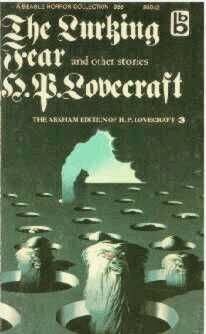
One weekend while visiting with Stuart Meisel he said, “I
want to show you something.”
He went upstairs and came back with a paperback book. He
handed it to me. The book was a bit worn with a creased cover and tattered
edges. The title was The Lurking Fear and
Other Stories.

“This is the scariest stuff I ever read,” he said.
The book was by someone I had never heard of before, H. P.
Lovecraft. He insisted I borrowed the book
to read.
During the next week I lay down on our living room floor one
bright afternoon. No one was home. The sun was shining through the front windows and
I lay in these blocks of light it made around me and read. I became so
engrossed in the stories that when a passing shadow broke the light I screamed.
I couldn’t even read the book at night.
I added Lovecraft to what I carried about school in my hip
pocket.
To tell the truth, up until I started writing my
autobiography I believed I didn’t get my nickname, “Frank”, until Twelfth Grade
after I did a showcase reading of my short stories at school. I was looking for
a picture in my 1957 copy of The Torch, the
school yearbook, when I read the inscriptions on the back page. These were
autographs I got from some of my classmates at the end of Tenth Grade. All but
one was addressed to Frank, Frankie or Frank-in-stine (sic). One inscription also reminded me of something
else.
 “Frank-in-stine,
to a real witty classmate. Always remember our trip to Audubon. Jeanette.”
“Frank-in-stine,
to a real witty classmate. Always remember our trip to Audubon. Jeanette.”
Jeanette Richards (pictured left) was one of the most desired
girls in my class. I doubt she would have ever gone on a date with me since she
had her pick of every guy in school, but she did become a friend and part of
what I might call my gang. In fact, most of those who signed that page would be
in that clique. Homer, Wyatt, Jon and Phil were among the signers.
 Mr.
Brown of Biology had sponsored the trip to Audubon and the Meadowbrook Bird Sanctuary. Nothing
Mr.
Brown of Biology had sponsored the trip to Audubon and the Meadowbrook Bird Sanctuary. Nothing
Beating
the bushes for Black-Capped Chickadees didn’t get me my nickname. Toting around
those genre books and talking about writing my own horror stories accomplished
that.
When school ended in June of ’57, I got a job picking
strawberries at Ridge Farm. The field was located along Route 23 about a mile
walk from my home. I had ambled down the Bucktown Hill early one morning and
inquired at the barn if they were hiring help. I started the same day.

There were no Daddy Longlegs in the strawberry bushes. There
weren’t any insects so I guess the farmer sprayed his fields. It was grueling
work. There was no shade whatsoever. You went up and down the field towing a little
cart of baskets. You duck-walked the rows all day plucking the ripe berries.
When you filled all the baskets on your cart you pulled it to the back room of
the barn.
 The farmer’s wife
oversaw this operation. She would tally your baskets each time you came in. You
got fifteen cents per full basket. (I forget the size of the baskets, they
weren’t real big, perhaps
The farmer’s wife
oversaw this operation. She would tally your baskets each time you came in. You
got fifteen cents per full basket. (I forget the size of the baskets, they
weren’t real big, perhaps
What can I say, it’s a living. I hear people saying Americans
won’t do this kind of labor anymore. I’m not sure I believe that. Why not, it’s
honest labor? I'd do it, except at my age I would probably expire from heat struck halfway down a row.
My mother gave me a surprise sixteenth birthday party in late
June. Like the last one in Fifth Grade, she invited some kids I wouldn’t have
and missed inviting some who I would. I don’t remember a great deal about this
party. I recall we played a morbid game in the dark. Mother passed about
various items and told us these were parts of a dissected man. We had to guess
what the part was. The person who got the most right won a prize. There was
macaroni for veins or some such thing. Grapes represented eyes. I dread to think what body parts would be represented in this day and age.
 The only gift I still remember was from Ronald Tipton. He
gave me a record album of Gospel songs by Mahalia Jackson. He said, “I know you like her.” I don’t know where he got that idea. I liked Gospel music okay, but not her style of singing. But still, it shows he paid attention to my interests and put some thought in what he gave. I do still have that album, although I transferred the tracks to iTunes.
The only gift I still remember was from Ronald Tipton. He
gave me a record album of Gospel songs by Mahalia Jackson. He said, “I know you like her.” I don’t know where he got that idea. I liked Gospel music okay, but not her style of singing. But still, it shows he paid attention to my interests and put some thought in what he gave. I do still have that album, although I transferred the tracks to iTunes.
Ronald was brought to the party by his date. Her name was Patty Daller. She left the party
with another boy, Charlie Crouse, leaving Ronald without a ride home. I don’t
know why this other boy was even invited. He was from Downingtown and I didn’t
even know him. Maybe he crashed the party.
There were a number of other parties over the next year I
enjoyed more than my own birthday bash. Richard Wilson and Joan Boder threw
most of these. They were just get-togethers at each other’s homes. It was dancing
and food. The attendees were friends of Richard’s usually, almost everybody
younger than I because Richard was two grades behind me. Girls wanted to dance
with me at these parties because they considered me a good dancer. We all knew
each other as friends. I wasn’t dating anyone attending.
Although we seldom played games, there was one we did. It was
at a party at Richard’s. There was a cookout in the late afternoon, and as the
sky grew dark everyone drifted onto and around the porch. The adults kind of
hung on the edge in groups, drinking beer, smoking and talking. As the evening
wore on their talking grew louder and was interspersed with loud guffaws. We
teenagers meanwhile began dancing in the center to music Richard played on his
record player. Eventually the night turned a little chill and the adults moved
inside the house.
We kids, probably warmed by our jumping about to the rock
beats, took over the porch completely. Eventually less and less of us were dancing.
Instead we were sitting down where we could or stood leaning on the railing.
Suddenly the music stopped and Richard picked up the record player and stepped
down on to the ground.
“Hey, you wanna play a game,” he said.

He
was waving a large flashlight about and he used it to lead us out to the garage.
The cars were outside and when our little parade marched inside we saw he had set
a group of chairs in a circle. He placed the record player down on a workbench next
to a wall outlet and plugged it in. It was very dark in the garage. The only
illumination came from the flashlight Richard held. He proceeded to explain the
game. As he did he shown the light in our faces and then the circle of chairs,
and then he handed the torch to his brother. Tommy didn’t participate in the
game; he manned the record player. It was musical chairs with a twist. The boys
sat down on the chairs and the girls circled around them while the music
played. During this time the flashlight was snapped off and it was pitch black
inside the building. When Tommy suddenly stopped the music the girls had to
jump on a boy’s lap.
I
did not enjoy the game. As soon as the first girl jumped on my lap I got an
erection that would not go away. I could not make out any faces in that dark,
but I sure could feel each girl’s

I spent the whole game trying to avoid having the girl feel
my condition when she jumped on my lap. Most of the time I failed in my
attempts, especially if she was one of the bouncers. Some girls kind of leaped
on to me and some sort of climbed up, grabbing me where ever they could to aid
their mount. I wanted to help them, but was fearful of touching them. I didn’t
know exactly what my hands might grab in the dark.
Frankly, I didn’t know
what to do with my hands. I was inclined to fold them over my lap, but what if a
girl felt my hands beneath her bottom when she jumped aboard? What would she
think I was up to? I gritted my teeth and kept my hands pinned close to my
chest. Fighting to keep hands off even though in my opinion most of the girls were landing
right in the worst possible spot. I felt embarrassed for the girl as well as
myself believing each and every one was discovering my condition. All I heard
around me were giggles, laughs and occasional shouts. Everyone else appeared to
be having a good time. I was too naïve to understand what I wished to avoid was
the real object of the game.
I had turned sixteen. The day after my birthday I was at
Motor Vehicles applying for my Learner’s Permit. Even though I would be taking
driver’s Education at school next semester, it was required in Eleventh Grade, I
wasn’t going to wait around another six months to get my license. I got a lot
of practice in during the spring on the back roads in all kinds of vehicles. I
was an experienced driver, although no one knew how I became so. I took my
driver’s test during the first week of July.
And I failed.
I had no difficulty with the written exam, which was the part
I was most concerned with. You were given about a dozen random questions that
were taken from anywhere in the Driver’s Manual. It seemed like a lot of
material to have to memorize, but the questions were fairly basic. I aced that
part.
I was sent outside behind the building and then ushered to a
test car. I got in the car for the road test next to this big State Trooper. He
was very intimidating. He spoke in that clipped military style. “You will start
your car and drive to that stop sign. Once there, you will turn right.”
I remembered to check my seat position and adjust my mirrors.
Cars did not have seat belts yet. I drove toward the stop sign and I put my arm
out the window to indicate I was stopping. I stopped. I pointed over the roof
that I was going to turn right. Some cars had a new devise called turn signals,
but even if you did have such a devise, you were required to use hand signals
in the test.
I breezed through the parallel parking and the weaving
through cones.
“Go halfway up this hill, stop and turn off the engine,” he
ordered.
Ah, yes, what some people thought was the hardest part of the
test. People were afraid they would stall the car trying to start up again from
a dead stop on a hill. It was a matter of not popping the clutch between
releasing the brake and giving the car enough gas to overcome gravity and
inertia. Yes, we took the test on a stick shift. Automatic transmissions were also a
rarity in those years. There was very little on these cars either automatic or
power driven. We were probably lucky we had some kind of windshield wipers. In
fact, the intermittent wiper system didn’t even go on to automobiles until the
1969 Mercury installed the first.
I restarted the car and pulled up the hill without a hitch, a
pause, a jerk or a gear grind. I had conquered the hard part.
 “I want you to do a three-point turn and take us back,” ordered the Trooper.
This
was the last step in the test. All I had to do was execute a three-point turn
and I was done. I turned forward into the first point. I backed up and my rear
bumper just barely scraped the embankment behind the shoulder.
“Is that it?” I asked weakly.
“That’s it,” he said, noting on the clipboard that I had
failed.
I had failed my driver’s test. I was mortified. I would have
to come back another time and go through all this tension again.