Banner photo of Larry Eugene Meredith, Ronald Tipton and Patrick Flynn, 2017.

The good times are memories
In the drinking of elder men...

-- Larry E.
Time II
Showing posts with label Jim Thorpe. Show all posts

Sunday, October 2, 2011

...To the Dark of the Dungeon

As I entered the waiting room and looked around I saw the sign on a mantle.

"I guess my wife's out of luck," I said to another man sitting nearby.

"Uh?" he said and I jerked my thumb to the old notice.

My wife is Irish; well, part Irish anyway. She had an Irish maiden name. Her other main parts are German and Native American (one-quarter Creek).

T'is, me Lads, the irony that Mauch Chunk should end up named Jim Thorpe. It is also an example of how this country can and does change usually in the right ways. You see, Jim Thorpe had a part-Irish, part-Sac and Fox father, one Hiram Thorpe. Jim's mother, Charlotte Vieux had a French dad and Potawatomi mom. Hiram and Charlotte named their son Wa-Tho-Huk ("path lighted by great flash of lightning") and raised him as a Sac and Fox. He was also Roman Catholic, which was probably another strike against him in some places in those times.

Jim Thorpe was born in 1888. Eleven years earlier there was an incident in Mauch Chuck that shows he probably wouldn't have been welcome there in 1877, even possibly the decade-plus later when he was born in Oklahoma. He probably would have been shunned or worse for being  (1.) Irish, (2.) an "Injun" and (3.) a papist.

To illustrate some of the mind-set of those times I will take us back to those mansions on top of the hill, specifically the home of Asa Packer.  I mentioned therein that the Packers, rich as they were, but people of hard-working humble beginnings, existed in wealth a long while without the prerequisite servants, until Sarah Packer reached a point when doing it all herself was difficult. They hired a Butler and a Maid, who each had separate quarters in the house. The Packers, faithful to their Protestant morals wanted to be sure there was no hanky-panky between this single man and single woman. Thus they hired an Irish Catholic Butler and a German Lutheran Maid, knowing one would never have anything to do with the other. (This is another story with ties to The Little Woman, with her Irish father and German mother, and being raised a Lutheran.)

If that is an amusing story, there are many darker tales to tell of the prejudices of those times, especially against the Irish.

The Irish lot on their native sod was not a particularly happy one in the 19th Century. They were viewed as less than vermin by England, to which they were subject much against their will. Many lived in abject poverty; in fact, it was rare if an Irish family was able to serve one piece of meat a year in their meals. Beginning in the 1840s many Irish began to immigrate to the United States and this flow continued well into the 1880s. The English took a "good riddance to rubbish" attitude and encouraged this.

The United States also encouraged this influx of Irish, at least the industrialist of the day did. They saw these people as an underclass, a supply of cheap labor and a desperate people they could exploit. They were not welcome in every place of business, as the sign at the beginning of this post shows, but they were welcomed into the black holes of Pennsylvania and West Virginia where coal could be harvested.

Mauch Chunk was a coal town.

Working as a coal miner was far from paradise, not only might you be digging down toward Hell, your life was the Devil's own as well, barely a notch about slavery. You worked a long day on a dangerous job for very little pay. Worse yet, you owed everything to the company. You lived in homes provided by the company, so leaving your job was forfeiting the roof over your head. You had to buy your own work tools and supplies from the company, which you could get at the company store, where you also bought the other necessities of your life. You got credit on your purchases, so to speak, but then your bill was deducted from your wages on payday. It wasn't unusual for a miner to find he owed more than his pay and so go home with nothing in this pocket.

During the time of this miserable situation grew a secret organization known as The Molly Maguires. How secret were they? So much so historians really know very little about them. Were they the terrorist one owner painted them to be in their day, killing brutally and often? Were they a discredited and maligned group of fighters for labor reformation? Truth is they were probably somewhere in between, but they had enough influence that owners of the coal industry saw them as a threat to the status quo and of course blamed every dirty deed that came down the pike on them.

One such industrialist was Franklin B. Gowen (pictured left). Like Asa Packer, Gowen was a wealthy, powerful man in Pennsylvania. He was the president of the Philadelphia Coal and Iron Company and the director of the Philadelphia and Reading Railroad. He was also a former Attorney General.

To say he was anti-union is an understatement and he did everything in his power to destroy any progress by labor that might effect his business. He made this statement about the words of the Declaration of Independence, "All men are created equal":

“Men were not created equal, the distinction between mind and matter, between the men who labored with their heads and those who labored with their hands. There [are] two great classes of people in this world, men of genius, or intellectual men, and those who [are] not so, the men of labor."

 Anyway, to make a long and fascinating story short, Gowen came to blame the Molly Maguires for all things Union and hired the Pinkerton Detective Agency to bring the group down. Eventually several men were arrested and charged with murder on the word of one detective, James McParlan, who went undercover and acted as an informant. He began accusing Molly Maguires after a murder where he had a hand in and may have been responsible for.

Four men were brought to trial at the Old Jail of Carbon County in the town of Mauch Chunk upon the lone testimony of McParlan. This was not a criminal trial, but a private one in which the county simply supplies the facilities. The Judges were men connected to Gowen and there is the possibilities he rigged the jury. In 1877 four men, accused of being  Molly Maguires and murderers were hung inside the Old Jail on gallows brought in for the occasion. They were John Donahue, Edward Kelly, Michael Doyle and Alexander Campbell.

Campbell left an impression behind. Declaring his innocence, he rubbed his hand on the floor and pressed his handprint into the wall of his cell. This was 137 years ago, but the handprint is still there for all to see (I saw it myself). Attempts were made to remove the print, but all failed. Here is the history of the handprint as described at Paranormal@101:


Over the years, county sheriffs have tried to remove the handprint to no avail.
In 1930, Sheriff Biegler had the wall torn down and replaced. The next day, the handprint reappeared.
Around thirty years later, Sheriff Charles Neast covered the handprint with latex paint, but it reappeared. His son, Tom, in the 1960s, loved to tell friends about the ghostly phenomenon. Word spread and people visited the Carbon County Jail to see the print.
Attempts to wash the image away failed.
In recent years, James Starrs, George Washington University forensic scientist, and Jeff Kercheval, Hagerstown MD police chemist, analyzed the handprint using high tech equipment. They found no logical scientific explanation for the handprint’s existence. They finally measured the exact location of the image in the event it there were attempts to remove it and it reappeared, they would know if the phenomenon returned to the same location or a different one.
The jail’s last sheriff, Bill Juracka, said he wouldn’t try to remove the handprint.


Now a days you can tour the Old Jail in Jim Thorpe. It is fascinating and a bit spooky. You enter and get your tickets and then go to the waiting room to await your guide. This area was actually the home of the Warden and his family, so in a sense the Warden was in jail with his prisoners.  In fact, when you go upstairs you are brought through the Warden's family bathroom and into a side wing of the jail where women offenders were housed.  
From there you wend your way back down into the main cell block where the men were. Here you see the infamous gallows that hung the Molly Maguires and Cell #17, where Campbell's handprint can be viewed upon the wall. (Sorry, they would not allow photographs of the handprint. Now, to tell the truth, it would have been very easy to sneak a picture, especially with my Flip, but I chose not to do that. The photograph seen above is from Weird Pennsylvania.)

To say the interior of the jail is bleak is an understatement. It would not be a place I would ever wish to find myself. That in itself should encourage one to behave. More depressing were the dungeons in the basement. Visiting these isolation cells certainly gave more meaning to the old coal miner's song:

It's dark as a dungeon and damp as the dew 
Where the danger is double and pleasures are few
Where the rain never falls the sun never shines
It's a dark as a dungeon way down in the mine.
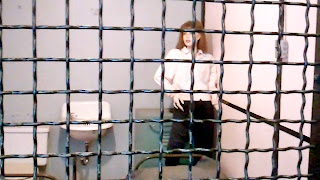
I don't want to tell some of the stories I heard there because if possible I think you should go and enjoy the tour. One of the amazing things to me is this jail was in service until 1995. I will leave you with a few more photos of the place, including our charming young guide holding up the narrow window through which a prisoner once escapes.

Although this prisoner was only sentenced to about a third of a year, he determined to break out. His method was probably worse than his punishment. First he starved himself until he felt he had lost enough weight to squeeze through the window frame the guide is holding up. meanwhile he stole the soap from the shower room until he had a supply hidden away. On the day of his escapade, he striped naked and lathered up his whole body. With help from his cell mates he pushed this window frame out on its pivot. He tossed his clothes down in a pillow case and flung tied together sheets out to climb down upon. Believe it or not, he got through that window and probably would have been far away, except he attempted his escape at 12 noon. Some women eating lunch on their porch were surprised seeing a foamed up naked man shimmying down the jail wall and...well, he was soon caught.

A word about Franklin Gowen, the head of the Philadelphia and Reading railroad. Said Mr. Gowen was found dead in a Washington DC hotel room on December 19, 1889, a small caliber pistol by him and powder burns on his face. His hotel room was locked and his death at age 53 was ruled a suicide. Stories and speculation arose that he had been murdered, and it was claimed this was done by a Molly Maguire who actually looked like Gowen. It was said this assassin had stalked him for years, had even purchased the pistol using Gowen's name and had hid in the hotel room, did the deed and escaped out the window.

People questioned his taking his own life because he was still relatively young, had wealth, reputation and a family. They saw no reason to think he would do such a thing, so it had to be murder and who better to blame than the Molly Maguires. However, I lean toward it being suicide. Gowen was no longer the head of the railroad. In fact, he was seeing a number of bonds he was involved with declining in value at this time and it might have been more a financial concern that led to his self-elimination.


All photos inside and out of the Old Jail by the author except:

The portrait of Franklin Gowen
The Jim Thorpe Wheaties Box
The Campbell Handprint in Cell 17 is from Weird Pennsylvania.


Friday, September 30, 2011

From the Top of the Hill...

There are mansions top the hill. This one sits the further up, perhaps not so deservingly so. It was the home of Harry Packer; Judge Harry Eldred Packer more exactly. Harry Packer was the youngest son, the unexpected son, the baby, the only child born when the family was secure in wealth so he was raised without knowing any deprivation or the modest means his older siblings had known.

The obituaries of his day speak highly of him at his death, a man who accomplished so much as a young man, Associate Judge of Carbon County and President of the Lehigh Railroad, as well as Board Member of Lehigh University. All positions he had stepped into after the death of his father as he had stepped into that mansion on the hill his father had built for him. They talk of his long and painful illness, his death from the internal hemorrhage brought about by its complications.

A month before his death, The New York Times reported on his illness, how he was confined to that mansion on the hill and attended by, of all names, Dr. Pepper. Dr. William Pepper, Provost of the University of Pennsylvania assured everyone of the ultimate recovery of the young judge. But at 2:00 AM on the morning of February 2, 1884 Judge Harry Packer packed it in. It was mentioned in the Times that the judge suffered from an affection of the liver. What Harry Parker suffered from were the indulgences and indiscretions he chose to adapt as the spoiled baby of the wealthiest family of Pennsylvania. What he died of, at the age of 34, was cirrhosis of the liver. Harry Packer would have been better off if he had drank Dr.Pepper rather than being examined by him.

The Harry Packer mansion stands today as a bed and breakfast where they hold murder-mystery audience participation plays.

Just a bit down the road from it is the mansion of his father, Asa Packer (pictured left), a rags-to-riches industrialist, who started out building canal boats and ended up a millionaire. Along the way he developed boatyards, construction companies and mining industries, as well as the Lehigh Valley Railroad and Lehigh University.

The Asa Packer Mansion sits high atop his beloved town of Mauch Chunk, now known as Jim Thorpe, PA. He could sit out on the front porch and gaze over much of what he had created, the railroad, the homes of his workers, the town and also the church he faithfully attended, St. Marks Episcopal.

Asa had not come to Mauch Chunk as an Episcopalian. He was a Methodist when he came. He took his family to a church in town and they sat down in a pew to await the service. He was embarrassed when he and his family were told to move because he had sat in a rented pew. He swore he would never go back to such a place of hypocrisy, and he didn't.

The Little Woman and I climbed the multitude of steps and stairs to take the tour of the Asa Packer Mansion. Believe me, their are a lot of steps from the streets of town to the front porch of the mansion. The town is in The Poconos and it snakes through the mountains like a low-lying river. You do a lot of steep walking, as I suppose one should expect when in a burg once known as "The Switzerland of America".

We paused for rest now and agin. I have grown use to scaling mounts from my morning walks through the Piedmonts, but inclines are difficult for the Little Woman, especially since she throw her one knee out of whack trying to keep up with our military trained daughter on a country hike a few months back.

This is the view as you approach the midpoint up the yard of the mansion. The tall pointy building in the center is St. Marks. Some of the brick buildings directly below are part of the Carbon County Courthouse.

The beginning point of the enjoyable tour back into the 19th Century life of the prominent begins on the porch, relaxing in a chair awaiting the guide.

You are led around to the left side and enter the building through Asa's office.

The mansion is not a restoration, but a preservation. What you see is how it was, at least at the time it was willed to Mauch Chunk in 1912 by his daughter Mary Hannah.

The Packers, Asa and his wife, a farmer's daughter named Sarah Minerva Blakslee, had seven children, most of whom died young. Daughters Catherine, Malvina and Gerdrude all died before the age of two. We already saw that Harry Packer, the last born died at age 34. The oldest son, Robert died at 40 or 41. Lucy, the first born was the only child to produce any grandchildren before she also died at age 40 or 41. Mary, who was the third child lived to be 73, the only offspring to live into the 20th Century.

All her siblings having died by 1884 left Mary as the heir to the Mansion and property of Asa. But Mary had a slight problem because of the thinking of the times, which simply put, did not allow a single woman to own property. Miss Packer was not about to let such a silly detail take this mansion away from her. She had a simple solution, she got married to a long time friend, a conductor on her father's railroad named Cummings. This marriage was preceded by one of our nations earliest prenuptial agreements. After a couple years, Cummings went his way with a tidy sum of cash in his pocket and Mary Hannah Packer Cummings sat in her home atop the hill.

Since she produced no children from this arrangement, upon her death her will deeded the Mansion and all its furnishings to the Borough as a memorial to her father's accomplishments. The town accepted the Mansion, but didn't know what to do with it (we all know how ahead-thinking politicians are) and so it sat there gathering dust for forty-two years. In 1954, just before the third wife of Jim Thorpe made her appearance that changed the name of the town, the Bear Mountain Lions Club asked to sponsor the Mansion as a community project and they opened its doors to the public on Memorial Day, 1956. [Gee, the Bear Mountain Lions, all they need is the wolf and they would be Cub Scout ranks. Of course, by 1956 when the Mansion opened as a museum, they were known as the Jim Thorpe Lions Club.]

Although it is a mansion, the rooms had a more homey feel to them than other museums of the rich we've been through. There certainly were many things in the furnishings or the imported wall papers, the chandeliers or the other accouterments that speak of wealth, yes, things people of that era put in their homes as status symbols. Still, for a time the Packers did not employee the staff of servants one would expect those of their financial level to retain. For a long time Sarah Minerva Blakslee Packer did all the cooking herself. She was a farmer's daughter and these type of things were in her blood. When first married the Packers attempted to eek out a living from the soil, but after four years they found themselves as poor as ever and he set out to find employment on coal barges. They were in their fifties when they built the mansion at a cost of $14,000. (Yes, 14 and only three zeros.)


I have not found any unkind word or scandal attached to Asa Packer or his wife. Perhaps his humble beginning reflected throughout his life even after he gained his fortune. At his death his estate was valued at $54,500,000, and remember he died in 1879. Certainly in today's money he would be a billionaire.

Although Asa Packer was a decent man and philanthropist (and Lehigh University charged no tuition the first 26 years of its existence), there were other rich and powerful men in the Carbon County coal towns not so generous to others and those who worked for many of these wealthy barons lived a life far below the top of the hill where the Packer's dwelt.

That is another part of the town of Jim Thorpe we will soon visit.


All photos by the author except:


The two mansion rooms (you are not allowed to photograph inside the house).
The oval photo of Mary Hannah Packer Cummings (from the Asa Packer Mansion Association).
The painting of Asa Packer by DeWitt Clinton Boutelle, 1873.


Thursday, September 29, 2011

Oh, Tell I Here of the Hotel There

No, that isn't a hotel shaped as a Wedding Cake. That is our hands fifty years ago in a mid-September. A lot of fuss is often made of the Golden Anniversary, proper parties and such. But times are rough and no one in my family is in shape to throw a big bash. The best we could come up with was a little trip of a couple days.

We may not even went off on such a thing if reservations and plans hadn't been in place before I lost my job at the end of August. But sometimes the best way to deal with adversity is to get away from it for awhile.

So to what grand and exotic spot did we go to celebrate such an auspicious occasion as our fiftieth?

Mauch Chunk, of course.

Ohhhh-kay, why?

Back in 2008 the Little Woman and I started off on an ill-conceived vacation into Northern Pennsylvania. After eating lunch in the Bear Swamp Diner at Macungie (and perhaps that name was a hint of what was ahead) we traveled northwest until we hit wilderness. After a while of seeing naught, but scrub grass and trees we got the heebie-jeebies about where we might stay the night or even eat. I confessed I may not have planned this out very well as we decided to turn around and flee for more civilization. We ended up having a wonderful few days staying in Gettysburg. (You can get the gory details of that truncated jaunt here -- Getting to Gettysburg: Jim Thorpe and Traveling is Broadening.)

Well, between Macungie and dread, we passed through the little burg of Mauch Chunk. (The Little Woman said it sounded like some kind of animal eating. Not far off, the name means Bear Mountain in the language of the Lenapes.) The town was very crowded that day and there seemed no where at all to park, so we only saw it from our moving car, but the Little Woman thought it charming and intriguing and ever since that day wanted to go back and visit the place.

By the way, although the rail station reads Mauch Chunk as do many signs in the place, it is better known as Jim Thorpe, Pennsylvania. Jim Thorpe (pictured right) is considered by some the greatest American athlete ever, even the greatest world athlete. He was born in Oklahoma and, like the Little Woman, was part Irish and part Native American. In 1904 he left the Okay state to attend the Carlisle Indian Industrial Boarding School where he first came to fame playing football for the Carlisle Indians. He went on to excel in football, baseball, basketball and win Olympic Gold metals in track.

So, he never lived in Mauch Chuck, perhaps never even visited, and Mauch Chunk isn't exactly a suburb of Carlisle, which is his connection to Pennsylvania. But like all humans, Jim Thorpe, super-athlete that he was, died and when his home state of Oklahoma wouldn't erect a memorial to him, his wife (his third) got angry. Most powerful weapon of mass destruction in the world is an angry woman. She made a deal with Mauch Chunk, an old coal town dying, and they erected a monument and renamed the town Jim Thorpe. He was interred there (His son began a lawsuit in 2010 to have his body exhumed and reinterred on Native American ground in Oklahoma.). His Wife got the memorial she felt he deserved and Mauch Chunk got new life as a booming tourist town. (There is a certain irony in Jim Thorpe and Mauch Chunk coming together this way, but I'll get to that in another post.)

This post is about hotels.

The Little Woman and I have been fortunate enough to do a little traveling. We have over time stayed in some interesting and historic hotels. Not the big grand ones, such as the Waldorf-Astoria, although we did spend a couple night in it many moons ago, but smaller, perhaps lesser known hostels.

(On the left is the Little Woman relaxing in our room at the Waldorf-Astoria, New York, 1962.)

Here are some of the very old and interesting places we have enjoyed staying at over the years:


The Inn on Canal Square in Lewes, Delaware. We have been privileged to  stay here several times in recent years. The photo here was from earlier this year. It rained all the first day and then turned to snow overnight, which turned to a blizzard burying the Mid-Atlantic.  We always stayed here out-of-season because of the cost in season.


The Lighthouse on Casco Bay at Sebasco, Maine. Like The Inn on Canal Square, we had a marvelous view from our room of water. Here we were overlooking an expansive bay and inlet rather than a canal. It was an unique place to stay.


Part of our room in the historic Hawthorne House, Salem, Massachusetts. The infamous "House of Seven Gables" was a short walk away and across the street was the "Salem Witch Museum". Yes, in was named for Nathaniel Hawthorne.


Independent Park Hotel in the Old City district of Philadelphia, just around the corner from Two Street; surrounded by the history of our country's founding and a few steps away from a world of dining experiences, from an Havana Street at Cuba Libre, the Indian cuisine of Cafe Spice, to eating off a coffin in the Eulogy Belgian Tavern.


These are all fine establishments, places I would recommend to anyone, at least if they have remained as they were when we visited. But here I want to sing the praises of The Inn at Jim Thorpe. I would put it at the top of an enjoyable carefree stay for comfort, cleanliness and accommodations.

Jim Thorpe seems to have a way of taking you to other places, but more on that in later posts. There is a certain reminiscence of New Orleans to the Inn. This had caught the Little Woman's eye when we passed by several years ago.

The flowers trimming the railings are real, I hope anyway, since a man is watering them.

Parking is ever a premium in this town and for a moment I feared I would find no room at the inn for my car (actually the Little Woman's car). I drove about the rather cramped lot twice. It was quite filled-up it seemed and had narrow stretches I had to maneuver to escape on the first run through.

I had to exit thought a alleyway, which grew more cramped the further you went. This deposited us back on the main street we had originally entered from, much to my anxiety. There were no sign of parking spots along this avenue.

"What do we do now?" I said.

"Go back around where we went before," said the Little Woman.

I gave her a questioning look, but did so.

"There," she said as we entered the lot again, "turn left."

Up ahead upon a wall that ended this drive was a sign saying, "Inn Parking" with arrows pointing both left and right. We had turned right before and ended up exiting.

"I thought I saw more parking to the left," she said.

But the left was not a lane to extra parking, simply an indication that spaces lined this side of the drive. I pulled forward and amazingly, glommed what was apparently the last possible spot of the moment.

Yes, that is our little red Fit tucked away between two walls and a large SUV, almost a feeling of being in a garage.

If the parking lot seemed a bit -- oh, I don't know - spooky, intimidating, cramped, this was not the nature of the Inn once inside.


The hallways were like compressed galleries in an art museum, festooned with paintings right and left to escort us to our room on the third floor.

I look at this picture and realize it is some what surreal; it must be the Dali wing. The way the left wall appears to wave and waffle.

I think it sets the mood for this very interesting town.

Someplace that changed from street to street, a place still somewhat frozen in a bygone era, a place of fascinating history and a place with surprises around each corner.

We were in room 312, what was called a mini-suite.

The Little Woman was thrilled when we threw back the door and entered. Ahead we could see a wide-screen television. No, it was not the TV that made my wife thrill; I mean, come on. It was the mantle of what the TV sat upon, a working fireplace.

I am not exactly certain why she has this love of fireplaces, but she does. We had stayed in a hotel in Monmouth, N.J. a couple years ago, near the university. We were there for a concert and I didn't want to make the long trip home so late at night, something ironic as it turned out. It was one of the Marriott Residence Inns and it had a fireplace. Oh, the little woman looked forward to coming back from the concert and nestling down together before a blazing fire.

It wasn't to be. Leaving the University we got hopelessly lost and didn't find our way back to that Inn until the wee hours of the morning, weary and shaken. The Little Woman didn't get her fire and I traveled more miles late at night than I would have going home.

I sort of hated telling her that you couldn't light the fireplace here until October. I had read that in a room description on the website. However, no one at the checkin mentioned not using the fireplace nor was anything posted or in the Welcome to the Inn book in the room. I was tempted to flick the ignition switch and see if anyone squawked. There was wood in the thing. But I didn't.

There were plenty of amenities in the room beside the TV and fireplace. There was A/C and heat, of course. There was a CD player and clock radio, a DVD player hooked to the TV, Coffee Maker and assorted coffees and teas, a microwave and a refrigerator stocked with free bottled water.

There was also a ceiling fan and a skylight, which made other lamps unneeded most of the day. We were blessed with two beautiful, sunny days, a nice respite from all the rain of the last month.

There was another amenity, which we both made good use of and did it ever feel good on this old body, a whirlpool bathtub.

Sorry, it was not surrounded by mirrors so no accidental catching of me splashing about in the altogether.

On the floor below was a lounge for those who wanted to use such a place. Besides some magazines there was a shelving unit holding several board games.

As nice as these facilities might be, we preferred to be out and about the town or snug in our room.

The staff here was very accommodating. In a reversal of the maid accidentally walking in on the guest, we walked in on the maid or maids actually. The two young ladies were very friendly as we sat about watching them work. When the one noticed the coffee we preferred, she left us extra of it.

On Sunday evening after we returned from dinner, the Little Woman had a hankering for a candy bar. Finding such a thing seemed a unlikely mission, but I set out into the dark and empty streets to try. I saw a couple places that probably did have candy, but they were closed. I returned to the hotel defeated, but in my best conspiratorial voice, asked the Desk Clerk if they had any candy bars hidden about.

"No," she said, "but Dugans sells candy bars and he is still open. It is just a block up the street."

She was correct and I came back with a half dozen assorted candy bars. The Little Woman was happy, which is what you want.

The Inn was once known as the American Hotel. In the 1800s it was one of seven grand hotels that graced the town, but today is the only one still remaining and doing business. Those were the days when Mauch Chunk was a tourist destination second only to Niagara Falls and people flocked in to dance at The Flagstaff, its "Ballroom in the Sky". By the time of Jim Thorpe, Mauch Chuck may have long shed its title of "wealthiest town - per capita - in America", home at one time at the same time to 13 millionaires, when a million dollars was real money. (I'll let you in on a secret: a million dollars is still real money to me, so anyone who feels it is chump change can toss it to this chump.)

Anyway, this is the hotel of which I tell and I would tell you to stay there is you ever have the desire to lay over in Mauch Chuck. Maybe go during the October Fall Foliage Festival and ride an old train up through the Lehigh Valley River Gorge or take in Jay Smar, singing coal country classics in Josiah White Park.

And while there enjoying the peace and quite or the colors of changing leaves or the wonderful Inn at Jim Thorpe, learn some history.

See the upsides and downsides of our history. Learn of Asa Packer. Learn of the Molly Maguires. Visit, by all means, the mansions on the hill and then do not overlook or miss the dungeons of the Old Jail.

Then you will know why Mauch Chunk indeed.


All photos by the author, except the portrait of Jim Thorpe.