From the time I was born until I married there were seven addresses in five townships; from my marriage to the present, eleven in eight places. These 18 addresses may be even more remarkable considering I've been in this house for the last 30 years and here is where I think of as home.
But if one asked about my boyhood home, I think of Washington Avenue. I moved there three times, twice to the same address. I lived on that street for 13 of my first 15 years.
It wasn't the longest street in the world, although it seemed so when, as a child, I walked it. It ran probably less than a half-mile end to end. It ran one block east of my own block, but I seldom had reason to go that way. It ran two long blocks to the west of mine and at the end of these, just before the creek, were my church and the movie theater. A half block off Brandywine Avenue also called Creek Road, at 120 Washington, was an apartment building where my life-long best friend lived when I first met him. (I've told the story of our meeting in "The Kid Met Him in the Funny Pages".)
On the left is 120 Washington as it looks today (actually not much different from then) and my not quite yet best friend sitting in the window of his apartment there.
Gee, he was kind of cute back in those days.
I knew someone else that lived in those apartments during those early years, a blond girl. Her name was Mary Jane and I had a crush on her through most of my elementary grades right into junior high school, although I never acted on my feeling for her and asked her out. I was friends with her and she came to my birthday parties.
We were eight years old in this photo and you won't find any other pictures of me getting quite so chummy with a girl that early on in my life. Now it is true I kissed a girl named Michele around this same time period (and got in a bit of trouble because of it) but I never had any true feelings for Michele as I secretly did for Mary Jane.
I suppose I should explain how I came to be a Washington Avenuer.
The first time we moved there I was six months old and it was to be my third home. My first had been in Modena and my second at Whitford. I've never really known why we moved to 424 Washington in town that Christmas season. We moved there with my maternal grandparents, who were the actual renters of the house (they never owned it). My parents had moved in with them at Whitford earlier in the year from Modena, my father's boyhood hometown. (Photo left: my mom holding me before the porch of 424.)
I know why my parents moved from the Modena apartment (bedbug infestation combined with financial need) to Whitford; but why the move shortly after to town I don't know. The "big house", as they called it, in Whitford appears to be large enough to accommodate two families, in fact, was probably larger than 424 Washington Avenue.
The Whitford house was where my mother grew up, so it had been my grandparents long time abode and was near to my grandfather's own family roots.
They didn't own that place either. It was actually part of the George Thomas III estate. The Thomas family was one of the original settlers of the area and one of its most prominent families. I do not know if George Thomas choose to end the renting of this property or if the move was somehow related to the bombing of Pearl Harbor on December 7, 1941. Perhaps the beginning of the war in which my father would serve for several years prompted changes. (Photo right: my mom as a child at Whitford.)
We all lived in that house throughout the war years. I made two close friends on the block, Iva and Bill. Iva was to remain a friend for always, but Bill moved away about the time I moved to 424 the second time and eventually we lost contact.
Why a second time? Why did we even move away from 424 a first time? Easy to explain, the war ended.
My dad had been in the South Pacific most of those first years at that 424 address. He got his discharge a couple years after the war ended and returned home in 1947. He got his first job as a long distance truck driver that fall, driving milk tankers for a man named Hines. A friend of his had told dad the company was hiring, but not to tell Old Man Hines he knew mechanics or he would never get outside the garage. Dad got the driver job instead at $100 a month and the house in the swamp.
There was this old home, half brick and half stucco, with scaffolding along one side, owned by the trucking company. It sat back from the highway, surrounded on two sides by a marsh, with a cornfield up the hill behind and a cow pasture to the East. Hines let dad live rent free because he was a returning vet, and thus we packed up our meager belongings and moved from 424 Washington for the next two years. (Photo right: me at the house in the swamp, 1948)
That house in the swamp was to have a great impact on my life and personality, but that is a different story. This one is about Washington Avenue.
So how did I get back there for the next five and half years of my boyhood?
Easy, my dad changed jobs for more money. In late 1949 he began driving for Atkinson Trucking; goodbye Hines, goodbye house in the swamp.
My folks moved back in with my grandparents at 424 Washington. At some point a bit later, a house up the street became available for rent and my parents moved there. 417 Washington was a double house next to a Quonset hut of a garage, a business selling farm equipment. (And yes, during evenings or Sundays when this store was closed and empty, I did sneak next door to play on the tractors in the lot.)
That is a picture of 417 Washington taken several years after I lived there as a child.
I think Washington Avenue sticks with me so much in my memories because I lived there in those growing years. All the adventures of my boyhood are centered on that street, both good and bad. My best friend, Ronald Tipton, lived on that street when I met him. Our grade school was across the street from my home. 424 also means more to me than 417, probably because on weekends, when my dad came home from his trucking runs that kept him away from Monday through Friday, my parents sent me down the street to stay with my grandparents so they had alone time. (Photo right: 424 Washington.)
Eventually I will tell more tales of life on Washington Avenue.
Where Larry Eugene Meredith Says Whatever may Cross His Mind On Any Given Day!
Banner photo of Larry Eugene Meredith, Ronald Tipton and Patrick Flynn, 2017.
The good times are memories
In the drinking of elder men...
-- Larry E.
Time II
Showing posts with label Ronald. Show all posts
Tuesday, December 6, 2011
Friday, December 2, 2011
Roger in the Hospital (really Ronald)
When we graduated from high school, my best friend, Ronald decided to join the Armed Forces, but discovered he had a double hernia. Before he could be accepted he had to have this repaired and went into Chester County Hospital for the operation. There were complications, incisions coming open and he caught a contagious infection that placed him in the isolation ward for a period of time. He was a very sick puppy. The contagious ward was in the basement of the hospital and to visit him you spoke through a window too the outside. It was very surreal to be kneeling on the ground talking to my friend through this wire barrier over the windows. He complained to me there were two babies in the contagious ward and they took turns crying. I wrote this piece at that time. (The photo is a more recent of my friend on another hospital visit, not from those dear dead days so many decades ago.) [This story also appears in my All the Monsters in My Mind blog of short fiction as part of the book, Wilmillar and Other Towns.]
ROGER IN THE HOSPITAL
by
Larry Eugene Meredith
I am behooved to tell the sad tale of my good friend, Roger Walters. I must say it sent a pang of deep regret to see him lying on a hospital bed (of course also a great deal of jubilation that it was he and not me). His face was pale, not at all its normal wallpaper paste white (it was encouraging to see some color in his complexion.) Then, a-sudden, he stared from his bloodshot optics to the ceiling in fright, something that sent terror through me as well, for he was lying on his stomach at the time.
A look of unparalleled fear contoured his face. He stopped in mid-breath, froze in this position. And then the sheet was pulled over his head and face.
He was hiding from the spider on the ceiling. Oh, the sufferings my friend has suffered since he went to the hospital for a routine operation.
He went into the operating room that day back in June with the fear of having a sponge left in his lower regions. He was assured doctors are careful and keep a specific count of the equipment they insert. His confidence was indeed shaken when a dreaded discovery was made after surgery. They took out one more sponge than they had put in.
This was indeed strange for Roger had one other operation in his whole life. He had his tonsils removed when a boy by Doctor Hiram Hickle, better known as Old Doc Butterfingers.
One afternoon the floor nurse walked in while Roger was hanging the doctor (in effigy). She was rather angry about this. Roger was not supposed to be out of bed that soon. She told him to ring her if he wanted to hang any more doctors. The nurses would be delighted to help. In fact, they would even supply the doctor.
Roger’s new doctor was extremely gentle. He claimed to have magic fingers. This made Roger quite happy, but he still didn’t want his back rubbed daily.
Roger was in and out of the hospital three times since the initial Herniatum neresursum gapduplicisum (which is Latin for double hernia operation, I think, but what do I know, I flunked Latin – curse you, Miss Horner), a total of thirty-two days, four rooms and two floors. He was becoming quite annoyed at receiving recall notices in the mail, especially when one came with an infectious infection.
He spent more than a week in the contagious ward, stuck between two babies who worked separate shifts. Such crying...and have you ever seen a grown man cry? It’s terribly embarrassing. For gosh sake’s, Roger, pull yourself together.
The nurses in the hospital are against him for no good reason other than he attempted to push the head nurse out the window. The other patients are mad at him because he didn’t succeed. That was when he was on a higher floor. The contagious ward was in the basement (closer to the morgue for convenience). It’d be kind of silly and fruitless to push someone out a basement window. What are they going to do, fall up? Besides those windows had wire cages around them so no germs could escape.
They discovered he was allergic to penicillin, but this wasn’t what needled him. His main complaint was they kept giving him blood tests.
“ Blood tests?" He said. “They took so much blood one time that I lost ten pounds.” If you saw Roger in those days and he lost ten pounds; then you wouldn’t see Roger.
They let him play the radio, but drew the line when he wanted to practice his Sousaphone.
He almost got drowned right after his third operation. During the procedure there was a call claiming a bomb was hidden in the hospital. When they noticed that Roger was ticking they threw him in a tank of water. Roger probably would have drowned if his surgeon hadn’t asked if anybody had seen his wristwatch.
After his fourth operation, he was told to go home. And that is the end of Roger...in the hospital, that is.
- 30 -
Monday, October 17, 2011
Streets
I sit here this morning about to enter a new street, and not so far away, and yet very distant another long ago friend has come to the dead end of a one way avenue.
His name is Gary Kinzey, and although he died the other day (October 15) and his life became a "was", I like to think his name remains an "is".
It is in my thoughts, it is in my faded memories and it is in various records somewhere. His name and he will always be part of me until I also travel that last avenue.
This is the only photo I have of him as a boy, in the time I knew him as a friend. Film was costly then, to buy and to get developed. For that reason I didn't take as many pictures as I may have wished. It was taken in front of another friend's home, Stuart Meisel, looking toward Lancaster Avenue. The date I have on this is 1952, when Gary would have been 11.
There is a story about the bike. It will seem an odd one to the children of today with their tricked up little X-games stunt bikes, but that bike was too small. Things were larger then; cars were larger, bikes were larger. The bike may not look that small, but for it's day it was. Notice how the seat is pulled high up on the shaft. The diameter of the wheels on his bike were 24 inches; the rest of us had bikes with 26 inch wheels. Two inches may not seem much, but in those days when it came to wheels, size mattered.
And yes, Gary was sensitive about his smaller bike.
We often feel different in life over insignificant and unimportant things.
When I say he died "not so far away" it is because he lived on a street not so far from me and died at home. But I only knew he lived there and only saw him at a high school reunion a couple years ago. My friendship with him was from that now distant time of childhood, when we were sometimes close friends and sometimes not. So now after nearly sixty years much of those days has blurred and faded.
I know I met Gary when we were very young, somehow, somewhere. He lived in apartments a couple blocks east of me and then, I believe, in a small house near where the Farmers' Market stood just outside of town. He seems to have flickered in and out of my boyhood because he moved and I moved and sometimes we were near and sometimes not.
He played the saxophone and I the trumpet.
What we had the biggest in common was trains, electric trains. We both indulged in building elaborate (at least it seems so) layouts. We had different emphasis, however. I was into building realistic landscapes, with papier-mâché mountains full of tunnels, with elevated tracks over felt-green meadows and little towns with rows of stores and bedroom communities. He was much more taken with the electrical mechanics of it all, building a master control of dials and switches where he controlled his world, of light displays and working gizmos here and there.
My room was full of comic books; his had stacks of Popular Electronics.
I thought him an electronics genius. In Junior High he came to class with a fountain pen in his pocket; except, it wasn't a fountain pen at all. It was a radio he had built inside a pen's shell.
His nickname was Sparky.
One of my last memories of Gary was also in Junior High. We were walking side-by-side between classes and for whatever reason, he began to punch me on the upper arm. Every so many steps down the corridor, wham, a punch to my arm. He ignored my pleas to stop and finally I turned and popped him back, at which point Mr. Caskey grabbed me by the shoulder and hauled me to the principal's office. One of the few times I ever got in trouble in school.
Strange the things we recall.
After school, like many other old friends and acquaintances, Gary and I went our separate lives. None the less, we once were friends and 70 is far too young to die.
(Left - Gary in 2002 at Downingtown High School class picnic at Dave Fidler's. Photo taken by Ronald Tipton.)
His name is Gary Kinzey, and although he died the other day (October 15) and his life became a "was", I like to think his name remains an "is".
It is in my thoughts, it is in my faded memories and it is in various records somewhere. His name and he will always be part of me until I also travel that last avenue.
This is the only photo I have of him as a boy, in the time I knew him as a friend. Film was costly then, to buy and to get developed. For that reason I didn't take as many pictures as I may have wished. It was taken in front of another friend's home, Stuart Meisel, looking toward Lancaster Avenue. The date I have on this is 1952, when Gary would have been 11.
There is a story about the bike. It will seem an odd one to the children of today with their tricked up little X-games stunt bikes, but that bike was too small. Things were larger then; cars were larger, bikes were larger. The bike may not look that small, but for it's day it was. Notice how the seat is pulled high up on the shaft. The diameter of the wheels on his bike were 24 inches; the rest of us had bikes with 26 inch wheels. Two inches may not seem much, but in those days when it came to wheels, size mattered.
And yes, Gary was sensitive about his smaller bike.
We often feel different in life over insignificant and unimportant things.
When I say he died "not so far away" it is because he lived on a street not so far from me and died at home. But I only knew he lived there and only saw him at a high school reunion a couple years ago. My friendship with him was from that now distant time of childhood, when we were sometimes close friends and sometimes not. So now after nearly sixty years much of those days has blurred and faded.
I know I met Gary when we were very young, somehow, somewhere. He lived in apartments a couple blocks east of me and then, I believe, in a small house near where the Farmers' Market stood just outside of town. He seems to have flickered in and out of my boyhood because he moved and I moved and sometimes we were near and sometimes not.
He played the saxophone and I the trumpet.
What we had the biggest in common was trains, electric trains. We both indulged in building elaborate (at least it seems so) layouts. We had different emphasis, however. I was into building realistic landscapes, with papier-mâché mountains full of tunnels, with elevated tracks over felt-green meadows and little towns with rows of stores and bedroom communities. He was much more taken with the electrical mechanics of it all, building a master control of dials and switches where he controlled his world, of light displays and working gizmos here and there.
My room was full of comic books; his had stacks of Popular Electronics.
I thought him an electronics genius. In Junior High he came to class with a fountain pen in his pocket; except, it wasn't a fountain pen at all. It was a radio he had built inside a pen's shell.
His nickname was Sparky.
One of my last memories of Gary was also in Junior High. We were walking side-by-side between classes and for whatever reason, he began to punch me on the upper arm. Every so many steps down the corridor, wham, a punch to my arm. He ignored my pleas to stop and finally I turned and popped him back, at which point Mr. Caskey grabbed me by the shoulder and hauled me to the principal's office. One of the few times I ever got in trouble in school.
Strange the things we recall.
After school, like many other old friends and acquaintances, Gary and I went our separate lives. None the less, we once were friends and 70 is far too young to die.
(Left - Gary in 2002 at Downingtown High School class picnic at Dave Fidler's. Photo taken by Ronald Tipton.)
Labels:
Aging,
BITS,
childhood,
death,
Friends,
Gary Kinsey,
Ronald,
School days,
Stu,
Written 2011 in Delaware
Friday, August 12, 2011
A History of Work
There I am, off to the office in 1953, age 12. No not really. The suit and tie jobs were still in the distant future, although I traded in that bow tie for Windsor Knots. This must have been my "Sunday-go-to-meeting" outfit.
How about the hat? This was the de rigeuer style back then.
I don't remember my first paid "job".
There was a small store on Chestnut Street, just around the corner from where I lived. (The photo on the right is how that building looks today, no longer a store.) It was a mom and pop operation, very akin to what we might call a convenience store today. It sold a variety of foodstuff and other things people regularly needed or often ran short of. It wasn't a place anyone did their weekly grocery shopping, just a place to fill in the daily needs. Early on in my boyhood, neighbor's might call me over and ask if I would run to that store and get them bread or milk or some such item. They would give me a couple pennies or even a nickel for my trouble. Pennies could actually buy things in those days, they had real worth, even if sometimes I blew it on wax lips.
So I suppose you could call that my first job.
I had a number of chores at home I was expected to do, wash the car, mow the lawn, help weed the garden when we had one and keep my room clean and neat. I hated those first three and was a dismal failure at the fourth. I had one chore I loved, taking out the trash.
Things were not like today with all our many restrictions and fears. There was less waste and there was a kind of a priori recycling. You didn't throw anything away until it was beyond recognition, let alone use. Clothes were patched and socks were darned. When you found yourself patching patches, then the item became a dust cloth and beyond that use it was a rag for the Ragman. Yeah, there was a Ragman who came about the neighborhood and took old rags.
We lived in a town bursting at the seams with paper mills (almost all gone now) and our used foolscap and magazines went to paper drives and back into the hoppers of these plants. Soda bottles and such were collected by we kids and returned to the store for a couple cents deposit. Garbage, real garbage, potato peels and apple cores and table scraps went to the curb in iron pails. The Garbage man took the contents. You knew when he was coming since you smelled him two blocks away, maybe even across town on a hot summer day if the rotting pulp from the paper mills didn't overwhelm all other scents. He drove an open bin truck. The refuge from our plates went to the slop troughs of the pig farms.
Ah, but there were some things not gathered or collected by others and this was the trash, mostly odd papers and boxes. This was the trash I had responsibility to depose of and how I enjoyed it. You see, it was burnt in large steel 55-gallon drums. Just about everyone on the street had their drum and from it regularly waifed a thin white smoke of burning trash. What made it attractive to me was I got to play with fire.
Here I am (back to the camera and wearing my motorcycle hat) with friends finding other uses for those 55-gallon trash barrels.
But those were household chores, not paying jobs, unless you count my quarter allowance. Oddly, as much as I hated doing most those at home, I jumped at the opportunities to do these things for others. I would mow a lawn, wash a car, even hoe a garden for a fee. I would solicit from a neighbor those things I tried to duck out from at home. So I guess they were my first employments.
I was in elementary school when I did those. I was also in elementary school when I became a professional writer writing, publishing and selling a newspaper ("The Daily Star," although it came out weekly) with my buddy, Stuart Meisel. We charged a penny a copy. We did make money. We were very successful.
Newspapers were to be important in my early "careers". When I moved from Grade School to Junior High I also moved to more regular employment, Paperboy being one. That occupation came a bit later and lasted only a short period, although I loved doing it and thought it the greatest job in the world. I kinda still think it was. I guess I'm a strange fish, but one of the things I enjoyed about the job was doing it in harsh weather, pushing on through the snow and battling the rain to keep my wares dry. I could imagine myself some kind of adventurer attempting to get supplies to an isolated outpost in some godforsaken part of the world, such fun.
I didn't like the breezy days or that blowhard Old Man March, no not at all. I could cover up my product from the downpours and hail stones if need be, but if an ill wind got under my pouch papers would do what Charles Brown's kite wouldn't. They would fly, here, there and everywhere.
I took over the route from my friend, Ron Tipton, known today as "Retired in Delaware". He moved on to bigger and better things, I hope, and turned over his customers to me. I had about 100 clients for the daily and perhaps a third less for the big Sunday edition. This was the Philadelphia Bulletin, then the premier Philly rag, now defunct. I was earning between 18 and 20 dollars a week, a lot of money for a thirteen-year-old kid in the early 1950s. That would have been around $148 to $165 today. Dailies cost a nickel and the Sunday paper was $25. I had to split that four ways, a portion for me, a portion for my Supervisor, some for the delivery truck driver and the rest to the owner of the newsstand where I picked up my allotment. I got a penny-and-a-half for the dailies and five cents for the Sunday.
And it only took me an hour a day to deliver. Wow, wouldn't you like to make a $165 an hour today?
I said this bonanza was short lived. Ron held onto his route until after Christmas the year he quit. He wanted to garner those extra-bonus Christmas tips from his cliental. I took over for the New Year, but then my parents moved out of town and in June I was living in the country and could no longer do that route.
I had held other positions in my Junior High days. I had spent a time being caretaker for my friend Stuart's family, cutting grass, watching the place and so forth.
The Meisel's had a large stone house on a good sized lot in the historic part of town. Here is a photo of the front of the home. Sadly, despite attempts by my friend to have the place preserved, it was torn down and apartments built upon the site.
In those times, too, some us walked just east of town and got jobs at the Farmer's Market. The Market was only open on weekends. A lot of Mennonites and some Amish from Lancaster County came down and had produce or meat stalls there. The place was something of a bizarre, selling a little of much, books and boots, clothes and clothes lines, hunting gear and records. It had a penny arcade of pinball machines. The place was our hangout on weekend nights, feeding nickels into those contraptions or making little records in recording booths. I and a friend got jobs one year with a greengrocer. I was not happy. My friend got to wait on customers. I stood in the back behind a tub of water washing celery. I wasn't long for that job.
When we moved from town upcountry, there wasn't a lot of opportunities for a teen. It was still real country then and there wasn't much around. In the summers I got employed on some farms in the area as a picker. I picked tomatoes and I picked strawberries. It was sweaty, uncomfortable work. It isn't called stoop labor for nothing. You either spent the day bend over or waddling up the rows like a duck. You came home sticky, covered with dust, thirsty, stiff and tired.
I plucked plants for the two summers between ninth and tenth, and between tenth and eleventh. On the third summer of High School I moved up and out, getting a job loading 18-wheelers at the farms in Lancaster County. Those Amish boys would gee their horse wagons up along side and I would offload their harvest onto the flatbeds, bushel baskets of tomatoes heading to the ketchup factories in the Western end of the state. The baskets got stacked to just above my head all down the trailer. You have any idea how many bushels of tomato you can stack six high down thirty feet of truck?
I think I got paid ten bucks a load.
That was summertime, when the livin' is easy. The winters were harsh and sparse. I got an occasional gig shoveling snow, mostly the parking lot of a restaurant called Flowing Springs Inn in Kirkwood, about four miles from my home. That was a hit or miss proposition. I only made money when a snow storm hit, otherwise I missed out on earning anything.
That's the Flowing Springs Inn as it looks today, under the name Titus Inn. That enclosed porch was open back then, so I had to shovel it and its steps off as well.
I guess I started those childhood chores for hire when I was 8. I might have done some earlier, but I was living isolated from the world in a swamp for a couple years. So all those little scraping jobs covered about a decade, from the third grade until I graduated high school.
They were the beginning of a history of work. Much more was to come and still is.
How about the hat? This was the de rigeuer style back then.
I don't remember my first paid "job".
There was a small store on Chestnut Street, just around the corner from where I lived. (The photo on the right is how that building looks today, no longer a store.) It was a mom and pop operation, very akin to what we might call a convenience store today. It sold a variety of foodstuff and other things people regularly needed or often ran short of. It wasn't a place anyone did their weekly grocery shopping, just a place to fill in the daily needs. Early on in my boyhood, neighbor's might call me over and ask if I would run to that store and get them bread or milk or some such item. They would give me a couple pennies or even a nickel for my trouble. Pennies could actually buy things in those days, they had real worth, even if sometimes I blew it on wax lips.
So I suppose you could call that my first job.
I had a number of chores at home I was expected to do, wash the car, mow the lawn, help weed the garden when we had one and keep my room clean and neat. I hated those first three and was a dismal failure at the fourth. I had one chore I loved, taking out the trash.
Things were not like today with all our many restrictions and fears. There was less waste and there was a kind of a priori recycling. You didn't throw anything away until it was beyond recognition, let alone use. Clothes were patched and socks were darned. When you found yourself patching patches, then the item became a dust cloth and beyond that use it was a rag for the Ragman. Yeah, there was a Ragman who came about the neighborhood and took old rags.
We lived in a town bursting at the seams with paper mills (almost all gone now) and our used foolscap and magazines went to paper drives and back into the hoppers of these plants. Soda bottles and such were collected by we kids and returned to the store for a couple cents deposit. Garbage, real garbage, potato peels and apple cores and table scraps went to the curb in iron pails. The Garbage man took the contents. You knew when he was coming since you smelled him two blocks away, maybe even across town on a hot summer day if the rotting pulp from the paper mills didn't overwhelm all other scents. He drove an open bin truck. The refuge from our plates went to the slop troughs of the pig farms.
Ah, but there were some things not gathered or collected by others and this was the trash, mostly odd papers and boxes. This was the trash I had responsibility to depose of and how I enjoyed it. You see, it was burnt in large steel 55-gallon drums. Just about everyone on the street had their drum and from it regularly waifed a thin white smoke of burning trash. What made it attractive to me was I got to play with fire.
Here I am (back to the camera and wearing my motorcycle hat) with friends finding other uses for those 55-gallon trash barrels.
But those were household chores, not paying jobs, unless you count my quarter allowance. Oddly, as much as I hated doing most those at home, I jumped at the opportunities to do these things for others. I would mow a lawn, wash a car, even hoe a garden for a fee. I would solicit from a neighbor those things I tried to duck out from at home. So I guess they were my first employments.
I was in elementary school when I did those. I was also in elementary school when I became a professional writer writing, publishing and selling a newspaper ("The Daily Star," although it came out weekly) with my buddy, Stuart Meisel. We charged a penny a copy. We did make money. We were very successful.
Newspapers were to be important in my early "careers". When I moved from Grade School to Junior High I also moved to more regular employment, Paperboy being one. That occupation came a bit later and lasted only a short period, although I loved doing it and thought it the greatest job in the world. I kinda still think it was. I guess I'm a strange fish, but one of the things I enjoyed about the job was doing it in harsh weather, pushing on through the snow and battling the rain to keep my wares dry. I could imagine myself some kind of adventurer attempting to get supplies to an isolated outpost in some godforsaken part of the world, such fun.
I didn't like the breezy days or that blowhard Old Man March, no not at all. I could cover up my product from the downpours and hail stones if need be, but if an ill wind got under my pouch papers would do what Charles Brown's kite wouldn't. They would fly, here, there and everywhere.
I took over the route from my friend, Ron Tipton, known today as "Retired in Delaware". He moved on to bigger and better things, I hope, and turned over his customers to me. I had about 100 clients for the daily and perhaps a third less for the big Sunday edition. This was the Philadelphia Bulletin, then the premier Philly rag, now defunct. I was earning between 18 and 20 dollars a week, a lot of money for a thirteen-year-old kid in the early 1950s. That would have been around $148 to $165 today. Dailies cost a nickel and the Sunday paper was $25. I had to split that four ways, a portion for me, a portion for my Supervisor, some for the delivery truck driver and the rest to the owner of the newsstand where I picked up my allotment. I got a penny-and-a-half for the dailies and five cents for the Sunday.
And it only took me an hour a day to deliver. Wow, wouldn't you like to make a $165 an hour today?
I said this bonanza was short lived. Ron held onto his route until after Christmas the year he quit. He wanted to garner those extra-bonus Christmas tips from his cliental. I took over for the New Year, but then my parents moved out of town and in June I was living in the country and could no longer do that route.
I had held other positions in my Junior High days. I had spent a time being caretaker for my friend Stuart's family, cutting grass, watching the place and so forth.
The Meisel's had a large stone house on a good sized lot in the historic part of town. Here is a photo of the front of the home. Sadly, despite attempts by my friend to have the place preserved, it was torn down and apartments built upon the site.
In those times, too, some us walked just east of town and got jobs at the Farmer's Market. The Market was only open on weekends. A lot of Mennonites and some Amish from Lancaster County came down and had produce or meat stalls there. The place was something of a bizarre, selling a little of much, books and boots, clothes and clothes lines, hunting gear and records. It had a penny arcade of pinball machines. The place was our hangout on weekend nights, feeding nickels into those contraptions or making little records in recording booths. I and a friend got jobs one year with a greengrocer. I was not happy. My friend got to wait on customers. I stood in the back behind a tub of water washing celery. I wasn't long for that job.
When we moved from town upcountry, there wasn't a lot of opportunities for a teen. It was still real country then and there wasn't much around. In the summers I got employed on some farms in the area as a picker. I picked tomatoes and I picked strawberries. It was sweaty, uncomfortable work. It isn't called stoop labor for nothing. You either spent the day bend over or waddling up the rows like a duck. You came home sticky, covered with dust, thirsty, stiff and tired.
I plucked plants for the two summers between ninth and tenth, and between tenth and eleventh. On the third summer of High School I moved up and out, getting a job loading 18-wheelers at the farms in Lancaster County. Those Amish boys would gee their horse wagons up along side and I would offload their harvest onto the flatbeds, bushel baskets of tomatoes heading to the ketchup factories in the Western end of the state. The baskets got stacked to just above my head all down the trailer. You have any idea how many bushels of tomato you can stack six high down thirty feet of truck?
I think I got paid ten bucks a load.
That was summertime, when the livin' is easy. The winters were harsh and sparse. I got an occasional gig shoveling snow, mostly the parking lot of a restaurant called Flowing Springs Inn in Kirkwood, about four miles from my home. That was a hit or miss proposition. I only made money when a snow storm hit, otherwise I missed out on earning anything.
That's the Flowing Springs Inn as it looks today, under the name Titus Inn. That enclosed porch was open back then, so I had to shovel it and its steps off as well.
I guess I started those childhood chores for hire when I was 8. I might have done some earlier, but I was living isolated from the world in a swamp for a couple years. So all those little scraping jobs covered about a decade, from the third grade until I graduated high school.
They were the beginning of a history of work. Much more was to come and still is.
Labels:
A Book A History of Work,
beginnings,
childhood,
Eateries,
Friends,
jobs,
Retired in Delaware,
Ronald,
Stu,
Written 2011 in Delaware
Tuesday, July 26, 2011
Hot and Hazy: I Sing the Body Elastic and other Rambles, The Series Continues
"The armies of those I love engirth me, and I engirth them..." wrote Walt Whitman as the beginning of his poem known as "I Sing the Body Electric", a title and line not included on the original, but added later.
Spellcheck is saying that word "engirth" is incorrect and it is difficult finding a definition of it. You have to get back to Shakespearian times to find out it means "surround". Whitman, being a poet, couldn't make reading easy and just say, "The armies of those I love surround me."
Despite whatever archaic vocabulary Whitman choose to employ, some people understood certain lines of his poem well enough to feel uncomfortable, thus Leaves of Grass, the collection of poems that engirthed it, was often banned.
I hope my Blog doesn't suffer a similar state as I Sing the Body Elastic.
My piece isn't a poem. It is a paean and diatribe about this soma that has carried me about for more than seventy years. Yes, I know paean and diatribe are quite opposite things; this is a little bit of both, a tiny bit of bitter with the sweet.
I feel my body was created by a government committee, you know a bunch of rascals who make a compromise and come up with a convolution rather than a solution. You give a group of monkeys enough time and they will recreate the works of Shakespeare; you give a government committee any time and they'll screw it up. My own twisted up body may have thus resulted because my father was a Democrat and my mother was a Republican, proof positive that love conquers all.
I am told when I was born the doctor said I had a beautiful and most perfectly shaped head. I don't know what that bought me. I never had a girl come on to me and say, "I must date you for you have such a perfectly shaped head!" Maybe by the time I was dating age it wasn't so perfect anymore, after all it had been knocked about a good bit by then, had a brick fall on it and been hit by a golf club (a driver specifically). Whatever, when I look at my baby pictures it looks like most other baby heads. (What's with that cap? Did I have a unicorn horn on the top of my beautiful, perfectly formed skull?)
I was tall for my age and tall for my times. There were a few contemporaries as tall or taller, but I was always in the top ten. In my kindergarden class photo (I am kneeling in the front row on the far left wearing the striped shirt and baggy shorts) you can see I was already above my peers vertically. (Note also the prejudice of the era as the only black child in the class is standing apart from the rest of us.)
I may actually be taller than my height. It sounds a ridiculous statement, but is probably true nonetheless. That government committee that designed my carcass packaged me with scoliosis and if you straightened out my spine I might be a couple inches higher.
My father was always yelling at me to stand up straight and threatening to put me in a brace, which he never did. He also made the idea of a brace sound a dire punishment, something that would hurt terribly, so a medical aid became an object I feared and had nightmares about. I would try to stand straight, but of course I really couldn't since I was born crooked. Now I say scoliosis, but I am not certain it was ever really diagnosed. My children were diagnosis with mild scoliosis, but it is barely noticeable. They don't have quite the same physique as I and I wonder if I don't have Scheuermann's disease. When I feel my backbone it doesn't seem to have any twist to it, just a rounding at the top, and my shoulders don't tilt to one side or the other. I certainly do have the typical traits of Scheuermann's, a humped back and a deep barrel chest. (Aren't barrel chests supposed to be manly? Ernest Hemingway had a barrel chest. Bob Hoffman had a barrel chest [more about Hoffman later]).
You can see this curvature very clearly in the photo on the right as I bend to stroke a cat. This certainly resemble illustrations I have seen of people with Scheuermann's and a hump does pop up upon me, although perhaps not as severe as the photo of the disease's victim on the left.
According to what I read neither of these conditions is easily changed, especially once past childhood. There isn't a lot that can be done, really, although surgery might be used on those with extreme cases. Surgery on the spine is always a delicate operation, and like my psoriasis, the risks aren't necessarily worth the cure. (Yes, that was another nice add-on provided by the government committee on body implantation, psoriasis, which also came equipped with a side dish of psoriatic arthritis.)
Coming head-on, this little hiccup in design isn't very apparent, except my neck kind of disappears. In this photo, taken in days when I still had hair, and dark hair at that, you can just see the slight curve of my spine. You can also see how it has given me that barrel chest spoken of. (You can also see I really do have a neck.) Although I would hardly call my distortions extreme, it was enough for other kids to taunt me as a humpback, and worse, as Quasimodo.
Adding to my ridicule at the hands of some of my peers, my eyesight was deteriorating. I did not know this for who knows how long. I knew I couldn't see a lot of writing on the blackboard, but just attributed this to being seated too far back. You see, it was common practice then to seat pupils by height. I was among the tallest so usually I was sitting in or near the rear row. When I went to Junior High my nearsightedness was uncovered because they gave us eye exams in school.
Now I had to wear glasses; now I was "four-eyes".
There weren't a lot of kids wearing glasses in those days, so it made you stick out. I don't know if it is such a big deal anymore. At least today you can get contacts or thin wire frames that are almost invisible. No such things when I first got specs. Oh, no, they came with thick heavy plastic frames, tortoise shell or black. There was no hiding them.
Worst yet, I got glasses as I entered puberty. My body now became very elastic, very thin, very gangly. I was like some large insect, a Praying Mantis perhaps, long, thin, with too many appendages, but with a pumpkin for a head.
This picture of me in my Boy Scout Summer Uniform is one I dislike with a passion, but it does best represent the awkwardness my body adopted in my adolescent years.
Note in this picture my long arms. I have unusually long arms for my height. Or maybe my arms are perfectly matched to my "real" height, but appear too long because my twisted spine has lowered me by a couple inches. I do not know, but I know it is very hard to find shirt sleeves to fit. Generally if a shirt fits my chest and my neck, several inches of wrist still hang bare.
Overall, my body is very difficult to tailor. I have broad shoulders, a barrel chest, a curved spine, thinner hips, a narrower waist-to-chest ratio and these over-extended arms. Once when I had to have some new suits altered, the tailor, with his tape measure about his neck, pins in his mouth and chalk in his hand stopped in mid-mark to call to an associate.
"Hey, Matty, come over here and look at there arms!"
Somewhat humiliating.
I've mentioned there was another period when I did not like taking off my shirt in public. My teen years were the time. It was not because of my spine curvature nor the beginning spots of psoriasis. It was my skinniness.
Oh, I was thin. That is a picture of me in my junior year of high school on the left. Strip off my shirt and you could use me in biology to explain the human skelton. Every bone was prominent. My ribs stood out making me a human Glockenspiel. I didn't want anyone seeing that chest. I feared gym because teams were usually divided into shirts and skins. When we counted off, I always seemed to end up on the skins.
I followed the usual route of the skinny guy getting sand kicked in his face, I turned to exercise. I had a course, ordered from a magazine ad, called The Manly Art of Self-Defense or some such title. It was mostly devoted to boxing lessons, which I wasn't all that interested in, but it also came with various calisthenics and charts where you could record you progress, both in reps and in muscle gain. There was a little wheel you turned and it would tell you the best exercises for baseball or football or wrestling and so forth.
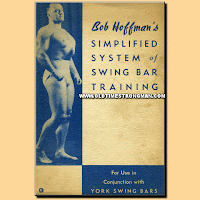
Despite this I stayed skinny, so I got my mom to buy me a barbell set. I still have that set and I have used it over and over in the years between then and now. It came with little booklets on developing various body parts, all written by Bob Hoffman (remember him of the barrel chest), who was a bodybuilder and head of York Barbell Company.
I suppose my lifting helped build my muscle tone, but nature took care of my thinness automatically. Halfway through my senior year I suddenly, like over night, filled out somewhat. I jumped from 155 pounds to 180 pounds.
Despite my weight gain, my limbs still looked like pipes. They were just too long. The measurements weren't bad and there was some definition, but with the extra long wrists what muscles I had kind of got lost. It is still this way. In most pictures my arms seem to dangle about with not much meat to them, but they really aren't all that slight.
Okay, I may not resemble Hulk Hogan, except around the hairline, but my arms get the job done.
My problem with my chest these days isn't it is too thin. It is the opposite. Oh, it was never in such great shape that I would ever be mistaken for Mr. America, but it was okay for laying about the pool without being totally a shame that it was seen in daylight by anyone.
When I was a teenager heros and tough guys in novels were always described as being six foot tall and weighing 200 pounds. That was what I thought was ideal during those skinny years. I was six foot tall, just nowhere near 200 pounds.
About a year before the picture on the right was taken, I had reached my dream and it was a nightmare. I not only achieved 200 pounds, I went up to 215 (my best bowling score incidentally). It was uncomfortable and this picture was after I shed all that excess baggage and got back well below 200 to the 180 I weighted at graduation from high school.
My weight has fluctuated up and down over the last few years. At the beginning of summer I was at 180 again, but I seem to always bloat up during the hot months and when i weighted myself yesterday I was at 190.
It is amazing how much difference ten pounds and the pull of gravity over seventy years can make, and that is why I never, well hardly ever, take my shirt off in public these days. And my paunch and drooping chest should make Ron feel a whole lot better about his own slight slippage.
Gee, do you think my white beard will get as long as Walt Whitman's?
Illustrations:
Photo at top of post: Walt Whitman in Camden, New Jersey, 1887 by Thomas Eakins
Photo of Scheuermann's Disease victim from Wikipedia.
All other photos taken by or owned by the author.
Spellcheck is saying that word "engirth" is incorrect and it is difficult finding a definition of it. You have to get back to Shakespearian times to find out it means "surround". Whitman, being a poet, couldn't make reading easy and just say, "The armies of those I love surround me."
Despite whatever archaic vocabulary Whitman choose to employ, some people understood certain lines of his poem well enough to feel uncomfortable, thus Leaves of Grass, the collection of poems that engirthed it, was often banned.
I hope my Blog doesn't suffer a similar state as I Sing the Body Elastic.
My piece isn't a poem. It is a paean and diatribe about this soma that has carried me about for more than seventy years. Yes, I know paean and diatribe are quite opposite things; this is a little bit of both, a tiny bit of bitter with the sweet.
I feel my body was created by a government committee, you know a bunch of rascals who make a compromise and come up with a convolution rather than a solution. You give a group of monkeys enough time and they will recreate the works of Shakespeare; you give a government committee any time and they'll screw it up. My own twisted up body may have thus resulted because my father was a Democrat and my mother was a Republican, proof positive that love conquers all.
I am told when I was born the doctor said I had a beautiful and most perfectly shaped head. I don't know what that bought me. I never had a girl come on to me and say, "I must date you for you have such a perfectly shaped head!" Maybe by the time I was dating age it wasn't so perfect anymore, after all it had been knocked about a good bit by then, had a brick fall on it and been hit by a golf club (a driver specifically). Whatever, when I look at my baby pictures it looks like most other baby heads. (What's with that cap? Did I have a unicorn horn on the top of my beautiful, perfectly formed skull?)
I was tall for my age and tall for my times. There were a few contemporaries as tall or taller, but I was always in the top ten. In my kindergarden class photo (I am kneeling in the front row on the far left wearing the striped shirt and baggy shorts) you can see I was already above my peers vertically. (Note also the prejudice of the era as the only black child in the class is standing apart from the rest of us.)
I may actually be taller than my height. It sounds a ridiculous statement, but is probably true nonetheless. That government committee that designed my carcass packaged me with scoliosis and if you straightened out my spine I might be a couple inches higher.
My father was always yelling at me to stand up straight and threatening to put me in a brace, which he never did. He also made the idea of a brace sound a dire punishment, something that would hurt terribly, so a medical aid became an object I feared and had nightmares about. I would try to stand straight, but of course I really couldn't since I was born crooked. Now I say scoliosis, but I am not certain it was ever really diagnosed. My children were diagnosis with mild scoliosis, but it is barely noticeable. They don't have quite the same physique as I and I wonder if I don't have Scheuermann's disease. When I feel my backbone it doesn't seem to have any twist to it, just a rounding at the top, and my shoulders don't tilt to one side or the other. I certainly do have the typical traits of Scheuermann's, a humped back and a deep barrel chest. (Aren't barrel chests supposed to be manly? Ernest Hemingway had a barrel chest. Bob Hoffman had a barrel chest [more about Hoffman later]).
You can see this curvature very clearly in the photo on the right as I bend to stroke a cat. This certainly resemble illustrations I have seen of people with Scheuermann's and a hump does pop up upon me, although perhaps not as severe as the photo of the disease's victim on the left.
According to what I read neither of these conditions is easily changed, especially once past childhood. There isn't a lot that can be done, really, although surgery might be used on those with extreme cases. Surgery on the spine is always a delicate operation, and like my psoriasis, the risks aren't necessarily worth the cure. (Yes, that was another nice add-on provided by the government committee on body implantation, psoriasis, which also came equipped with a side dish of psoriatic arthritis.)
Coming head-on, this little hiccup in design isn't very apparent, except my neck kind of disappears. In this photo, taken in days when I still had hair, and dark hair at that, you can just see the slight curve of my spine. You can also see how it has given me that barrel chest spoken of. (You can also see I really do have a neck.) Although I would hardly call my distortions extreme, it was enough for other kids to taunt me as a humpback, and worse, as Quasimodo.
Adding to my ridicule at the hands of some of my peers, my eyesight was deteriorating. I did not know this for who knows how long. I knew I couldn't see a lot of writing on the blackboard, but just attributed this to being seated too far back. You see, it was common practice then to seat pupils by height. I was among the tallest so usually I was sitting in or near the rear row. When I went to Junior High my nearsightedness was uncovered because they gave us eye exams in school.
Now I had to wear glasses; now I was "four-eyes".
There weren't a lot of kids wearing glasses in those days, so it made you stick out. I don't know if it is such a big deal anymore. At least today you can get contacts or thin wire frames that are almost invisible. No such things when I first got specs. Oh, no, they came with thick heavy plastic frames, tortoise shell or black. There was no hiding them.
Worst yet, I got glasses as I entered puberty. My body now became very elastic, very thin, very gangly. I was like some large insect, a Praying Mantis perhaps, long, thin, with too many appendages, but with a pumpkin for a head.
This picture of me in my Boy Scout Summer Uniform is one I dislike with a passion, but it does best represent the awkwardness my body adopted in my adolescent years.
Note in this picture my long arms. I have unusually long arms for my height. Or maybe my arms are perfectly matched to my "real" height, but appear too long because my twisted spine has lowered me by a couple inches. I do not know, but I know it is very hard to find shirt sleeves to fit. Generally if a shirt fits my chest and my neck, several inches of wrist still hang bare.
Overall, my body is very difficult to tailor. I have broad shoulders, a barrel chest, a curved spine, thinner hips, a narrower waist-to-chest ratio and these over-extended arms. Once when I had to have some new suits altered, the tailor, with his tape measure about his neck, pins in his mouth and chalk in his hand stopped in mid-mark to call to an associate.
"Hey, Matty, come over here and look at there arms!"
Somewhat humiliating.
I've mentioned there was another period when I did not like taking off my shirt in public. My teen years were the time. It was not because of my spine curvature nor the beginning spots of psoriasis. It was my skinniness.
Oh, I was thin. That is a picture of me in my junior year of high school on the left. Strip off my shirt and you could use me in biology to explain the human skelton. Every bone was prominent. My ribs stood out making me a human Glockenspiel. I didn't want anyone seeing that chest. I feared gym because teams were usually divided into shirts and skins. When we counted off, I always seemed to end up on the skins.
I followed the usual route of the skinny guy getting sand kicked in his face, I turned to exercise. I had a course, ordered from a magazine ad, called The Manly Art of Self-Defense or some such title. It was mostly devoted to boxing lessons, which I wasn't all that interested in, but it also came with various calisthenics and charts where you could record you progress, both in reps and in muscle gain. There was a little wheel you turned and it would tell you the best exercises for baseball or football or wrestling and so forth.
Despite this I stayed skinny, so I got my mom to buy me a barbell set. I still have that set and I have used it over and over in the years between then and now. It came with little booklets on developing various body parts, all written by Bob Hoffman (remember him of the barrel chest), who was a bodybuilder and head of York Barbell Company.I suppose my lifting helped build my muscle tone, but nature took care of my thinness automatically. Halfway through my senior year I suddenly, like over night, filled out somewhat. I jumped from 155 pounds to 180 pounds.
Despite my weight gain, my limbs still looked like pipes. They were just too long. The measurements weren't bad and there was some definition, but with the extra long wrists what muscles I had kind of got lost. It is still this way. In most pictures my arms seem to dangle about with not much meat to them, but they really aren't all that slight.
Okay, I may not resemble Hulk Hogan, except around the hairline, but my arms get the job done.
My problem with my chest these days isn't it is too thin. It is the opposite. Oh, it was never in such great shape that I would ever be mistaken for Mr. America, but it was okay for laying about the pool without being totally a shame that it was seen in daylight by anyone.
When I was a teenager heros and tough guys in novels were always described as being six foot tall and weighing 200 pounds. That was what I thought was ideal during those skinny years. I was six foot tall, just nowhere near 200 pounds.
About a year before the picture on the right was taken, I had reached my dream and it was a nightmare. I not only achieved 200 pounds, I went up to 215 (my best bowling score incidentally). It was uncomfortable and this picture was after I shed all that excess baggage and got back well below 200 to the 180 I weighted at graduation from high school.
My weight has fluctuated up and down over the last few years. At the beginning of summer I was at 180 again, but I seem to always bloat up during the hot months and when i weighted myself yesterday I was at 190.
It is amazing how much difference ten pounds and the pull of gravity over seventy years can make, and that is why I never, well hardly ever, take my shirt off in public these days. And my paunch and drooping chest should make Ron feel a whole lot better about his own slight slippage.Gee, do you think my white beard will get as long as Walt Whitman's?
Illustrations:
Photo at top of post: Walt Whitman in Camden, New Jersey, 1887 by Thomas Eakins
Photo of Scheuermann's Disease victim from Wikipedia.
All other photos taken by or owned by the author.
Monday, July 25, 2011
Hot and Hazy: Man Boobs and other Rambles, The Series Continues
At this time in my life I do not appear in public shirtless, for basically the same reason that Arnold (pictured left) should consider the same policy. There was a time I hated to remove my top for another reason, but we'll get to that next post.
Even so, it has been a blast furnace out there for several days, and since the "out there" I have been in the most is backwoods, I made a couple concessions to the hot and broke my rule. Doing so was not without reluctance, but a week ago I was on a trail where over the many moments I have walked it, I have almost never met another hiker and it had been months since that last "almost never" occurred. It seemed safe to throw caution, and my shirt, to the wind and I must say the shade of the forest did feel good on my bare skin.
I was indeed enjoying this freedom when what to my wandering eyes should appear, but a lady and two tiny reind...I mean, two dogs, neither really tiny, coming up the path toward me.
Oh well, nothing to do but step aside, blush, and let the lady and her pooches pass. We spoke briefly as polite people do and went our separate ways.
And yesterday I was on the same trail and made the same reluctant decision, and wouldn't you know, here comes the same woman and the same dogs and we exchanges the same pleasantries and went our same separate ways. And still I met the same woman once again before I had finished the trail. This lady has now seen my bare chest more times in recent years than anyone except my wife. My doctor hasn't even seen my bare chest three times in the last two years.
Okay, why are we talking about bare chests today anyway. It is because in a recent Post on his Blog, "Retired in Delaware", my life-long friend Ron complained he was getting "man boobs" (sometimes called "moobs"). On the right is the photo he posted as proof of his getting this condition plus a paunch. But before we deal with how if he thinks this he has a very vivid imagination, we probably should take a look at the word "boob" and gain some insight into it and this thing called "man boobs".
The word was once considered somewhat vulgar, but it has grown to such common overuse you barely go a day without hearing or seeing it, especially on the boob tube. For some of a newer generation who may think boob tube is some sort of pornographic peep show on the Internet, the term came into being about fifty years ago to describe television. Therefore, we see the word was in the common vocabulary decades ago. It is a stupid sounding word — boob — and that was its meaning during the years of my youth. If you did something stupid, you were a "boob". Crazy people were put in a "booby hatch", because they had to be restrained from doing stupid things. These terms had a different origin and had nothing to do with chests.
Boob, meaning fool, is a corruption of the Spanish for stupid, "bobo". It actually traces to the Latin word "balbus". Balbus didn't mean stupid, it meant stammering, but since the Romans thought anyone who stammered was stupid, it is virtually the same thing. Anybody ever read I, Claudius or see the PBS series based on it? Claudius had a bad stammer so everyone thought he was a moron until he became emperor.
Boob, meaning breast, has a different etymology, not Spanish nor Latin. Actually, there are some varied opinions. Some think it came from the buboes, the swelling of lymph glads, during the bubonic plague. Others place the blame on a 1762 novel by Henry Fielding, where a woman named Lady Booby tried to seduce the hero by exposing her breasts. Since the word boob or booby didn't really come into popular usage until the mid-1900s I rather discount this theory. Somehow I don't think a lot of people were reading, Fielding s' The History of Joseph Andrews in the 1930s and '40s.
The word "bubby" came about in the 1930s and over the next couple decades turned into "booby" and "boob". "Bubby" came from the German word "Bubbi", and remember Germany was a country much watched in the 'thirties. "Bubbi" means "teat" and "teat" means basically a nipple or the part of a mammal where it's young can drink milk. Teat was a fairly common term in farm country when I was a boy.
Fine, students, history lesson is over, let's get to the heart of his matter of "man boobs".
This term probably became popular in our lexicon after a particular Seinfeld episode concerning a problem of George's father and the invention of the Manssiere or Bro. It is a condition many of we males experience with age as years of gravity, decline of exercise and possible overeating have their way with our bodies. (Remember when Arnold had six-pack abs instead of looking like there were too many six-packs inside the abs.) Yes, sad but true, for many of us our once defined hard pecs become round and soft and resemble women's breasts. It generally does go as a set with a growing paunch. Look at my friend's photo again and you'll see he has pretty much failed the test of true man boobs and paunch. But he is young yet, only 69, he still has time to grow that belly and droop that chest.
In truth, this condition my friend is concerned about isn't really man boobs. It is just some flab and weakening muscle tone. There is a medical condition of man boobs called "Gynecomastia" caused by possible hormonal imbalances or other health issues and sometimes by medications. Men suffering from Gynecomastia can develop quite impressive breasts.
If Ron is concerned, he need only compare himself to Arnold. He has a long way to go to boast of a paunch of such worthwhile note.
Oh, and what of myself? I've already confessed I never take my shirt off in public. I don't even walk about my house shirtless. So this is very difficult for me, but here I be shirtless on that trail yesterday. Ron can take more comfort now. I am three inches shorter than he and probably weight thirty pounds more right now.
I've always felt I had a body build by a government committee. More about that next time.
TO BE CONTINUED -- NEXT: I Sing the Body Elastic.
Even so, it has been a blast furnace out there for several days, and since the "out there" I have been in the most is backwoods, I made a couple concessions to the hot and broke my rule. Doing so was not without reluctance, but a week ago I was on a trail where over the many moments I have walked it, I have almost never met another hiker and it had been months since that last "almost never" occurred. It seemed safe to throw caution, and my shirt, to the wind and I must say the shade of the forest did feel good on my bare skin.
I was indeed enjoying this freedom when what to my wandering eyes should appear, but a lady and two tiny reind...I mean, two dogs, neither really tiny, coming up the path toward me.
Oh well, nothing to do but step aside, blush, and let the lady and her pooches pass. We spoke briefly as polite people do and went our separate ways.
And yesterday I was on the same trail and made the same reluctant decision, and wouldn't you know, here comes the same woman and the same dogs and we exchanges the same pleasantries and went our same separate ways. And still I met the same woman once again before I had finished the trail. This lady has now seen my bare chest more times in recent years than anyone except my wife. My doctor hasn't even seen my bare chest three times in the last two years.
Okay, why are we talking about bare chests today anyway. It is because in a recent Post on his Blog, "Retired in Delaware", my life-long friend Ron complained he was getting "man boobs" (sometimes called "moobs"). On the right is the photo he posted as proof of his getting this condition plus a paunch. But before we deal with how if he thinks this he has a very vivid imagination, we probably should take a look at the word "boob" and gain some insight into it and this thing called "man boobs".
The word was once considered somewhat vulgar, but it has grown to such common overuse you barely go a day without hearing or seeing it, especially on the boob tube. For some of a newer generation who may think boob tube is some sort of pornographic peep show on the Internet, the term came into being about fifty years ago to describe television. Therefore, we see the word was in the common vocabulary decades ago. It is a stupid sounding word — boob — and that was its meaning during the years of my youth. If you did something stupid, you were a "boob". Crazy people were put in a "booby hatch", because they had to be restrained from doing stupid things. These terms had a different origin and had nothing to do with chests.
Boob, meaning fool, is a corruption of the Spanish for stupid, "bobo". It actually traces to the Latin word "balbus". Balbus didn't mean stupid, it meant stammering, but since the Romans thought anyone who stammered was stupid, it is virtually the same thing. Anybody ever read I, Claudius or see the PBS series based on it? Claudius had a bad stammer so everyone thought he was a moron until he became emperor.
Boob, meaning breast, has a different etymology, not Spanish nor Latin. Actually, there are some varied opinions. Some think it came from the buboes, the swelling of lymph glads, during the bubonic plague. Others place the blame on a 1762 novel by Henry Fielding, where a woman named Lady Booby tried to seduce the hero by exposing her breasts. Since the word boob or booby didn't really come into popular usage until the mid-1900s I rather discount this theory. Somehow I don't think a lot of people were reading, Fielding s' The History of Joseph Andrews in the 1930s and '40s.
The word "bubby" came about in the 1930s and over the next couple decades turned into "booby" and "boob". "Bubby" came from the German word "Bubbi", and remember Germany was a country much watched in the 'thirties. "Bubbi" means "teat" and "teat" means basically a nipple or the part of a mammal where it's young can drink milk. Teat was a fairly common term in farm country when I was a boy.
Fine, students, history lesson is over, let's get to the heart of his matter of "man boobs".
This term probably became popular in our lexicon after a particular Seinfeld episode concerning a problem of George's father and the invention of the Manssiere or Bro. It is a condition many of we males experience with age as years of gravity, decline of exercise and possible overeating have their way with our bodies. (Remember when Arnold had six-pack abs instead of looking like there were too many six-packs inside the abs.) Yes, sad but true, for many of us our once defined hard pecs become round and soft and resemble women's breasts. It generally does go as a set with a growing paunch. Look at my friend's photo again and you'll see he has pretty much failed the test of true man boobs and paunch. But he is young yet, only 69, he still has time to grow that belly and droop that chest.
In truth, this condition my friend is concerned about isn't really man boobs. It is just some flab and weakening muscle tone. There is a medical condition of man boobs called "Gynecomastia" caused by possible hormonal imbalances or other health issues and sometimes by medications. Men suffering from Gynecomastia can develop quite impressive breasts.
If Ron is concerned, he need only compare himself to Arnold. He has a long way to go to boast of a paunch of such worthwhile note.
Oh, and what of myself? I've already confessed I never take my shirt off in public. I don't even walk about my house shirtless. So this is very difficult for me, but here I be shirtless on that trail yesterday. Ron can take more comfort now. I am three inches shorter than he and probably weight thirty pounds more right now.
I've always felt I had a body build by a government committee. More about that next time.
TO BE CONTINUED -- NEXT: I Sing the Body Elastic.
Thursday, July 14, 2011
Remembering Little Things
Left to right (1957 to 2011):
Larry, Stuart and Ronald.
Memories, like ghosts, float about to haunt our senior nights. Sometimes they come unbidden; sometimes through incantations uttered wispily we call them forth. There are bad recollections, of course. The ones we conjure up and embrace are the good reminisces, which we occasionally wish we could relive.
"Let's form a band." I don't recall who had the idea. It seemed a good one at the time. Rock 'n' Roll was blossoming with people like The Mike Pedicin Quartet, Freddie Bell and the Bellboys, Bill Haley and the Comets and some wiggle worm named Elvis. We all played instruments, why not get in on the action.
There were four of us and we got together a few times and gave it a shot. Or was it someone tried to shoot us? There was Stuart on his baritone, a kind of undernourished tuba, Teddy on slide trombone and me on trumpet, all trying to produce some kind of harmony to the rhythmic beats of Bill on his snare drum.
We were a long way from the aforementioned pioneers of Rock. We were more a pathetic echo of a very bad Salvation Army Band. All we lacked was Ron on the Sousaphone, but this was a few years before he took up that instrument.
We were making our caterwauling in a room at Stuarts.This shows the graciousness of his lovely mother that she didn't attack us with a broom and sweep us out the door.
There were three of us who stuck fast through those days, Stuart and Ronald and I. Other friends flitted in and out of our world, but it was always we three who danced to the same drummer, although we were different in many ways. I remember evenings of gathering before early TV to watch frontier Playhouse, old westerns cut down to fit the screen, which seemed new to us. Or the more scary or imaginative stuff we shared an appetite for. Stuart and I sharing some horror on "Shock Theater", laughing along with the cadaverous host, Roland (pictured on left). Or Ronald and I at his place taking in the latest episode of "Twilight Zone".
We were fans of horror. Stuart introduced me to the writings of H. P. Lovecraft and the three of would sit in the sticky-floor dark of Roosevelt Theater watching those Universal Monsters terrorize the foggy British countryside. One winter we took in the afternoon matinee of "Wolfman". At one of the transformation scenes, I turned my fur-lined gloves inside out and grabbed Stuart's neck. He slid off his seat with a scream.
(The former Roosevelt Theater, formerly Downingtown Opera House, as it appears now is on the right.)
But time and the river flow on and life took us away from each other. If the highways of life parted us, the web of the internet brought us back. After I lost my bank job ten years ago, Ronald contacted me and we picked up by email our old friendship. Not long after he found Stuart in Florida and I began to co-author plays with Stu, just as we use to create songs together fifty-plus years ago.
Still, it was a long distance relationship. Oh, Ron moved down to Southern Delaware and I did get to visit with him a handful of times, it was forty or more years since either of us breathed the same air as Stuart. Then just before Stuart and I approached our 70 birthdays at the end of June, along came Leslie.
Leslie is the charming and talented daughter of Stuart (and how could she not be talented with a father such as he?) She began arranging a reunion between us, a get together in the vicinity of Philadelphia and so, on July 10, we came together once again in Mrs. Marty's Deli in Broomall.
It was as if time had never been. The comfort was there, the ease, the banner and the talk.
I hope we can meet again this way before another forty years or so rolls down the highway. My knees aren't so good now. I fear they may give out altogether when I am over 110.
Below is a video record of the day, pieced together by your's truly from film taken by Ronald and myself. Leslie took her own and hopefully we'll see us from her lens viewer one of these fine days.
Now, if I could only reunite with my hair!
Desperadoes for Dessert
Desperadoes in the Afternoon
Larry, Stuart and Ronald.
Memories, like ghosts, float about to haunt our senior nights. Sometimes they come unbidden; sometimes through incantations uttered wispily we call them forth. There are bad recollections, of course. The ones we conjure up and embrace are the good reminisces, which we occasionally wish we could relive.
"Let's form a band." I don't recall who had the idea. It seemed a good one at the time. Rock 'n' Roll was blossoming with people like The Mike Pedicin Quartet, Freddie Bell and the Bellboys, Bill Haley and the Comets and some wiggle worm named Elvis. We all played instruments, why not get in on the action.
There were four of us and we got together a few times and gave it a shot. Or was it someone tried to shoot us? There was Stuart on his baritone, a kind of undernourished tuba, Teddy on slide trombone and me on trumpet, all trying to produce some kind of harmony to the rhythmic beats of Bill on his snare drum.
We were a long way from the aforementioned pioneers of Rock. We were more a pathetic echo of a very bad Salvation Army Band. All we lacked was Ron on the Sousaphone, but this was a few years before he took up that instrument.
We were making our caterwauling in a room at Stuarts.This shows the graciousness of his lovely mother that she didn't attack us with a broom and sweep us out the door.
There were three of us who stuck fast through those days, Stuart and Ronald and I. Other friends flitted in and out of our world, but it was always we three who danced to the same drummer, although we were different in many ways. I remember evenings of gathering before early TV to watch frontier Playhouse, old westerns cut down to fit the screen, which seemed new to us. Or the more scary or imaginative stuff we shared an appetite for. Stuart and I sharing some horror on "Shock Theater", laughing along with the cadaverous host, Roland (pictured on left). Or Ronald and I at his place taking in the latest episode of "Twilight Zone".We were fans of horror. Stuart introduced me to the writings of H. P. Lovecraft and the three of would sit in the sticky-floor dark of Roosevelt Theater watching those Universal Monsters terrorize the foggy British countryside. One winter we took in the afternoon matinee of "Wolfman". At one of the transformation scenes, I turned my fur-lined gloves inside out and grabbed Stuart's neck. He slid off his seat with a scream.
(The former Roosevelt Theater, formerly Downingtown Opera House, as it appears now is on the right.)
But time and the river flow on and life took us away from each other. If the highways of life parted us, the web of the internet brought us back. After I lost my bank job ten years ago, Ronald contacted me and we picked up by email our old friendship. Not long after he found Stuart in Florida and I began to co-author plays with Stu, just as we use to create songs together fifty-plus years ago.
Still, it was a long distance relationship. Oh, Ron moved down to Southern Delaware and I did get to visit with him a handful of times, it was forty or more years since either of us breathed the same air as Stuart. Then just before Stuart and I approached our 70 birthdays at the end of June, along came Leslie.
Leslie is the charming and talented daughter of Stuart (and how could she not be talented with a father such as he?) She began arranging a reunion between us, a get together in the vicinity of Philadelphia and so, on July 10, we came together once again in Mrs. Marty's Deli in Broomall.
It was as if time had never been. The comfort was there, the ease, the banner and the talk.
I hope we can meet again this way before another forty years or so rolls down the highway. My knees aren't so good now. I fear they may give out altogether when I am over 110.
Below is a video record of the day, pieced together by your's truly from film taken by Ronald and myself. Leslie took her own and hopefully we'll see us from her lens viewer one of these fine days.
Now, if I could only reunite with my hair!
Three Desperadoes Ride Again
Desperadoes at Lunch
Desperadoes for Dessert
Desperadoes in the Afternoon
Labels:
A BOOK Meandering Metaphysically,
friendship,
Leslie Meisel,
Reunions,
Ronald,
Stu,
Written 2011 in Delaware
Friday, July 1, 2011
Wave to Uncle Ron (Written January 29, 2011)
Retired in Delaware found himself visited by the Black Dog of Depression the other day. That can be almost as bad as being hounded by the Hounds of the Baskervilles I understand. Such beasts have tracked down The Little Woman many times in her life. It isn't a pleasant thing.
Ron seems to be recruiting cats to hiss and claw away the Black Dog, so here is another cat trying to cheer him up.
This little guy, Kerouac (yes, named for the "Beat" writer), a few months ago was on the road himself. Do not know his history, but my son and his co-workers found this tiny kitten huddled beneath the carts outside their store.
He had apparently been hiding out there a couple days. My son brought him home and here he is.
If he wasn't here, he would have probably died, either from starvation, because he was skinny and famished when we took him in, or run over by the many cars in the parking lot of that mall.
He is the cutest little rascal, who nows likes to sleep in the crook of my arm when he isn't finding something new to play with.
Last year about this same time in similar conditions, that is much, much snow, this other cat showed up here. He was the opposite of Kerouac, being very large and black. Where he came from we do not know either and we assumed for a long time he was feral, but it turned out he wasn't. We were putting out food for him through two blizzards and the entire winter, finally luring him close that May. Now he is not out in that stuff this year, but cozy and warm and happy to snooze in a bed too small.
He had headed to this bed when we took him in and I guess he considers it his and compared to sleeping beneath a house in freezing weather, who cares if it is a bit snug.
The cat in the new Profile Picture is Mark. Mark came here (just for overnight) five years ago when he was a kitten. My middle daughter brought him home. He had been found wandering the road in front of St. Marks High School by a shelter worker, who rescued him and brought him to the shelter. My daughter, also a shelter worker, brought him home because there was no room for him at the inn. "Just overnight," she said. Mark made a beeline for my chest as I lay watching TV and nuzzled up against my chin. So much for this just overnight nonsense.
Cats always know who the big softie is.
Ron seems to be recruiting cats to hiss and claw away the Black Dog, so here is another cat trying to cheer him up.
This little guy, Kerouac (yes, named for the "Beat" writer), a few months ago was on the road himself. Do not know his history, but my son and his co-workers found this tiny kitten huddled beneath the carts outside their store.
He had apparently been hiding out there a couple days. My son brought him home and here he is.
If he wasn't here, he would have probably died, either from starvation, because he was skinny and famished when we took him in, or run over by the many cars in the parking lot of that mall.
He is the cutest little rascal, who nows likes to sleep in the crook of my arm when he isn't finding something new to play with.
Last year about this same time in similar conditions, that is much, much snow, this other cat showed up here. He was the opposite of Kerouac, being very large and black. Where he came from we do not know either and we assumed for a long time he was feral, but it turned out he wasn't. We were putting out food for him through two blizzards and the entire winter, finally luring him close that May. Now he is not out in that stuff this year, but cozy and warm and happy to snooze in a bed too small.
He had headed to this bed when we took him in and I guess he considers it his and compared to sleeping beneath a house in freezing weather, who cares if it is a bit snug.
The cat in the new Profile Picture is Mark. Mark came here (just for overnight) five years ago when he was a kitten. My middle daughter brought him home. He had been found wandering the road in front of St. Marks High School by a shelter worker, who rescued him and brought him to the shelter. My daughter, also a shelter worker, brought him home because there was no room for him at the inn. "Just overnight," she said. Mark made a beeline for my chest as I lay watching TV and nuzzled up against my chin. So much for this just overnight nonsense.
Cats always know who the big softie is.
Labels:
A BOOK Cats and Dog,
Animals,
cats,
dogs and cats,
kindness,
Retired in Delaware,
Ronald
Tuesday, June 28, 2011
Desperadoes
Over Christmas of 1949 my family moved from the isolation of a swamp into a town. After the Christmas-New Years vacation ended, I resumed third grade in a new old school. I put it that way because I had statred in that school in First Grade, but we had moved away half through that year, so it was an old school for me, but by now also a new one. I was starting over again and was very much the oddball, the hick, the country bumpkin as far as most of the other students were concerned. That is my Third Grade picture on the left, but I am not certain in which school it was taken.
I did make a few friends in my new situation. One of the first (I did have a continuing friendship with a girl I had known since whenever we can actually know others) was a tall, gangly fellow named Ronald. That is his Third Grade Photo on the right.
Our friendship started as just an exercise in trading comic books, but quickly grew to best friend status. Ron was someone I felt very comfortable around, more so than probably anyone I have ever known. After 61 years, differences and distances, we remain close friends and I insist we do until one of us is a pallbearer for the other.
There really was a third member of this life-long friendship, another boy I counted as a best friend and who also remains so to this day. I met him around the same time as Ron, so we three desperatoes have been a group for a long time. This other guy was Stuart. All three of us were probably something of outsiders in our little town.
That is Stuart in a Third Grade group photo, the boy standing on the right in a striped shirt. Ron is standing directly behind and half hidden by him in this picture.
We hung together through Grade School and pretty much high school, although I moved from town to country in 1956 and it was as often we could get together.On the right are we standing behind the carriage house behind Stuart's home in 1957. That is your's truly slouching on the left and Ron on the right; both of us using Stuart as a leaning post between us.
Both Stuart and my birthdays were this week, three days apart, so Ron remains very much our junior, since he will not turn 70 until November.
Stuart is the furtherest flung since he lives in Florida. Ron and I both dwell in the wonderful state of Delaware, me at the top and he at the bottom. Right now we are making plans to all get together in Philadelphia next month. This should be wonderful.
I supposed the years have made some changes to our appearance, but not to our love of each other.
Last week, Ron invited me down to his place and a visit to Rehoboth Beach. It was his birthday present to me, much appreciated too. We went to the Olde Tyme Photo Shoppe (not certain they actually spell it this way) and had our picture taken as the cowboys we really are at heart. Here is the result:
Don't we look like we rode with John Wayne?
Here is video of our day. (I suggest you turn off my music player by scrolling to the bottom of my blog and then turning up your speakers.)
Labels:
A BOOK Meandering Metaphysically,
Eateries,
Friends,
friendship,
Ronald,
Stu,
Videos
Subscribe to:
Posts (Atom)


