Banner photo of Larry Eugene Meredith, Ronald Tipton and Patrick Flynn, 2017.

The good times are memories
In the drinking of elder men...

-- Larry E.
Time II
Showing posts with label music. Show all posts

Thursday, April 14, 2016

Music Calms My Savage Beast or Breast or Whatever...

Before TV we had records. There was a large console radio/record player belonging to my parents that played 78 RPM records. Music provided another world that I could escape to from the day after day depression I was beginning to feel. There is a saying that music has charms to soothe a savage breast, which I thought was savage beast. Apparently I am not alone in my mistake, this seems to be a common misquote, just as the saying is often attributed to either Shakespeare or The Bible.  You know, when in doubt of a source Shakespeare and The Bible are always good guesses. This particular quote is from neither, I fear, but is the first line from a play by William Congreve titled, The Mourning Bride.
Some of the guys who terrorized my streets at times may have been savage beasts, and music  may have given me respite from them, but it also was an alternative to the savage breast if you count those imaginary pirate ladies that haunted my imagination. Often, since much of my time at home was alone, I simply plopped down on the floor before the great music console and listened to my parent’s records, an eclectic collection.
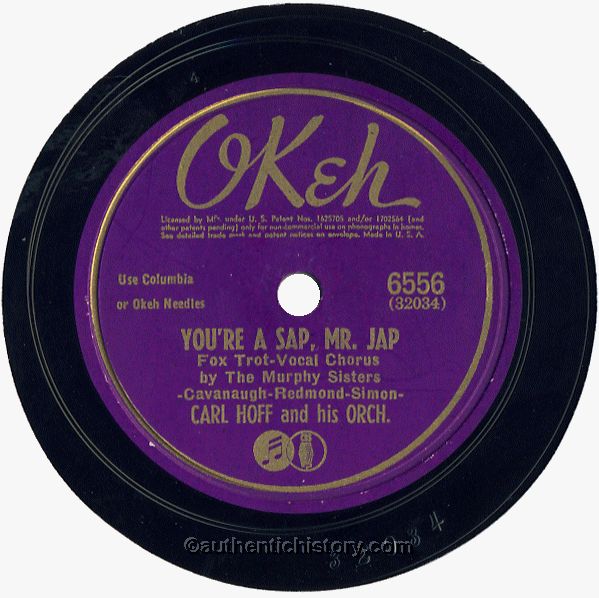
It ranged from my dad’s varied Hillbilly singers, such as Montana Slim (Real name: Wilf Carter), Patsy Cline and Hank Williams, to recordings of Horace Hite and his Californians, Fred Waring and the Pennsylvanians, Kay Kyser, Woody Herman, Ella Fitzgerald, Paul Whitman, Jo Stafford and Bing Crosby. Think about it, from Bill Monroe and the Blue Grass Boys to Vaughn Monroe crooning “Ballerina”. Not to mention such hits as “We Gotta Put Shoes on Willy” and “You’re a Sap, Mr. Jap”. You can throw into this mix a guy that quickly became one of my favorites, Spike Jones & his City Slickers (pictured).

I received a portable record player between Grade School and Junior High. What they considered portable then was often heavy enough to need a hand truck to move.

The size of the player was not the only difference between my player and my parent’s console. Mine would play 78 and 45-RPM records. A 45 was about half the size of a 78, except for the hole that was many times larger. The record player had a removable spindle to allow for this center hole differential. This also allowed me to own my own records.
I bought a lot of Gateway Record covers of hit songs down at Newbury’s. Gateway was a knockoff record company and their recordings were half the cost of the big name labels like RCA, Decca, Columbia or Okeh (which became Epic Records in 1953). I figured if I liked a song it didn’t matter much who sang it, but I did mix in some name artists when I could afford it.
There was a new sound on the market at this same time. The  songs were mostly covers of older Rhythm ‘n’ Blues songs sung by White bands. The lyrics were sometimes “cleaned up” a bit. This kind of music was really catching on by 1954 and ‘55. Alan Freed, a disc jockey known as Moondog (pictured right) is credited with the term Rock ‘n’ Roll. Freed was the king of the airwaves for a period, but his career plummeted in the Payola Scandals of 1960.

Rock ‘n’ Roll had also taken over afternoon TV. After school I would turn on the TV for a local show out of Philadelphia called “Bandstand” hosted by Bob Horn (pictured left). Horn had a show on radio called “Bob Horn’s Bandstand”. He moved to TV in 1952, replacing movies on Channel 6. At first he showed short films, the grandfathers of music videos. He didn’t like this format. There was another radio show at the same time called the “950 Club” hosted by Joe Grady and Ed Hurst. (Remember those names they will come up again.) The “950 Club”, despite being a radio show, invited teenagers to dance to the music in the studio. Horn stole that idea for his TV show and “Bandstand” became ahit and Horn a area star.

Horn hosted the show from 1952 to 1956. He ran afoul of the law by then. A teenage dancer accused Horn of statutory rape. They never convicted him on this charge, but he was convicted for drunk driving. His DUI got him fired on July 9, 1956. Walter Annenberg, owner of both WFIL and The Philadelphia Inquirer, hired a 30-year old TV host, who looked like he was about 18 years old, named Dick Clark to host the show.

An example of the revamped Rhythm “n’ Blues songs was “Hound  Dog”, a big hit on the R&B Charts in 1952 for Willie Mae “Big Mama” Thornton. The first successful Leiber and Stroller song, it became a big hit again in 1955 when released with slightly altered lyrics by Freddie Bell and the Bellboys. (In 1958 it would again be a hit when done by some southern boy with the odd name of Elvis.)
The musician who really put Rock ‘n’ Roll on the map in the early 1950s, though,  was a guy from Boothwyn, Pennsylvania (not far from where I now live) sporting a strange loop of hair on his forehead. Bill Haley and the Comets (pictured left) had a string of hits, including “Shake, Rattle and Roll”, “Dim, Dim the Lights” and what would become the signature song of the era, “Rock around the Clock”.

Stuart, Ronald and I had been making little recordings of our own at the Farmers’ Market. Stuart said to me one afternoon, “Let’s start our own Rock ‘n’ Roll band.” (Have you notice that Stuart was quite the idea man. I’d say he still is, but we'll wait to many, many years in the future to continue that thought, if we ever get that far.)


I wish I had a picture of our band. We were closer to a Salvation Army Band than any Rock Band you ever saw. There was no guitar in sight. Our drummer was Bill Brookover, who had but one snare drum to beat rhythm upon. Most of the band was brass, Teddy Miller on Trombone, Stuart Meisel on his Baritone and I on Trumpet. Gary Kinzey may have snuck in there on his Saxophone. We practiced in one of the parlors at Stuart’s house and at one point we tried playing back on a plank platform we built in the woods. We didn’t build this for our band; it was all ready there. Perhaps it was the remains from our old lean-to. We were downright awful. We probably scared every squirrel and chipmunk out of Downingtown. Our attempt at Rock fame and fortune did not last for long.
Rock ‘n’ Roll wasn’t completely dominating the charts yet. One of the biggest hits of 1955 came out on October 17. Tennessee singer-comedian-actor Ernie Ford sung it. “Sixteen Tons” stayed at the top of “Billboard” so long the TV show, Hit Parade was running out of ways to present it each week. The song became one of my earliest poem parodies since “The Ballad of Peppy the Pup”. I wrote “Rich Man$ $ixteen Ton$” in ’55.

Some people say a man is made out of mud.
A rich man is made out of money he loves;
Money he loves and dollars and cents --
A wallet that’s thick and a safe that’s strong.

He loads sixteen tons of cash every day.
Sixteen tons and that ain’t hay.
Saint Peter don’t you call him,
‘Cause you all know.
You can’t take it with you,
            So he won’t go!

As much fun as it was fooling around with music with my friends that fall, I still had to face my worse school year to date, Ninth Grade. I think the school photos captured my descent through junior high.
A photographer took class pictures every year in public school. I have my portraits showing my changing features for each grade except those at West Whiteland. West Whiteland is the black hole of my life. The records of those years are gone and the memory erased from my brain. I didn’t even find any photographs among my mother’s collection.
This photograph is sixth grade and I am looking straight on at the camera for the last time. My face is getting the roundness it took on in early puberty.

Seventh Grade was my first year wearing spectacles. I use that older word because glasses made you a spectacle of ridicule in the 1950s. Note how my head is turned and tilted to my left. Here was another setting apart from others. The photographers would no longer take me full face because the glasses lens reflected their lighting.

My face grew gaunt by eighth grade and even my faint smile disappeared. At least the photographer had my head at a less awkward angle. I believe you can see some of my growing inner torment in this picture.

I had been going to Clarence Miller’s Barber Shop since dad forced my first haircut on me as a toddler. I had been to a couple other barbers briefly during grade school. I went to a new young barber who had a shop somewhere on a cross street off of Chestnut near Pepperidge Farm. His name was Tony. It was at the time when the “Teddy Bear” cut was popular. I don’t know why I needed a different barber for that. The barber basically ran his electric clippers all over your head and left you with a layer of fuzz.
The other temporary barber was my grandfather’s idea. He took me to this barber on the West Side. This man’s shop was next to the pool hall and he charged a quarter less than Miller. But I always came back to Clearance.
As Rock ‘n’ Roll took hold of the music scene haircuts changed. There was more variety. I had never been satisfied with the way Miller cut my hair, but as a kid was reluctant to correct my barber. Now I demanded a different cut, one of the new styles appearing on the scene. They called it the “Hollywood”. They cut the top like a “flattop”, even and bristly, but left the sides longer, then swept it up and back. I also left my sideburns longer.
Other kids even razzed me about the sideburns. It isn’t like I had Muttonchops down to my chin, but sideburns were another little different between us; that is, they were weird for about a year until Elvis Presley made a splash and then everyone suddenly had them.
I choose Ping Pong as my club in Ninth. I had never played the game before as far as I know. Ronald was also in that club with me. Whether he choose it because I did or vice versa I don’t know. There were three separate Ping Pong clubs with nearly fifty kids altogether. Near the end of the year they held a Round Robin tournament among the three clubs. I finished fifth.

I was fairly good in any sport requiring a net except Basketball. (Boys didn’t play Hockey, which was strictly a girl’s sport in those days. I probably would not have played Hockey well.) I was good at Volleyball, Badminton and later Tennis.

It may have been a mistake not returning to Audio Visual Aids. Ninth Grade Classes were something I really wished to escape from. They were a horror for me and they were coming soon.

Wednesday, March 23, 2016

Blasts

 Downingtown did not have middle schools in the 1950s. You went to Elementary School for six years, not counting kindergarten. There were three years of Junior High School followed by three of Senior High. There was one teacher and one classroom each grade for those first six years. The only deviation was for Music and Gym.  (Picture left: Mrs. Yost and my sixth grade class.)

Beginning with Fourth Grade we had what they called Gyn. A Physical Education teacher would come twice a week and lead us through some kind of activity. In the cold or wet weather we would play such things as Dodge Ball or Steal the Bacon in a large room in the basement. We even had square dancing once in awhile.
We would go outside when the weather permitted. We might still play Dodge Ball out on the blacktop, which was fine by me. If there was one thing I was good at it was dodging. I was quick and skinny. We played sports such as baseball and soccer. We also played Kick Baseball and Capture the Flag. I knew how to play soccer., more than my classmates, the only team sport I could make such a claim about. I must have learned it at West Whiteland, where they played a lot of soccer, which was my only memory of that school. I couldn’t remember actually playing it while there though. I had vague images of bleachers and people playing was all. This was another piece of the puzzle that was West Whiteland for me.
Other than soccer, I was usually chosen near last for teams. I actually wasn’t that bad at most of these games by Sixth Grade, but I still wasn’t popular. I was very bad at Basketball. I wouldn’t have picked me for Basketball either. I could throw the ball through the hoop easily enough. I did well in games such as H-O-R-S-E, but in an actual game of Basketball I got totally confused. I fowled all the time, threw the ball to the other team or simply stood around like a rock.
The Gym teacher who came to East Ward was the principal of the West Ward Elementary School and his name was Mr. Dreibelbis. I remember he wore glasses and had acme scars on his cheeks. He was not a harsh coach.
Once a week we had Music. Mr. Joseph Poltrone was the Music Teacher. I though he had the perfect name, Poltrone sounded like a musical instrument. He also was the director of the bands for both East Ward and West Ward Grade Schools as well as the Junior High. He recruited for Band in fourth grade. I was one of those he talked into it.
I choose to play the Clarinet. The school supplied a loaner instrument and Mr. Poltrone gave some initial lessons. I didn’t last long on the "licorice stick". I could not get the hang of pressing the keys with both my right and left hands. After a couple weeks I switched to the trumpet. The trumpet only had three valves to worry about all played with the right hand. I didn’t have to fool around with those temperamental reeds with a Trumpet either.
My mother and grandmother took me to a store in Coatesville and bought me my own Trumpet. We rode the Short Line Bus both ways because they still hadn’t learned to drive. Next they enrolled me for lessons with a private tutor. My trumpet teacher was Mr. Miller. He was the son of my barber, Clarence Miller. Once a week I would go to Mr. Miller’s house (pictured left) located  on Manor Avenue, near the Jr.-Sr. High School, for an hour and torture the poor man with my bleats.
Actually I learned to play well enough to get by in band. I had trouble tuning the horn because of my hearing glitch, but thankfully the Trumpet didn’t go out of tune very often. It wasn’t as complicated to tune as a guitar, something I taught myself to play many years later.
Some of my friends were in East Ward Band except Ronald, Dave Fidler and Bill Brookover. Bill wasn’t in Band, but he did play the accordion. Gary Kinzey played Saxophone. Teddy Miller played slide trombone and Stuart played a brass instrument called the Baritone (pictured right). It looked something like a tuba, but was smaller and had a higher pitch level. Dave did play the violin, but there weren’t any strings in the East Ward Band.
We didn’t march either. We did play a couple concerts. I played all four years from Fourth through Sixth.

The administrators realized the transition from Grade School to Junior High was difficult for some. When the Sixth Grade school year was nearing its end the school board set aside one day in late spring to acquaint us with Junior High.
On a day in May Mrs. Yost led us through the streets of Downingtown to the Junior High School (on the left is me in front of the Junior High emoting, “I have arrived”, 1953). They brought all the Sixth Grades in the district there on that same day. Mr. Dreibelbis came with the West Warders.
If the visit was to reassure us, it failed. The hallways were crowded with older kids all in a rush between classes. They shoved, bumped into and snarled at us. Everybody looked so much bigger than we were.
Ronald, Stuart and I hoped to stay together, but they split us up and put us in groups with kids we didn’t know. A Seventh Grader guided us throughout the day. Every period it was go to this room and then to that. Sometimes the rooms were at extreme opposite ends of the building. A bell rang and you had a set time to get to the next class. When a second bell rang you had only seconds before being late.
Part way through the day was a lunch hour. There was a cafeteria at East Ward, but it was only a large room in the basement with long wooden tables and chairs. The only thing sold at East Ward was milk. It was fifteen cents for a pint. Duer Smedley’s father was a milkman and delivered the milk to the school each weekday morning. I forget the brand. Everybody brought his or her lunch from home in a brown paper bag or little tin lunchbox. The cafeteria smelled like a concoction of bologna, peanut butter and bananas.
In comparison the High School Cafeteria was huge. Downingtown had one High School building. It served as both Junior and Senior Highs. The Junior High wing was to the South side. There was one cafeteria, one gymnasium and one auditorium for all grades seven through twelve. Long fold up tables of a tan color filled the center of the room. The chairs were folding chairs, too. There was a kitchen to the back and serving stations along its front. The line of kids stretched around the outer walls of the room and into the hallway.
They sold full lunches in the cafeteria. There was a different entrée each day along with side and desert choices. They gave us the menu for the week during the morning orientation. Hot dogs and Beans, Macaroni and Cheese, Sloppy Joes, something called Rigatoni, which sounded like the name of an opera, and something else called Shepherd’s Pie. The school gave us a free lunch that day as visitors.

The line moved slowly. There were two older students behind me. I overheard one say, “Go ahead ask him. I bet he does.” Next thing I knew one of them tapped me on the shoulder.
I turned my head.
“Hey,” he said, “do you play with yourself?”
What a stupid question. I answered it truthfully. “Sure. If I don’t have anyone else to play with, I play with myself.”
They doubled over in laughter. I didn’t see what was so funny. Did they always have a friend around so they never had to play by themselves?
One tapped my shoulder again after they had calmed down. “You have that teacher?”
“Who?” I asked.
“He pointed to a man further ahead in the line. I recognized Mr. Deibelbis, the principal of West Ward.
“Sometimes,” I said.
“Do you know his name?” he asked. He didn’t give me a chance to answer. “Mr. Drivel Piss,” he said and they doubled over in laughter again.
I got my food and found a table. I just wanted the day to be over.

I didn’t feel I was going to like this place very much. I didn’t know the half of it yet.


EXCERPT FROM MRS. CAREY'S CHICKENS
(Written Downingtown, 1954)

Carey led her flock across a quadrangle of walks, through a side entry and down a corridor, through another door into the gymnasium. Waiting beneath the basketball hoop was another gathering of kids, behind which waited a small cluster of adults. They were the West Warders and their chaperones. Mrs. Carey joined these adults leaving her East Warders facing across at their sixth grade counterparts from the “bad side of town”. A moment passed in silence before a thin man slipped from the adult pack waving his arms for attention.
The man gave a brief smile, unused or uncomfortable doing so. His arms still waved, pulling his jacket up a little on his neck. He had a long nose, gray hair and slightly lopsided mouth.
Somebody giggled.
A teacher went, “shhh!”
“Good morning.” said the man. “My name is Mr. Maxilla. I will be your principal next year. I welcome you here. I expect in the three coming years, in fact am certain, you will bring to us much honor, much credit to Wilmillar Junior High. Meanwhile, I wish to make perfectly clear why you are here today.
“As you have probably heard, the school board, with my full agreement by the way, has long felt the transition from grade school, with its one teacher, one classroom tradition, to junior high school, with its many teachers, many classrooms technique, can be traumatic.
“Therefore, it is felt, and I agree, make no mistake about that, a gradual withdrawal from the elementary milieu is best. This visit allows you to obtain knowledge of your future and thus be better prepared to conduct yourselves with honor and dignity when you arrive full time next September.
“Now I must be about the important business of a principal. I leave you to your guides. Thank you for your attention, and good luck.”
With a nod, he rushed from the gym. In the next minutes, they counted off into groups of three. Each group was assigned to a seventh grader to guide them through the labyrinth of junior high. Frank March, Larry Brown and a west warder named Cary John Masters had a guide named Doug Virgilson, a skinny, freckled youngster with floppy brown hair and sleepy eyes.

“The first thing, y’know,” said Doug, “is to see the locker set-up, y’know, and get my books, y’know.”

Friday, March 7, 2014

A Mind for Music…or did they say, "If I think this is music I must Be Out Of My Mind?

Way back in the ancient days when dinosaurs still roamed the earth (or were they just automobiles with giant fender fins?), I dabbled in a number of things. One of those things was songwriting so to speak. Having something of a tin ear, this was pretty much a challenge. I couldn't carry a tune if you loaded it on a forklift. However, in fourth grade I had learned how to read music and I played a trumpet, a-rooty-toot-toot!

I also began writing some poetry early on, being inspired by the rhythms and wordplay of Edgar Allan Poe. A lot of that early verse was parody of popular songs.

Then one day my friends and I discovered these recording booths at the Downingtown farmers market.
This was where we frittered away our time on weekends, at the farmers market playing pinball machines and somewhere along the line noticed these booths. We began to crowd into one of the things, sometimes as many as four of us, and chatter away, cracking corny jokes or insulting easy other for posterity.

But Stuart Meisel and I began making records of us singing duets. Generally we did old songs we learned at school or some of the popular hits of the day, but on occasion we just began making it up as we went.

One day at Stuart's we came across an old-time dictaphone that cut recordings into wax cylinders. Now we didn't have to spend our quarters, we could sit up in his bedroom and make all the recordings we wanted for free…or at least until the supply of wax cylinders ran out (they never did).

Our little duets and made-up songs weren't our first collaboration, nor would be our last either. We had created, wrote, printed and sold a newspaper called "The Daily Star" when we were in sixth grade. We were back writing plays and song together almost fifty years later as two old men. In the mid-2000s we collaborated on nine plays and 33 songs; songs such as "Zat Chew", "Bad Teachers", "Talkin' Termination Blues", "Bald-Headed Smiling Men", "Duck Walk Blues" and "Wad Welder Song".

One song we did back in the mid-fifties together was called "Ya-Ha-Whoey! and I used that later when I wrote a play of the same name to impress a girl right after graduating high school.

On the left is a cover I did for that play many years after the fact. It is my wife I used for the model.

On the right is the girl I was trying to impress. I don't think I
did, even though we did date for some time in 1959 and 1960.

Anyway, in those mid-fifties I wrote a song myself. Since most of the music I heard on the radio or on the old 78 rpm records at home was selected by my father, I was more familiar with Country and Western than a lot of other forms. So I wrote what I considered a Country and western song. It was a mournful love-lost ballad with death images and all. It didn't have a truck or a dog in the lyric, so maybe that is why it didn't go anywhere.

Or maybe it was the arrangement on the record.

Backup a moment; did I say record? Yes, there was a record.

I wrote the song when I was 14 and still at Junior High School in Downingtown, Pennsylvania.  I sent the thing out now and again and lo and behold when I was 15 it got published on sheet music by a New York firm. By this time I had moved to Bucktown and lived in the country and changed schools. In 1957, when I had turned 16, the song got recorded by one Ben Tate.

I was somewhat displeased when I heard it because I didn't feel it sounded as Country as I wrote it.

Didn't much matter because I doubt many others ever heard the song. Mr. Tate and the song quickly disappeared into oblivion.

I stumbled upon the record this week. I decided it may be good for a chuckle, so here it is in video
along with a bunch of photographs of me at the time it was written, published and recorded. Stuart appears in a couple of photos, as does my friend Ronald Tipton. A couple of my teenage girlfriends are also included, Jeannette and Joan. The video is introduced by Frantic Frank. I did some stand-up comedy in those days and Frantic Frank was my stage persona. Back then I had to wear a bald cap. Today I wouldn't need that, nor the fake goatee.

So, for posterity or for hilarity, here is straight from obscurity,  something you have never heard and will probably wish it had stayed that way, Ben Tate's version of "My Little White Lamb."