


 On Saturday we made
one of our frequent outings to Willow Grove Amusement Park. You
On Saturday we made
one of our frequent outings to Willow Grove Amusement Park. You 
 There were the
bigger parks that have survived even into the current times, such as Dorney
There were the
bigger parks that have survived even into the current times, such as Dorney
You might say we were amusement park groupies in our younger
years, but never on the roller coasters because of my fear of height.
As I write about these amusement parks I grow very happy I
was young when I was. We had so much about us to go and enjoy and we weren’t
isolated by technolgy. Besides the glut of amusement parks we were surrounded
by bowling alleys, drive-in theaters, miniature golf courses, roller rinks and
other diversions. It was a golden time to be young.
 Even Fast Food hadn't taken foothold yet. There was a variety of diners and independent hamburger joint all over the country, my favorites being Dick Thomas' Brick Oven in Exton and Jimmy John's Pipin' Hot Sandwiches, about 5 miles south of West Chester. There were a few chain restaurants around, but they were not the dominate places like todays franchises. There were Howard Johnsons, especially along the turnpike and here and there were a White Tower Hamburger shack, although I don't remember any of these being near my territory. There were some White Towers in Philadelphia, such as the one pictured at broad and Race Streets. We hadn't become a cookie cutter society yet.
The first places I recall being around that would fall into today's fast food category was Gino's. These 15 cent hamburg
 providers began to be seen abut the county and for a while dominated the market. They were started by two former Baltimore Colts players, Alan Ameche and Gino Marchetti, from whom they took the franchise name. There was a third partner, a friend of theirs named Louis Fischer. The chain began in Baltimore in 1957. McDonald's didn't begin really showing up around our area until around 1961. Of course, we are still stuck with McDonald's, but Gino's has long ago disappeared into fast food history and probably been forgotten by most.
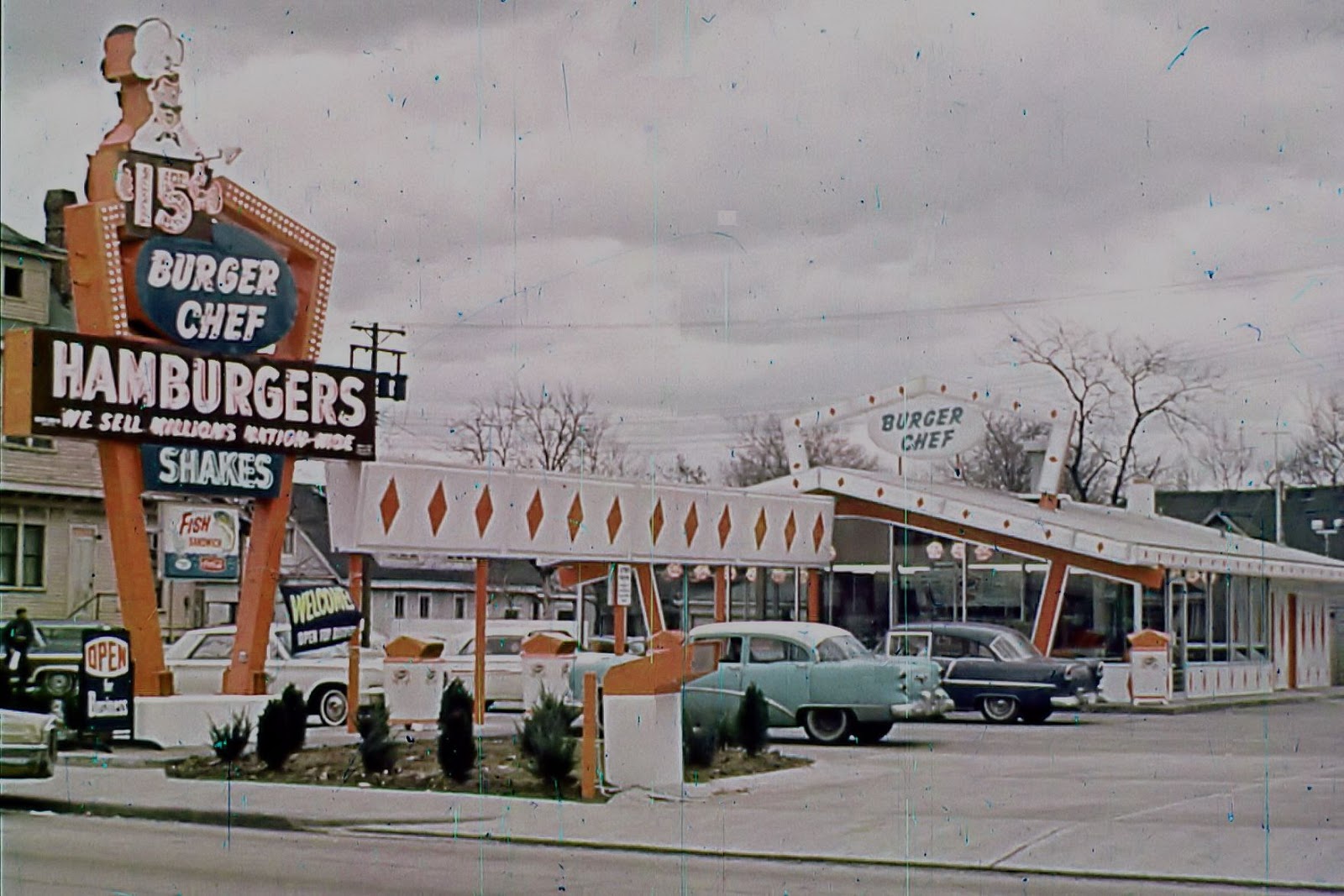
 I think Gino's teamed up in the early days with Colonel Sanders to peddle his chicken. And actually the next fast food chain that popped into my history came before McDonald's as well, it was called Burger Chef, not Burger King, but Burger Chef.
 Somehow in-between amusement park runs we squeezed in another fishing expedition. Once more we set off in the darkness of early morning to depart Indian River Inlet upon a charter. It was pretty much the usual gang of idiots, except this time Lois was aboard.
 Beginners luck prevailed and Lois landed the first catch of the day, a pretty sizable tuna.Unfortunately from the moment her prize was securely on deck she came down with a case of seasickness that lasted the rest of the way. Now I had never suffered from motion sickness up to that point, except that time the Tilt-A-Whirl operator wouldn't let us off his infernal machine. Nonetheless, I suppose out of sympathy, I also came down with the green skin and churning innards, wobbling over to sit beside her and try to control what my stomach so badly wished to rid itself of.
 There was another neophyte along this trip, Patty Lilly. Way back in the dark ages you may recall seeing Patty and I in a field together. We weren't very old, but we did stay friends through all those years since.
 In the OJR Ledger blurb for Paul Miller it mentioned his frequent trips to West Chester. What was in West Chester? Patty Lilly was in West Chester. They are the other couple hoisting fish in the photo above. Take note of how they tower over us. Were they that much taller? Yes, they were. Keep in mind, I was six foot tall and Lois was 5 foot 10. Eventually Paul and Pat would get married and I guess, raise giant kids.

The first places I recall being around that would fall into today's fast food category was Gino's. These 15 cent hamburg

 Somehow in-between amusement park runs we squeezed in another fishing expedition. Once more we set off in the darkness of early morning to depart Indian River Inlet upon a charter. It was pretty much the usual gang of idiots, except this time Lois was aboard.
 Beginners luck prevailed and Lois landed the first catch of the day, a pretty sizable tuna.Unfortunately from the moment her prize was securely on deck she came down with a case of seasickness that lasted the rest of the way. Now I had never suffered from motion sickness up to that point, except that time the Tilt-A-Whirl operator wouldn't let us off his infernal machine. Nonetheless, I suppose out of sympathy, I also came down with the green skin and churning innards, wobbling over to sit beside her and try to control what my stomach so badly wished to rid itself of.
 In the OJR Ledger blurb for Paul Miller it mentioned his frequent trips to West Chester. What was in West Chester? Patty Lilly was in West Chester. They are the other couple hoisting fish in the photo above. Take note of how they tower over us. Were they that much taller? Yes, they were. Keep in mind, I was six foot tall and Lois was 5 foot 10. Eventually Paul and Pat would get married and I guess, raise giant kids.
 Ronald did make it home that Labor Day weekend, but I missed
him most of the time because we were away here and yon. When he called to
announce his arrival, Lois and I were at Willow Grove. The next day, Sunday, the
family, including Lois and I went somewhat north and spent the day at Roadside
America, a giant train layout, and exploring Crystal Caves. On Labor Day itself
I did pick up Ronald, then we went and got Lois and spent the day at my house. Doesn't that sound exciting?
Ronald did make it home that Labor Day weekend, but I missed
him most of the time because we were away here and yon. When he called to
announce his arrival, Lois and I were at Willow Grove. The next day, Sunday, the
family, including Lois and I went somewhat north and spent the day at Roadside
America, a giant train layout, and exploring Crystal Caves. On Labor Day itself
I did pick up Ronald, then we went and got Lois and spent the day at my house. Doesn't that sound exciting? 
The most that was going on under the surface as we swam was
the nips of these tiny fish. Lois did not find their “kisses” very pleasant at
all.
 Summer 1960 was coming to a fast end. In
September television broadcast the Richard
Summer 1960 was coming to a fast end. In
September television broadcast the Richard
In my life there was the Sonja-Lois debate and Lois was
clearly winning that campaign. I purchased an engagement ring for $125, equivalent to just over
$1,000 today. I didn’t consider it a great ring, but it was the best I could
afford. I bought it on the 29th, but even though we had a date that
night, I wasn’t ready to propose quite yet. And then an accident on the
Schuylkill Expressway delayed my drive home from her house for 45 minutes. There
were three people killed. I hoped this wasn’t a bad omen.

Ronald Tipton completed his training at Fort Devens. They
gave him a choice of his permanent assignment based on class ranking. Although
he had finished ninth in his class it wasn’t high enough for the plum
assignments.

Ronald, who joined the Army to see the world, would serve out
his commitment at Fort Meade, Maryland. He was often able to come home for the
weekends. He wanted to see foreign shores, but never got off the Eastern coast
of the United States.

I was not about to waste my opportunity. October 15 was Lois’
birthday. I took her to dinner at the
Black Angus restaurant in Ludwig’s Corner near where I lived. Valley Forge
Battlefield was on the route between our homes and as I drove through this
historic site I pointed to the glove compartment.
“Do you hear that rattling?” I asked.
She said no.
I
said, “Something keeps rattling in the glove department. It’s annoying.”
 I pulled into one of the parking areas along the road. I got out of the car, walked around to her side and opened the door.
I took out the ring box I had placed there, got down on one knee beside the car and asked her to marry me.
She said yes.

On November 8 a razor thin majority, less than one percent, elected John F. Kennedy President of the United States.
On December 6 Ronald came home on leave. He made a date with Vivian Beale, a woman he had dated off and on during his high school years, and the four of us spent a night out. I guess all was forgiven. Vivian was Ronald's date for the Downingtown Senior Prom, but he couldn't get a ride that night and he stood her up, he didn't call her or anything.He says this is something he regrets having done to his day. Ronald went down to Aberdeen, Maryland to Fort Meade the next day.
I began the countdown to my marriage.
Lois was literally doing a count down. Despite the fact we
saw each other every weekend and ate lunch together as often as possible, she
wrote me regular love letters on the days we didn’t get together. In most of
her missives there would be “only 286 1/2 days” or “190 1/2 days” or “85 1/2
days”.
With the engagement came a time warp. At moments the marriage
felt far off and like it would never arrive. Others moments the time rushed by
too quickly to get everything done. The events and occurrences became a jumble
in the mind.
On November 26, we attended the marriage of Dottie Bender to
Jack Walls at the West Chester Methodist Church. Dottie’s parents were longtime
friends of my parents. Her father Joe
had served with my dad in the Navy during World War II and I believe Joe
helped my dad land his job at Hines Trucking. The Benders had moved to
Downingtown around the same time we moved back and for a brief period Dottie
was my babysitter. Now that she married she would become one of our social
friends after our own marriage.
The next day Lois and I were at Tommy Wilson’s birthday party
at the Norco Fire House. I do not know exactly what happened, but Lois apparently
felt she did or said something to be embarrassed about. Two days later I
received a letter from her typed on Atlantic Refining Letterhead.
Darling,
I’m
sorry if I embarrassed you at the party Sunday night. I was only kidding you,
but I know it must have sounded awful. Please forgive me, honey. I know I
shouldn’t have been so impulsive and I
promise it won’t happen again.
Oh
Larry, I love you so much. I promise that I will never ever embarrass you like
that again. I feel so bad now but I know that nothing can be done now except to
watch myself in the future. Once again let me apologize for my foolish actions.
I just hope your folks aren’t too mad at me. I love you.
I wish I knew what
in the world she could have done to feel this way. I also wish it was true that
such things would not happen again.

 These moments of doubt were something deep seated we didn’t
realize. She suffered from poor self-image. She spoke of herself as if she was
a homely person, but she was really quite good looking. She was 19 and it was
incredible how much she looked like her mother at the same age. That is her
mother, age 19, on the left and Lois, age 19, on the right.
These moments of doubt were something deep seated we didn’t
realize. She suffered from poor self-image. She spoke of herself as if she was
a homely person, but she was really quite good looking. She was 19 and it was
incredible how much she looked like her mother at the same age. That is her
mother, age 19, on the left and Lois, age 19, on the right.


 Now
one of the things I feared were the Giant Swings. The Giant Swings were just
that, great big swings shaped like boats. Each sat a dozen people at a time.
The swings were not motorized. An attendant would give them a push to start,
but the riders had to pump to make them continue. They would go almost vertical
to the ground. I didn’t ride these because of my fear of height.
Now
one of the things I feared were the Giant Swings. The Giant Swings were just
that, great big swings shaped like boats. Each sat a dozen people at a time.
The swings were not motorized. An attendant would give them a push to start,
but the riders had to pump to make them continue. They would go almost vertical
to the ground. I didn’t ride these because of my fear of height.


